No, Salesforce Einstein AI isn’t overrated, but it’s often misunderstood. In many organizations (something we frequently discuss with learners at H2kinfosys), the real issue isn’t the technology itself but how companies implement and learn to use it effectively.
Is Salesforce Einstein AI Overrated?
If you spend any time around CRM discussions, you’ll eventually hear someone say it: “Einstein AI is overhyped.”
And honestly? I get why people feel that way.
Over the last few years, AI has been slapped onto almost every enterprise tool imaginable. CRM platforms, marketing dashboards, sales pipelines everything suddenly became “AI-powered.” Salesforce was no exception. Salesforce made commitments to predictive insights, automated recommendations, and enhanced customer engagement when it launched Sales Einstein AI.
Big promises.
But here’s the thing I’ve noticed after working with teams learning through Salesforce training classes and salesforce crm administrator training programs: the disappointment rarely comes from the AI itself. It usually comes from unrealistic expectations or incomplete implementation.
Let’s unpack what’s really going on.
What Salesforce Einstein Actually Does (Beyond the Marketing)
Before deciding whether something is overrated, it helps to understand what it actually does.
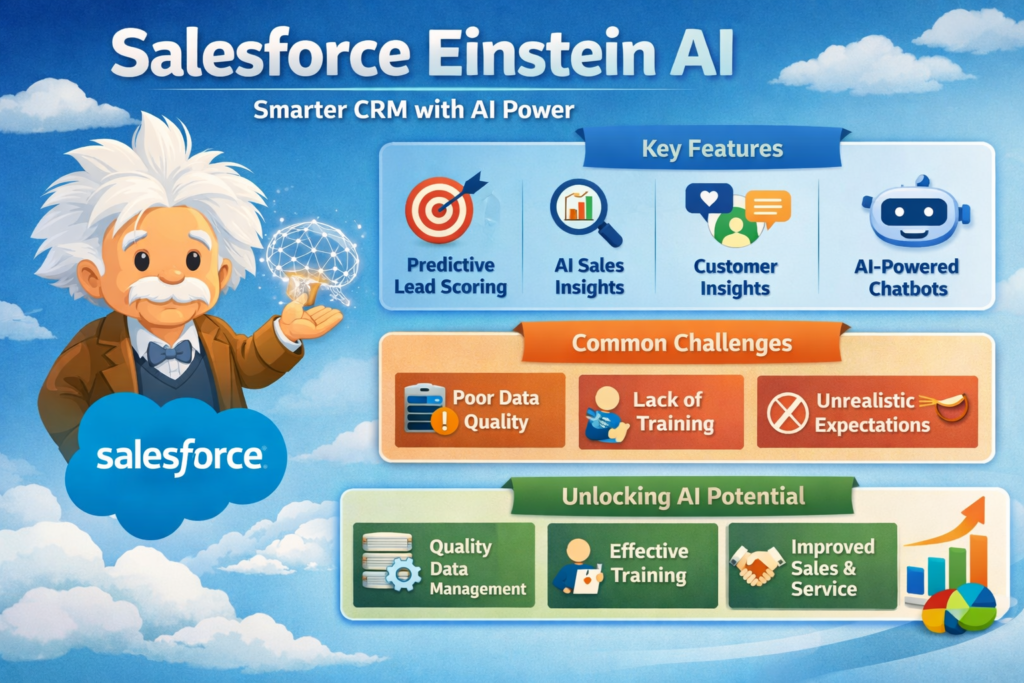
At its core, Salesforce Einstein AI is a collection of AI tools built directly into the Salesforce ecosystem. Instead of requiring external data science teams, it allows everyday CRM users to use machine learning inside their workflows.
Some of its main capabilities include:
- Lead scoring predictions
- Opportunity insights
- Automated email insights
- Customer sentiment analysis
- Forecast predictions
- AI-powered chatbots
- Data recommendations for sales teams
In simple terms, Salesforce Einstein AI tries to turn the huge piles of CRM data companies collect into something useful.
And if you’ve ever looked at a CRM with 50,000 leads sitting untouched. You know why that matters.
Why Some People Think Einstein AI Is Overrated
I’ve seen a pattern across organizations adopting AI tools.
The same pattern shows up with Salesforce Einstein AI too.
1. Companies Expect Instant Results
This is probably the biggest misconception.
Many executives expect Salesforce Einstein AI to magically produce insights the moment it’s activated. But AI systems rely heavily on clean, structured, and historical data.
If a CRM database has messy duplicate contacts, missing fields, inconsistent sales stages, the predictions simply won’t be very good.
It’s a bit like asking a GPS to guide you while half the map is missing.
In numerous Salesforce certification training courses, instructors point out something that can astonish novices: The quality of data is even more crucial than the AI.
The most sophisticated models of machine learning fail without quality data.
2. AI Needs Enough Data to Learn
Another issue? Data volume.
Smaller organizations sometimes deploy Salesforce Einstein AI but only have a few hundred leads in their system. That’s not much for machine learning models to learn from.
Think of it like teaching someone to recognize patterns after seeing only five examples. The results will be shaky.
This is why Einstein AI Salesforce tools tend to shine more in organizations with thousands of records and longer sales cycles.
Once the system has enough history, predictions start becoming surprisingly accurate.
3. Many Teams Don’t Know How to Use the Insights
Even when Salesforce Einstein AI generates helpful predictions, teams sometimes ignore them.
A classic example I’ve seen:
- Einstein predicts a lead has a 92% chance to convert.
- The sales rep still prioritizes another lead because it “feels hotter.”
Human instinct often wins over data even when the data is right.
That’s why proper training matters. Teams that go through structured Salesforce training classes tend to trust and apply AI insights far more effectively.
Where Salesforce Einstein AI Actually Shines
Now, onto perhaps the most neglected aspect of the conversation.
When done right, Salesforce Einstein AI has the potential to deeply change the way teams function.
And not in a way that is overstated and sci-fi-like. More like a subtle productivity boost across everything.
Here are a few real-world scenarios where it works remarkably well.
Predictive Lead Scoring That Saves Time
Sales teams waste enormous amounts of time chasing low-quality leads.
Salesforce Einstein AI examines past conversion data to score leads and rank them by potential.
Sales reps do not have to manually guess which leads to focus on.
I have previously worked with a mid-sized SaaS company that used Salesforce Einstein AI and lead response time improved by 40%. The sales reps’ AI follow-up suggestions are instead of searching through spreadsheets.
Sometimes the simplest ideas bring the most improvement.
Support Teams Get Help Too
Support teams have to deal with a lot of tickets.
Salesforce Einstein AI can auto-assign support tickets by category, determine the priority and even suggest answers.
This helps the support agent solve the problem instead of wasting time trying to figure it out.
Many companies using Salesforce Einstein AI tools have reported improved customer satisfaction and response time.
And honestly, customers notice.
Nobody enjoys waiting three days for a basic support reply.
Sales Forecasting That’s Less Guesswork
Forecasting has traditionally been a messy process.
Managers ask reps for numbers. Reps give optimistic estimates. Leadership hopes for the best.
Salesforce Einstein AI evaluates past behavior in the pipeline to create more informed predictions.
The system does not relegate the input of human intuition to the background; rather, it integrates it with a system of insight that is capable of being driven by data.
And in volatile markets, that extra perspective matters.
The Rise of AI Inside CRM Platforms
The conversation around Salesforce Einstein AI has changed a lot recently.
Earlier versions focused mainly on predictive analytics. Now, with generative AI entering the scene, Salesforce has been expanding Einstein’s capabilities.
If you’ve followed Salesforce’s recent announcements, you’ve probably heard about Einstein GPT—an extension designed to generate emails, summarize cases, and create automated content inside the CRM.
This evolution shows that Salesforce Einstein AI is becoming less of a niche feature and more of a central layer within the platform.
AI is no longer a “nice extra.” It’s slowly becoming the interface itself.
Why Training Matters More Than the Technology
Here’s something that often gets overlooked in AI discussions.
Technology is rarely the hardest part.
The real challenge is adoption.
Salesforce CRM administrator training helps organizations realize the full potential of tools such as Salesforce Einstein AI because administrators can configure models, handle and analyze datasets, and draw valuable insights from the results.
Without these valuable skills, the AI functionality of Salesforce Einstein is left untapped.
It’s like buying a high-end camera but never learning how to adjust the settings.
The Career Angle: Why Einstein Skills Matter
There is another dimension to this conversation that does not get the attention it deserves.
Professional prospects.
Organizations using AI in their CRM systems need to have people who know how to use Salesforce and understand automated data-driven processes.
This is the reason Salesforce certification training now has a strong focus on the inclusion of AI.
With this in mind, the admins, consultants, and developers who know Salesforce Einstein AI will be in very high demand.
Recruiters often look for professionals who can:
- Configure predictive models
- Interpret AI insights
- Optimize CRM workflows with automation
- Ensure data quality for machine learning systems
In other words, the people who know how to use the AI, not just turn it on are in high demand.
The Real Reason Einstein AI Sometimes Fails
If I had to sum up the biggest reason implementations struggle, it’s this:
Companies adopt Salesforce Einstein AI expecting it to fix broken processes.
But AI amplifies systems it doesn’t repair them.
If a company already has:
- clean data
- structured pipelines
- disciplined CRM usage
Then Salesforce Einstein AI becomes incredibly powerful.
But if those foundations are missing, the results will feel underwhelming.
That’s not a flaw in the AI.
It’s a reflection of the environment around it.
So Is Salesforce Einstein AI Overrated?
Not really.
It’s better described as underutilized.
When organizations combine strong data practices, proper implementation, and solid Salesforce training classes, the capabilities of Salesforce Einstein AI become much clearer.
It helps sales teams prioritize smarter.
It helps service teams respond faster.
And it helps leadership make decisions with better forecasting.
Is it magical? No.
Is it useful? Absolutely.
With Salesforce integrating AI tools into its products, it will likely become a commonplace expectation for CRM users to know how to use Salesforce Einstein AI.
Conclusion
The use of AI in CRM is in a very formative stage. What is cutting-edge now will become commonplace in a very short time.
What is certain is that Salesforce Einstein AI and similar products will be the starting points of how businesses will interact with customers, automate processes, and analyze data.
Companies that figure out how to use these tools effectively will be able to move beyond having AI that does more. They will be able to have AI that makes better decisions.