Deep learning terminology refers to the standardized set of technical terms used to describe how artificial neural networks are designed, trained, evaluated, and deployed in production systems. These terms cover model architecture, data processing, optimization methods, evaluation metrics, and operational workflows. Understanding this language is essential for working with AI systems in enterprise, research, and applied technology environments.
What Is Mastering Deep Learning Terminology: The Language of AI?
This topic focuses on building a clear, professional understanding of the vocabulary used across deep learning projects, documentation, and technical discussions. It helps learners move beyond surface-level definitions and understand how terms relate to real-world workflows, such as data preparation, model training, deployment, and monitoring.
Rather than memorizing isolated definitions, mastering terminology means understanding how concepts connect across the full lifecycle of an AI system from collecting raw data to maintaining a deployed model in a production environment.
Why Is Deep Learning Terminology Important for Professionals?
In enterprise and research settings, AI projects involve cross-functional teams that include data scientists, software engineers, IT operations, product managers, and compliance officers. Clear communication depends on shared technical language, and many professionals strengthen this foundation by aligning their knowledge with structured learning paths such as an Artificial intelligence Engineer Course that standardizes terminology, workflows, and best practices across roles.
Understanding deep learning terminology helps professionals:
- Interpret model documentation and technical reports
- Participate in architecture and design discussions
- Evaluate system performance and limitations
- Communicate risks, assumptions, and results to non-technical stakeholders
It also supports effective collaboration with cloud teams, security teams, and business units that interact with AI systems at different stages.
How Does Deep Learning Fit Into Real-World AI Workflows?
Deep learning models do not operate in isolation. They are part of a structured pipeline that includes data systems, infrastructure, and operational processes.
Typical Enterprise AI Workflow
- Data Collection
Data is gathered from databases, sensors, logs, or external APIs. - Data Preparation
Raw data is cleaned, labeled, and transformed into formats suitable for training. - Model Design
Engineers select a neural network architecture based on the problem type. - Training and Validation
Models are trained on labeled data and evaluated using metrics. - Deployment
The trained model is integrated into applications or services. - Monitoring and Maintenance
Performance, data drift, and system stability are continuously tracked.
Each stage uses specific terminology that reflects both technical and operational considerations.
Core Concepts in Deep Learning
Artificial Neural Network (ANN)
An artificial neural network is a computational model inspired by biological neural systems. It consists of interconnected units called neurons, organized into layers, that process input data and produce outputs, and these concepts are commonly reinforced through AI Training Courses that explain how such models are designed, trained, and applied in real-world enterprise and research environments.
In enterprise environments, ANNs are used for tasks such as image recognition, language translation, and predictive analytics.
Neuron
A neuron is the basic unit of a neural network. It receives input values, applies a mathematical function, and passes the result to the next layer. Each neuron uses weights and a bias to adjust how strongly it responds to different inputs.
Layers
Neural networks are structured into multiple layers:
- Input Layer: Receives raw data
- Hidden Layers: Perform intermediate computations
- Output Layer: Produces the final prediction or classification
The number and type of layers define the model’s architecture and complexity.
Weights and Bias
- Weights determine how much influence an input has on a neuron’s output.
- Bias is an additional parameter that allows the model to shift predictions independently of the input.
These values are learned during training and are critical to model accuracy.
Activation Functions
Activation functions introduce non-linearity into a neural network, allowing it to model complex relationships.
Common Activation Functions
- ReLU (Rectified Linear Unit): Outputs zero for negative values and the input itself for positive values.
- Sigmoid: Maps values between 0 and 1, often used in binary classification.
- Tanh: Outputs values between -1 and 1, commonly used in hidden layers.
- Softmax: Converts outputs into probability distributions for multi-class classification.
Choosing the right activation function affects training speed and model performance.
Loss Function
A loss function measures how far a model’s predictions are from the actual values. It provides a numerical value that the training process aims to minimize.
Common Loss Functions
| Loss Function | Typical Use |
|---|---|
| Mean Squared Error | Regression tasks |
| Binary Cross-Entropy | Binary classification |
| Categorical Cross-Entropy | Multi-class classification |
In professional systems, selecting the appropriate loss function is essential for aligning model behavior with business objectives.
Optimization and Training Concepts
Gradient Descent
Gradient descent is an optimization algorithm used to adjust model parameters by minimizing the loss function. It calculates how changes in weights affect the loss and updates them accordingly.
Learning Rate
The learning rate controls how large each parameter update step is during training. If it is too high, training may become unstable. If it is too low, training can become slow and inefficient.
Backpropagation
Backpropagation is the process of computing gradients by propagating errors backward through the network. It allows the model to learn which parameters contribute most to prediction errors.
Data-Related Terminology
Training Dataset
The training dataset is the portion of data used to teach the model how to make predictions.
Validation Dataset
The validation dataset is used during training to evaluate model performance and tune parameters without influencing learning directly.
Test Dataset
The test dataset is used after training to assess how well the model performs on unseen data.
Label
A label is the correct output associated with an input data point, such as a category or numerical value.
Overfitting and Underfitting
Overfitting
Overfitting occurs when a model performs well on training data but poorly on new, unseen data. This often happens when a model is too complex for the dataset size or quality.
Underfitting
Underfitting occurs when a model is too simple to capture the underlying patterns in the data.
Professionals aim to balance model complexity and generalization.
Regularization Techniques
Regularization helps prevent overfitting by limiting model complexity.
Common Methods
- L1 and L2 Regularization: Add penalties to the loss function based on weight size.
- Dropout: Randomly disables neurons during training to encourage redundancy.
- Early Stopping: Stops training when validation performance stops improving.
These techniques are widely used in enterprise systems to improve model reliability.
Model Architecture Terminology
Convolutional Neural Network (CNN)
CNNs are specialized for processing grid-like data such as images. They use convolutional layers to detect patterns like edges and textures.
Recurrent Neural Network (RNN)
RNNs process sequential data by maintaining a memory of previous inputs. They are commonly used in language modeling and time-series analysis.
Long Short-Term Memory (LSTM)
LSTM is a type of RNN designed to handle long-term dependencies in sequential data.
Transformer
Transformers use attention mechanisms to process sequences in parallel. They are widely used in natural language processing systems.
Attention Mechanism
An attention mechanism allows a model to focus on specific parts of the input when making predictions. It assigns weights to different input elements based on their relevance to the current task.
This concept is central to modern language models and recommendation systems.
Feature Engineering
Feature engineering involves transforming raw data into meaningful inputs for a model. In deep learning, this process is often partially automated, but understanding feature representation remains important.
Examples include:
- Normalizing numerical values
- Encoding categorical variables
- Creating embeddings for text or images
Embeddings
Embeddings are numerical representations of data such as words, images, or users. They capture semantic relationships and allow models to work with complex, high-dimensional data efficiently.
Model Evaluation Metrics
Accuracy
Accuracy measures the proportion of correct predictions out of all predictions.
Precision and Recall
- Precision: Measures how many predicted positives are actually positive.
- Recall: Measures how many actual positives were correctly identified.
F1 Score
The F1 score is the harmonic mean of precision and recall, providing a balanced measure of model performance.
ROC Curve and AUC
These metrics evaluate how well a model distinguishes between classes across different thresholds.
Hyperparameters
Hyperparameters are configuration values set before training, such as:
- Learning rate
- Batch size
- Number of layers
- Number of neurons per layer
Unlike weights, hyperparameters are not learned during training and must be tuned through experimentation.
Transfer Learning
Transfer learning involves using a pre-trained model as a starting point for a new task. This approach reduces training time and improves performance when labeled data is limited.
It is commonly used in image recognition and language processing systems.
Model Deployment Terminology
Inference
Inference refers to the process of using a trained model to make predictions on new data.
Model Serving
Model serving involves hosting a trained model so that applications can send data to it and receive predictions.
Latency
Latency measures how long it takes for a model to return a prediction. In real-time systems, low latency is often a critical requirement. MLOps Concepts
Continuous Integration and Deployment (CI/CD)
CI/CD refers to automating the process of testing and deploying models and code changes.
Data Drift
Data drift occurs when the statistical properties of input data change over time, potentially reducing model accuracy.
Model Monitoring
Model monitoring involves tracking performance metrics and system health after deployment.
Ethical and Governance Terminology
Bias
Bias refers to systematic errors in model predictions that disadvantage certain groups or outcomes.
Explainability
Explainability is the ability to understand and interpret how a model makes decisions.
Compliance
Compliance refers to meeting legal and regulatory requirements related to data usage and AI systems.
How Deep Learning Terminology Is Used in Enterprise Communication
In professional settings, terminology appears in:
- Technical documentation
- Architecture diagrams
- Compliance reports
- Performance dashboards
Clear definitions help teams align on expectations and system behavior.
Common Challenges in Learning Deep Learning Language
- Interpreting academic vs. industry terms
- Understanding mathematical foundations
- Connecting concepts to practical systems
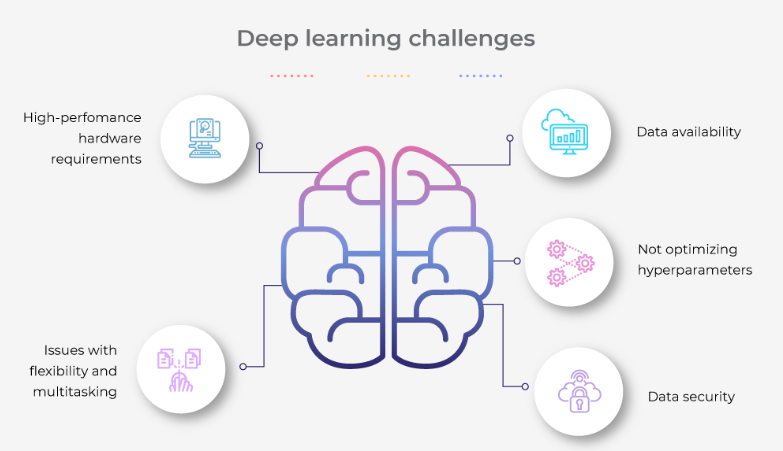
Professionals often address these challenges through project-based learning and real-world exposure.
Practical Tips for Mastering Terminology
- Read official framework documentation
- Review architecture diagrams
- Participate in code reviews
- Analyze production system logs
- Practice explaining concepts to non-technical audiences
These activities reinforce understanding beyond theoretical study.
Frequently Asked Questions (FAQ)
Is deep learning terminology the same across all frameworks?
Most core terms are consistent, but specific implementations and naming conventions can vary between frameworks.
Do I need advanced mathematics to understand the terminology?
Basic knowledge of algebra and statistics helps, but many concepts can be understood at a practical level through applied examples.
How often does terminology change?
New terms emerge as technologies evolve, especially in areas like model architecture and deployment practices.
Can non-technical professionals benefit from learning these terms?
Yes, product managers, analysts, and compliance professionals often use this terminology to work effectively with AI teams.
Key Takeaways
- Deep learning terminology defines how AI systems are designed, trained, evaluated, and deployed.
- Understanding these terms supports effective communication across technical and business teams.
- Core concepts include neural networks, optimization methods, evaluation metrics, and deployment workflows.
- Professional environments emphasize reliability, governance, and system performance alongside model accuracy.
- Mastery comes from applying terms in real-world projects, documentation, and operational systems.
Explore structured AI and deep learning learning opportunities with H2K Infosys to apply these concepts in real-world, project-based environments.
Enroll in professional programs designed to support long-term skill development and career growth in modern AI and analytics roles