Yes, non-IT professionals can absolutely enroll in the Artificial Intelligence course at H2K Infosys USA. In fact, many people who join their Artificial intelligence course for beginners come from non-technical backgrounds like finance, healthcare, sales, education, or even hospitality. The program is intentionally structured so that beginners can transition into AI and data-driven careers step by step.
Let’s unpack how that actually works in real life, because this is the part most people worry about.
Why AI Is No Longer Just for Programmers
A few years ago, artificial intelligence felt like something reserved for hardcore developers and data scientists. But things changed quickly.
Today, companies are integrating AI into almost every department marketing teams use AI for campaign optimization, HR uses predictive analytics for hiring, and healthcare organizations use machine learning for patient insights.
That shift created a huge demand for professionals who understand AI tools and concepts, not just those who build algorithms from scratch.
And honestly, this is why so many best AI courses for beginners are now designed specifically for people who are switching careers.
I’ve spoken with professionals who started learning AI after working in completely unrelated roles one former accountant now works in data analytics, and a teacher I know transitioned into AI-assisted education technology. Neither of them had a computer science degree when they began.
Can Someone Without an IT Background Really Learn AI?
Short answer: yes. But the learning path matters.
The biggest mistake beginners make is jumping straight into advanced machine learning theory. That’s where many people get stuck.
A beginner-friendly program typically starts with the fundamentals:
- Basic programming concepts (usually Python)
- Data analysis and visualization
- Introduction to machine learning
- AI tools and real-world applications
- Practical projects
When the course structure is designed well, even someone with zero technical experience can follow along.
That’s why structured programs like the Artificial intelligence course for beginners at H2K Infosys focus on gradual skill building instead of overwhelming students with complex math from day one.
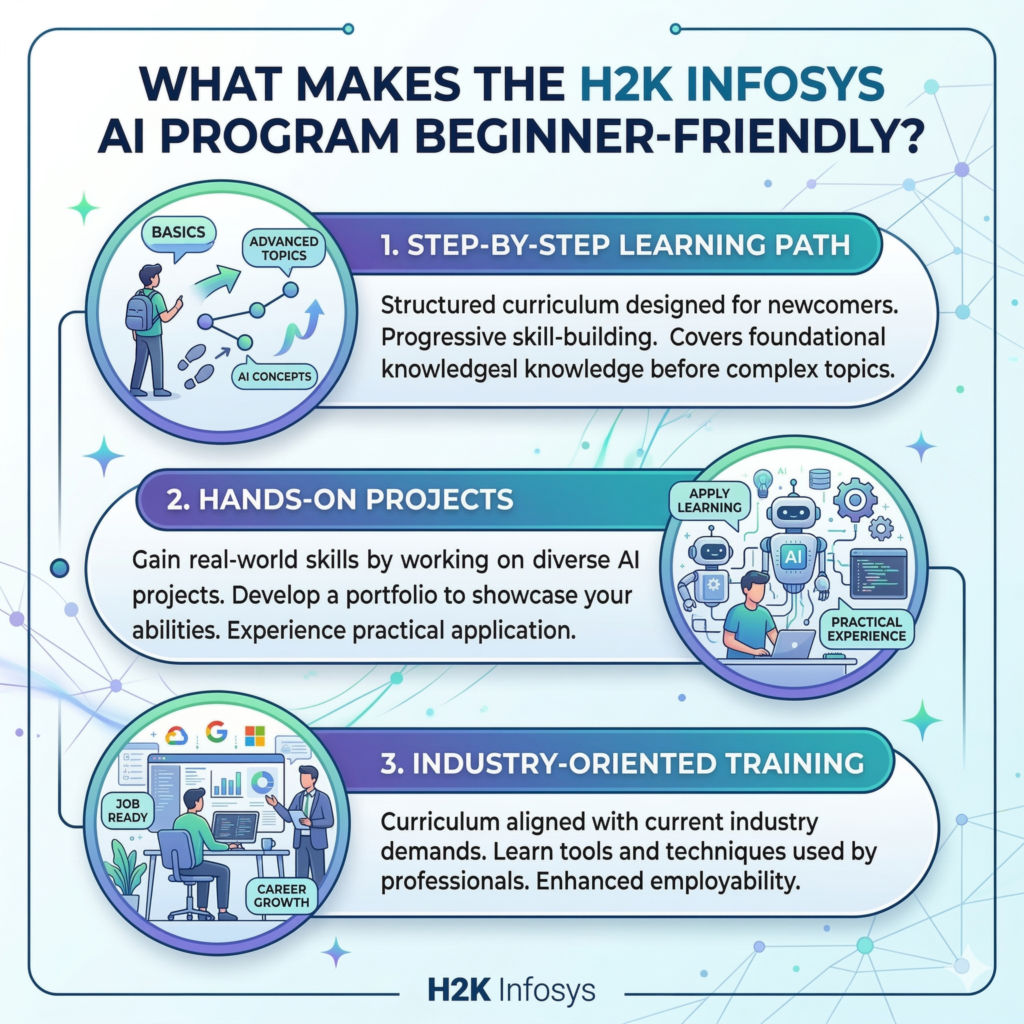
What Makes the H2K Infosys AI Program Beginner-Friendly?
One interesting thing about career-switching courses is that the teaching style matters just as much as the syllabus.
From what many learners mention, the program focuses on practical exposure rather than theory overload.
Here’s what usually helps non-IT learners succeed:
1. Step-by-Step Learning Path
Instead of assuming prior knowledge, the course typically introduces:
- Programming basics
- Data handling
- AI fundamentals
- Real-world AI tools
This layered approach makes the transition smoother for beginners.
2. Hands-On Projects
Learning AI without practice is almost impossible.
Good AI training includes projects such as:
- Predicting trends using datasets
- Building simple machine learning models
- Working with AI-based business insights
These projects help students understand how AI actually works in business scenarios.
3. Industry-Oriented Training
Another big difference between random online tutorials and structured training is industry exposure.
Courses that include real case studies tend to prepare students much better for job roles.
For example:
- Customer behavior prediction in retail
- Fraud detection models in banking
- Healthcare data analysis
These are the types of problems AI professionals solve in real companies.
AI Careers That Non-IT Professionals Can Enter
Here’s something many beginners don’t realize: not every AI career requires deep coding expertise.
There are several entry-level roles where foundational AI knowledge is enough to get started.
Some examples include:
AI Data Analyst
Professionals in this role analyze datasets and help companies make data-driven decisions.
Many people transitioning from business or finance backgrounds find this role approachable.
Machine Learning Support Roles
These roles involve assisting data science teams with:
- Data preparation
- Model evaluation
- Reporting insights
It’s often a stepping stone toward more advanced AI positions.
AI Business Analyst
This role connects AI technology with business strategy.
People from management, marketing, or operations backgrounds often transition successfully here.
Why Placement Support Matters in AI Training
Let’s be honest learning AI is one thing, getting hired is another challenge entirely.
That’s why many learners specifically look for an AI course with placement support.
Placement assistance usually includes:
- Resume preparation
- Mock interviews
- Real project experience
- Job referral networks
This part is especially helpful for people switching careers because employers often want to see practical experience.
Some training institutes partner with industry mentors who guide students through actual job-level projects, which makes a big difference when attending interviews.
Real-World Example: Career Switch Into AI
A common story I’ve heard goes something like this.
Someone works in a non-technical job maybe customer service or accounting for years. They start noticing how AI tools are changing workplaces.
At first, they try learning through YouTube tutorials or random online resources. But without structure, progress feels slow.
Then they enroll in a structured Artificial intelligence course for beginners, where they:
- Learn Python basics
- Work on real datasets
- Build small machine learning models
- Practice interview scenarios
Within months, they move into an entry-level AI-related role like data analyst or junior machine learning support.
This kind of transition is becoming more common as AI adoption grows across industries.
Why AI Skills Are Becoming Essential
If you’ve been following tech news lately, you’ve probably noticed something.
Artificial intelligence isn’t just a tech trend anymore it’s becoming a core business skill.
Companies now expect employees to understand:
- Data interpretation
- AI-assisted decision making
- Automation tools
- Predictive analytics
Even roles like marketing managers, HR analysts, and financial planners increasingly rely on AI-driven insights.
That’s why many professionals are actively searching for the best AI courses for beginners they want to stay relevant in a rapidly changing job market.
Who Should Consider Learning AI?
The truth is, AI training is no longer limited to programmers.
You might benefit from learning AI if you are:
- A professional looking for a career change
- A recent graduate exploring tech careers
- Someone interested in data-driven decision making
- A business professional wanting to understand AI tools
Courses that combine technical foundations with real business applications tend to work best for beginners.
Final Thoughts
Yes, non-IT professionals can enroll in the Artificial Intelligence course at H2K Infosys USA and many of them do.
Programs designed as an Artificial intelligence course for beginners focus on foundational skills, hands-on projects, and industry-ready training. When combined with an AI course with placement support, they can open doors to new career opportunities in data and AI-driven roles.
And honestly, the biggest barrier isn’t a lack of technical background it’s usually hesitation.
Once people start learning step by step, AI becomes far less intimidating than it initially seems.