If you’re looking for a clear Overview of Salesforce Einstein AI, H2kinfosys trainers often describe it this way: it’s Salesforce’s built-in artificial intelligence layer that analyzes customer data, predicts outcomes, and automates decisions across the CRM platform.
Any serious Overview of Salesforce today has to include Einstein AI because it has quietly become one of the most powerful components of the Salesforce ecosystem. What started as a set of predictive tools inside the CRM has evolved into a full AI platform integrated across sales, service, marketing, analytics, and development workflows.
And honestly, if you’ve worked with Salesforce in the last few years, you’ve probably seen how dramatically AI is changing the way businesses use CRM systems.
Understanding Einstein AI in the Salesforce Ecosystem
When people ask me for a quick Overview of Salesforce capabilities, I usually start by explaining the basic idea behind Einstein AI: it turns the massive amount of CRM data companies collect into useful predictions and recommendations.
Sales teams generate data constantly through emails, meetings, leads, and opportunity updates. Marketing platforms collect campaign interactions. Customer support teams log cases and resolutions. Without AI, all that information just sits there.
Einstein AI analyzes it.
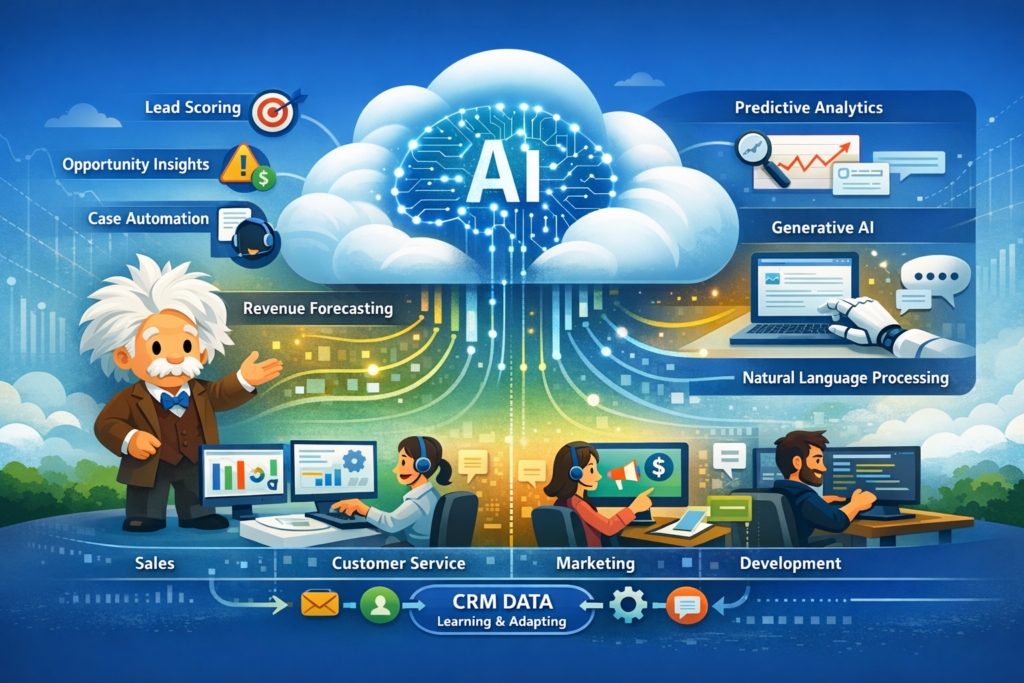
In simple terms, Salesforce Einstein applies machine learning, predictive analytics, and generative AI directly inside the CRM interface people already use every day.
A practical Overview of Salesforce also means understanding that Einstein isn’t just one feature. It’s more like taking advantage of many AI-driven capabilities integrated into various Salesforce clouds.
For Example:
- Lead Scoring by Einstein predicts lead conversion
- Opportunity Insights by Einstein notifies sales reps of risks to a deal.
- Case Classification by Einstein sorts support tickets automatically.
- Forecasting by Einstein provides the possible outcome of revenue.
The above mentioned tools give organizations the ability to make decisions quickly without having a complete data science team.
The Foundations Behind Einstein AI
In a lot of Salesforce classes, teachers usually begin with a basic Overview of Salesforce architecture and then they move on to Einstein AI. That foundation matters because Einstein runs directly on Salesforce’s cloud infrastructure.
At a technical level, Einstein AI combines several technologies:
- Machine learning models
- Natural language processing
- Predictive analytics
- Generative AI models
- Real-time data processing
But a modern Overview of Salesforce isn’t complete without mentioning how the platform now integrates with large language models and generative AI capabilities through Einstein GPT.
This is where things get interesting.
Instead of just predicting outcomes, Salesforce AI can now generate content emails, summaries, reports, and even code snippets inside development environments.
It’s part of a broader trend in AI Salesforce solutions where CRM platforms move from simple data management tools to intelligent assistants.
Real-World Example: AI in Sales Operations
The best way to understand Einstein AI is through real scenarios.
A few months ago, I was reviewing a demo from a SaaS company implementing Salesforce. During the session, the consultant showed a live dashboard where Einstein predicted which deals would likely close in the next quarter.
This kind of scenario shows why any modern Overview of Salesforce must include predictive analytics.
In the past, sales managers frequently relied on their intuition and spreadsheets. Now, the CRM evaluates previous deal patterns and identifies deals and opportunities that could be at risk.
From a technical Overview of Salesforce’s perspective, the model works by analyzing:
- Previous opportunities and their outcomes
- Deal size and lengths of time
- Patterns of customer engagement
- Email and meeting activity
- Historical sales cycles
The CRM is always learning with the addition of new data.
Einstein AI and the Rise of Data-Driven CRM
During a recent Salesforce course I reviewed, the instructor framed the Overview of Salesforce platform around one central idea: CRM data becomes far more valuable once AI interprets it.
That’s exactly what Einstein does.
Think of a customer support center with thousands of new tickets each week. In a world without AI, agents have to read, categorize, and prioritize every case.
Because of the Einstein Case Classification, the system independently recognizes and classifies the following:
- Type of issue
- Product type
- Level of urgency
- Proposed resolution steps
This is the reason every new Overview of Salesforce includes predictive models and automation workflows as essential features, not as features that can be turned on or off.
Core Components of Salesforce Einstein
An Overview of Salesforce must include all of the components that define Einstein AI.
1. Einstein Prediction Builder
Prediction Builder allows admins to create machine learning models without writing code. Companies can predict things like:
- Customer churn risk
- Upsell probability
- Renewal likelihood
My favorite part of any Overview of Salesforce demo is showing how quickly these models can be deployed sometimes within minutes.
2. Einstein’s Discovery
Einstein Discovery uses advanced analytics to find patterns in business data.
Instead of just displaying reports, it explains why certain trends occur.
For example:
“Customers who open at least three marketing emails and attend a webinar are 65% more likely to convert.”
That level of insight is where Salesforce and AI really start to shine.
3. Einstein GPT
Einstein GPT combines CRM data with generative AI to produce content automatically.
Sales reps can generate:
- Follow-up emails
- Meeting summaries
- Sales proposals
Support teams can generate:
- Case responses
- Knowledge base articles
- Chatbot answers
It’s essentially bringing generative AI directly into CRM workflows.
How Businesses Are Actually Using Einstein AI
In enterprise consulting projects, an Overview of Salesforce often becomes more practical once companies see how others are using the technology.
These are a few real examples.
Retail
Retail brands use Einstein to predict purchase behavior and personalize product recommendations.
Financial Services
Banks use AI models to detect churn risk and recommend cross-sell opportunities.
SaaS Companies
Software firms use Einstein to prioritize leads and forecast subscription renewals.
In enterprise consulting, an Overview of Salesforce often becomes the starting point for larger digital transformation projects.
During my Salesforce training courses, I encountered another example with a telecom company that incorporated AI-enabled chatbots that use Einstein to handle basic customer service inquiries automatically.
What was the outcome?
There was a nearly 40% reduction in customer wait times.
Why Developers Care About Einstein AI
From a developer’s Overview of Salesforce viewpoint, Einstein AI is interesting because it’s deeply integrated with the platform’s development environment.
Developers can access AI features using:
- Apex APIs
- Salesforce Flow
- Lightning components
- REST integrations
That means AI predictions can trigger automated workflows inside the CRM.
An example user of Einstein’s ability to predict deals will receive an automated workflow to schedule a follow-up call or send an alert to the sales manager.
This explains the increased number of higher-level Salesforce classes that incorporate AI.
Salesforce and AI Integration
With the rapid AI advances, Salesforce Overview has to consider how to integrate AI.
Salesforce’s data cloud platform has allowed Salesforce to invest in the backend data infrastructure to improve AI and generative data.
This platform merges customer data across multiple systems, and the data is used to train the Einstein models.
Increasingly, AI has been used to improve CRMs to offer business users AI copilots instead of just CRMs.
With the rise of AI and privacy issues, Eisen’s Relaxation Trust Layer and Trust Frameworks focus on AI to help protect customers with CRM data from being unintentionally used in external AI models.
Learning Einstein AI: Where to Start
Before you start any AI training in Salesforce classes, it is very helpful to have a clear Understanding of the Salesforce architecture.
Most learning paths typically include:
- Salesforce fundamentals
- CRM data models
- Automation tools (Flow, Process Builder)
- Einstein AI capabilities
Choosing the best Salesforce course is important since knowledge of the core platform is essential for the AI features.
A beginner who goes directly to the Einstein tools will have no idea what’s going on with the CRM data structures.
For this reason, good Salesforce training courses tend to introduce AI features in small increments.
The Future of Einstein AI
The importance of AI in CRM systems is likely to increase over time.
Analysts anticipate that Salesforce and similar platforms will develop into completely self-directing automated workflow systems that suggest and perform tasks on their own.
The latest Salesforce Overview includes:
- AI copilot for sales teams
- automated agents for customer service
- forecasting customer behavior
- generative marketing
The merging of real-time analytics with generative AI is yet another recent advancement that impacts the Salesforce Overview.
Imagine asking your CRM:
“Which enterprise customers are most likely to renew this quarter?”
And receiving an instant explanation, prediction, and action plan.
That future is already starting to appear inside the Einstein ecosystem.
Final Thoughts
At its core, Einstein AI represents Salesforce’s shift from a traditional CRM platform to an intelligent business system.
Anyone examining the platform, a solid Overview of Salesforce offers the basis to comprehend how AI augments customer information, sales predictions, and automation.
If you are considering exploring AI Salesforce functionalities for your business or signing up for a Salesforce course to develop your technical competence, understanding Einstein AI is becoming foundational in the CRM field.
Because the reality is straightforward: businesses do not simply keep customer data anymore.
They expect their CRM to think with them.