Salesforce Careers are not fading in the AI era in fact, with companies like H2kinfosys expanding specialized programs, Salesforce Careers are becoming more strategic, more intelligent, and more future-proof than ever before.
Let’s talk honestly about what’s happening.
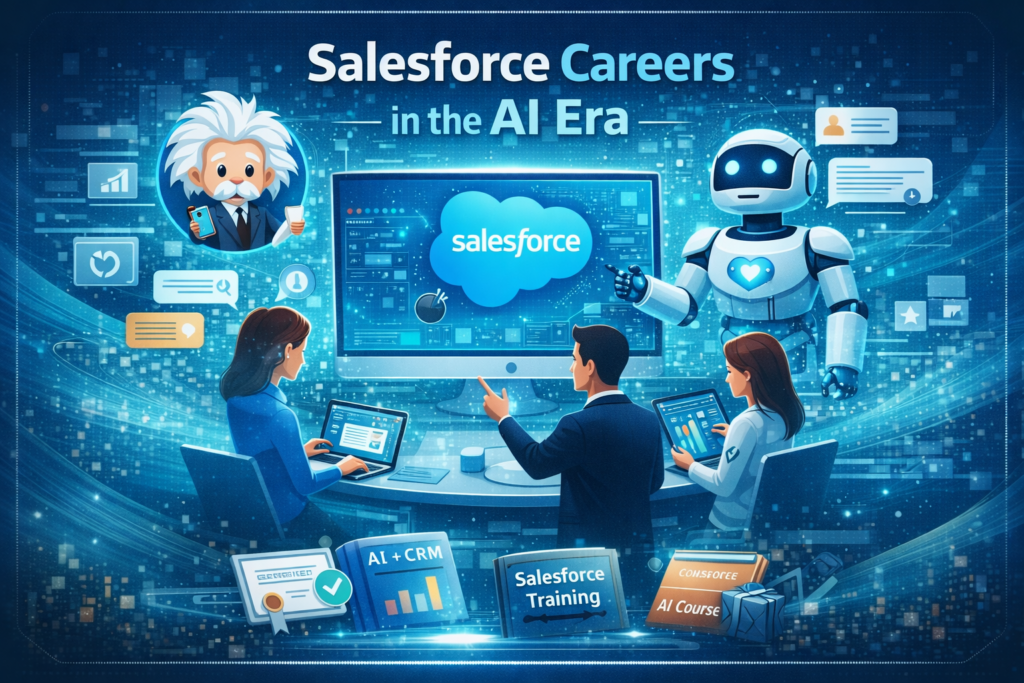
Over the last two years, AI hasn’t just “entered” the Salesforce ecosystem, it has embedded itself into it. From Einstein GPT to predictive automation and AI-powered CRM workflows, Salesforce is quietly transforming how businesses operate. And here’s the interesting part: instead of replacing professionals, AI is reshaping Salesforce Careers into higher-value roles.
If you’re considering a Salesforce course or exploring Salesforce training courses, this shift is actually good news.
Why AI Is Strengthening Salesforce Careers
A lot of people panic when they hear “AI automation.” I get it. I’ve worked with teams where the first reaction was: Will this replace admins?
The reality? AI still needs configuration, governance, human judgment, and customization. That’s where Salesforce Careers evolve.
Take Salesforce’s AI Cloud announcements from recent Dreamforce events. Automation is becoming commonplace in businesses, meaning trained specialists are needed to:
- Set up the AI models that are integrated with Salesforce
- Sustain the accuracy of the data
- Manage the compliance, as well as the ethical use of AI
- Convert the objectives of the business into the workflows of the CRM
AI handles patterns. Humans handle strategy.
And Salesforce Careers sits right in that strategic layer.
The Growing Demand for Salesforce Admins in the AI Era
Let’s talk about Salesforce admin training specifically.
Historically, CRM Administrators focused primarily on user permissions, dashboards, and workflow rules. Today? A Salesforce CRM administrator training path includes:
- AI-driven reporting setup
- Automation using Flow and AI prompts
- Data governance for AI insights
- Integration with third-party AI tools
Companies aren’t looking for “button-clickers.” They’re looking for admins who understand business logic and AI implications.
I recently worked with a mid-sized healthcare firm implementing AI-powered case routing. The AI could suggest routing, but someone had to define the logic, validate it, and monitor performance. That role? A certified Salesforce administrator.
That’s why Salesforce certification training has become more valuable in 2026. Certification now signals that you understand both platform fundamentals and evolving AI capabilities.
How AI Is Creating New Specializations Inside Salesforce Careers
One thing I’ve noticed: Salesforce Careers are fragmenting into smarter niches.
We’re seeing:
- AI Workflow Specialists
- Salesforce Data Analysts
- Automation Architects
- AI-Integrated CRM Consultants
- Prompt Engineers within Salesforce environments
AI doesn’t simplify the ecosystem it makes it more powerful and slightly more complex. That complexity fuels Salesforce Careers growth.
As per the latest recruitment activity on LinkedIn and sector-specific job boards, roles on Salesforce and the automation and AI integration facets have recorded steady growth in their remuneration. Recruiters are focusing on Salesforce admin training and applied AI.
Hence, if you are paying for Salesforce training courses now, you are not late. You’re actually stepping in at the right moment.
The Role of Certification in Future-Proofing Salesforce Careers
Let’s be practical.
Can you build Salesforce Careers without certification? Yes.
Is it harder in 2026? Also yes.
As AI alters expectations around CRM, companies are demanding confirmation of structured knowledge. Salesforce certification training demonstrates that you are unveiled:
- Security and data modeling
- Automation best practices
- AI governance fundamentals
- Platform scalability
Certifications act like credibility accelerators. They shorten hiring cycles.
And when AI tools grow even more sophisticated, certified professionals are generally trusted with overseeing implementation.
In Salesforce Careers, experience, example, and structured validation for both are becoming more and more important for professionals.
Real-World Example: AI + Salesforce in Retail
For example, a retail client I recently observed was implementing predictive inventory management inside Salesforce through AI integrations.
The AI forecasted surpluses in demand using historical buying trends. But it didn’t instantaneously “solve” operations.
Their Salesforce team had to:
- Build automation flows
- Design exception alerts
- Monitor inaccurate predictions
- Adjust AI logic
This is where Salesforce Careers grows out of technical setup and into business advisory roles.
And that’s the essential change of the AI age. The Salesforce professionals are emerging as strategic advisors.
Why Learning Salesforce Now Makes Even More Sense
Here’s something most people miss.
AI tools are easier to adopt inside established platforms like Salesforce. That means organizations are consolidating tech stacks around major ecosystems.
Why adapting Salesforce Careers into AI is simply deepening reliance on the platform.
If you’re enrolling in a Salesforce course today, you don’t just learn the basics of CRM. You learn how AI is embedded into the enterprise workflows.
That’s powerful.
Salesforce Careers now intersect with:
- Marketing automation
- AI-powered sales forecasting
- Customer service chatbots
- Predictive analytics
- Compliance monitoring
It’s no longer “just CRM.”
The Human Skills AI Cannot Replace in Salesforce Careers
Let me be honest here.
AI can suggest automation. It cannot:
- Mediate the conflicting interests of stakeholders
- Clarify the vague objectives of a given business
- Establish ethical parameters on automation
- Describe system tradeoffs
Salesforce Careers rewards soft skills and technical skills more and more.
I’ve seen projects fail not because of technical gaps but because admins couldn’t align AI automation with business culture.
That alignment? Still human.
And that’s why Salesforce admin training today includes business analysis thinking, not just configuration steps.
What the Next 5 Years Look Like
Based on platform roadmaps, AI product releases, and hiring trends, here’s what I see happening:
- Salesforce Careers will become more AI-augmented, not AI-replaced.
- Salesforce CRM administrator training will now include AI prompt configuration and governance.
- Salesforce certification training will now include additional, deeper AI modules.
- Strong salary growth is anticipated for mid-level professionals due to skill scarcity.
- Salesforce + AI strategy will be a dominant hiring requirement for hybrid roles.
Salesforce Careers are becoming more robust as CRM-driven insights are critical for the business.
A Practical Roadmap If You’re Starting Today
If you’re new and thinking about enrolling in Salesforce courses, this is what it will look like:
- Begin with the foundational Salesforce admin training.
- Build practice automation workflows using Flow.
- Deeply understand data modeling.
- Include additional AI-focused learning modules.
- Earn Salesforce certification training credentials.
- Build small real-world portfolio projects.
Salesforce Careers reward applied knowledge.
Not just theory.
Final Thoughts
AI is not the end of Salesforce Careers, it’s the upgrade.
The professionals who combine CRM expertise with AI awareness will thrive. Those who ignore AI might struggle.
If you approach learning intentionally through a structured Salesforce course, hands-on projects, and relevant Salesforce certification training, you position yourself in one of the most adaptable tech ecosystems in the enterprise world.
And honestly? From everything I’ve seen in projects, hiring patterns, and platform evolution, Salesforce Careers are not shrinking.
They’re expanding into smarter, more strategic territory.
If you’re thinking long-term, that’s exactly where you want to be.