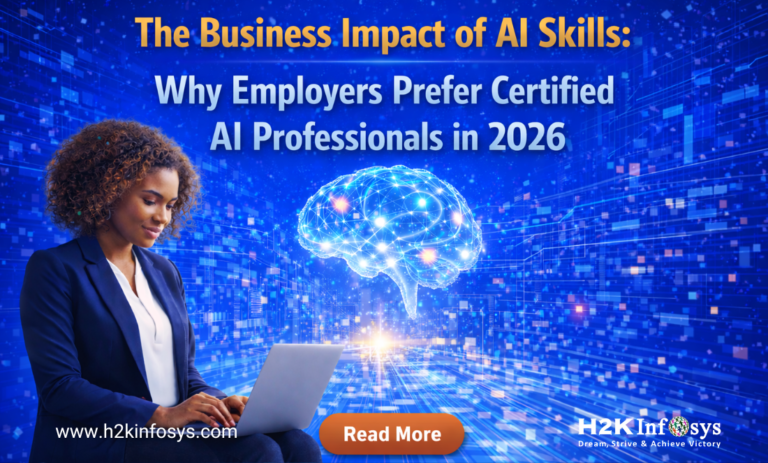
Artificial intelligence skills directly influence how organizations design systems, automate decisions, and manage data-driven operations. In 2026, employers increasingly prefer professionals with verified AI competencies because certification provides a standardized signal of technical readiness, applied knowledge, and familiarity with enterprise-grade tools and workflows. This preference reflects the growing integration of AI into core business processes, compliance requirements, and production environments rather than experimental or isolated use cases.
What Is the Business Impact of AI Skills in 2026?
The business impact of AI skills refers to how an organization’s ability to design, deploy, monitor, and govern AI systems affects productivity, cost efficiency, decision quality, and risk management. AI is no longer limited to innovation teams. It is embedded in:
- Customer support automation
- Fraud detection and compliance monitoring
- Predictive maintenance in operations
- Sales forecasting and marketing optimization
- Software testing and quality assurance
- Cybersecurity threat detection
In practical terms, this means AI and machine learning courses are increasingly aligned with business functions, not just technical experimentation. Certified professionals are often preferred because they demonstrate structured exposure to:
- Data pipelines
- Model lifecycle management
- Governance and audit requirements
- Integration with cloud platforms and enterprise systems
How Does AI Work in Real-World IT Projects?
In enterprise environments, AI projects typically follow a standardized workflow rather than ad-hoc model building. Understanding this workflow is a core expectation in artificial intelligence certification online programs.
Typical Enterprise AI Workflow
- Problem Definition
- Identify a business process suitable for automation or optimization.
- Define success metrics (accuracy, cost reduction, response time, risk reduction).
- Data Collection and Preparation
- Extract data from ERP systems, CRM platforms, logs, or sensors.
- Clean, normalize, and validate data for quality and compliance.
- Model Development
- Select algorithms (classification, regression, clustering, NLP, or computer vision).
- Train and validate models using historical data.
- Deployment
- Integrate models into applications or APIs.
- Host on cloud platforms or internal infrastructure.
- Monitoring and Governance
- Track performance drift.
- Maintain audit logs and version control.
- Apply security and access policies.
Example: AI in Customer Support Systems
A typical project might involve:
- Collecting historical chat or ticket data.
- Training a natural language model to classify issues.
- Integrating the model into a helpdesk platform.
- Monitoring response accuracy and escalation rates.
Professionals who complete structured AI and Machine Learning Courses often encounter these workflows through guided labs or simulated enterprise environments, preparing them for real production constraints.
Why Is AI Certification Important for Working Professionals?
Employers evaluate AI professionals not only on theoretical knowledge but also on their ability to operate within regulated, scalable, and secure systems. Artificial Intelligence Certification Online programs help standardize this evaluation.
Business Reasons Employers Prefer Certified Professionals
- Risk Reduction
Certified professionals are expected to understand data governance, bias mitigation, and model transparency. - Faster Onboarding
Structured training aligns skills with enterprise tools such as cloud platforms, CI/CD pipelines, and monitoring systems. - Compliance Alignment
Many industries require audit trails, explainability, and controlled access to data and models. - Operational Readiness
Certification often includes exposure to deployment, logging, and maintenance rather than just model training.
What Skills Are Required to Learn AI and Machine Learning in 2026?
AI learning paths in 2026 typically blend software engineering, data science, and domain-specific knowledge.
Core Technical Skills
| Skill Area | Description | Business Relevance |
|---|---|---|
| Programming | Python, SQL, basic scripting | Automating workflows, integrating models |
| Data Handling | Data cleaning, transformation, validation | Ensures reliable model outputs |
| Machine Learning | Supervised and unsupervised learning | Prediction, classification, optimization |
| Cloud Platforms | Model hosting and scaling | Production deployment |
| APIs and Integration | Connecting models to systems | Enterprise application support |
| Monitoring | Logging, performance tracking | Reliability and compliance |
Supporting Skills
- Version control (Git)
- Security basics (access control, encryption)
- Documentation and reporting
- Cross-team communication
These skill sets are typically formalized in structured AI and machine learning courses, which map learning objectives to enterprise use cases.
How Is AI Used in Enterprise Environments?
Enterprise AI systems differ significantly from academic or experimental projects. They must operate reliably at scale, integrate with existing infrastructure, and meet regulatory standards.
Common Enterprise Use Cases
- Finance: Fraud detection, credit risk scoring, transaction monitoring
- Healthcare: Medical image analysis, patient data classification
- Retail: Demand forecasting, personalization engines
- Manufacturing: Predictive maintenance, quality inspection
- IT Operations: Anomaly detection in logs and system metrics
Infrastructure Components
- Data lakes and warehouses
- Model serving platforms
- Identity and access management
- Observability tools
Certified professionals are often expected to understand how models interact with these components, not just how to build algorithms.
What Job Roles Use AI Skills Daily?
AI skills are no longer limited to data scientists. Several roles integrate AI into daily workflows.
Role vs Skill Mapping
| Job Role | Daily AI Tasks | Key Skills |
|---|---|---|
| Data Analyst | Dashboard automation, predictive insights | SQL, Python, visualization |
| Machine Learning Engineer | Model deployment, monitoring | CI/CD, cloud platforms |
| QA Engineer | Test automation, anomaly detection | Scripting, ML basics |
| Cybersecurity Analyst | Threat pattern detection | Data analysis, ML models |
| Business Analyst | Forecasting, decision modeling | Data interpretation, AI tools |
This broad role distribution explains why artificial intelligence certification increasingly target non-traditional IT professionals.
Why Do Employers Value Certification Over Self-Study?
Self-study can demonstrate initiative, but certification provides a standardized reference point.
Employer Evaluation Criteria
- Curriculum Coverage
Certification ensures exposure to industry-relevant topics. - Practical Assessment
Many programs include labs, projects, or scenario-based evaluations. - Documentation
Verifiable credentials simplify hiring and compliance processes. - Consistency
Certification helps align expectations across teams and departments.
How Do AI Skills Impact Business Performance?
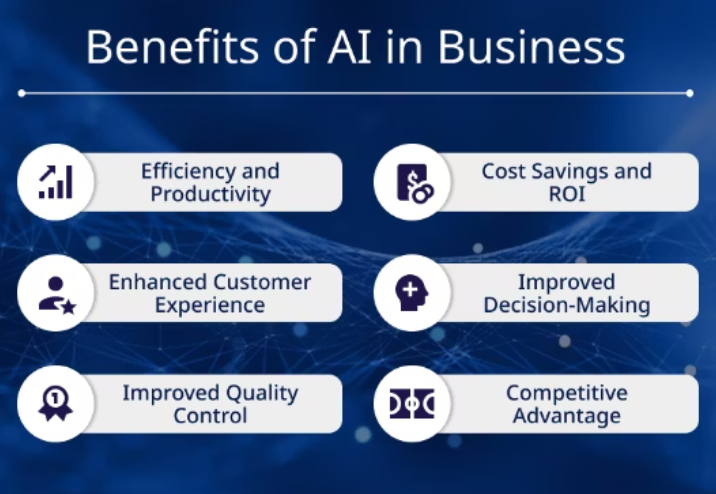
AI implementation can influence several performance metrics.
Operational Metrics
- Reduced manual processing time
- Improved forecasting accuracy
- Lower error rates in transactions
- Faster incident response
Strategic Metrics
- Data-driven decision quality
- Scalability of digital services
- Competitive differentiation
- Compliance and risk posture
These impacts are most visible when AI projects move beyond pilot phases into fully governed production systems.
What Are the Challenges in Enterprise AI Adoption?
Understanding constraints is a key part of professional-level AI training.
Common Challenges
- Data Quality Issues
Inconsistent or biased data can compromise model reliability. - Integration Complexity
Legacy systems may not easily support AI components. - Security and Privacy
Sensitive data requires strict access controls and encryption. - Model Drift
Changing business conditions can degrade model performance over time. - Regulatory Compliance
Industries may require explainable and auditable AI decisions.
Certification programs often include case-based discussions around these issues to prepare learners for real-world environments.
Learning Path for AI and Machine Learning Professionals
A structured learning path helps professionals progress from fundamentals to applied enterprise work.
Sample Learning Path
| Stage | Focus | Outcome |
|---|---|---|
| Foundations | Programming, data basics | Technical literacy |
| Core ML | Algorithms, evaluation | Model development |
| Applied AI | Use cases, integration | Business alignment |
| Deployment | Cloud, APIs, monitoring | Production readiness |
| Governance | Security, compliance | Operational trust |
This progression aligns closely with the structure of many AI and machine learning courses offered in professional training environments.
How Are AI Projects Governed in Organizations?
Governance ensures AI systems operate within legal, ethical, and operational boundaries.
Governance Practices
- Model version control
- Access role definitions
- Audit logging
- Performance reviews
- Bias and fairness assessments
Certified professionals are often trained to document and follow these processes, which is critical in regulated industries.
What Careers Are Possible After Learning AI in 2026?
AI training supports a range of career paths, not just technical specialization.
Career Options
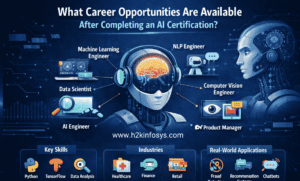
- AI Analyst
- Machine Learning Engineer
- Data Engineer
- AI Solutions Architect
- Automation Specialist
- AI Governance and Compliance Officer
Each role emphasizes a different balance of technical, business, and operational skills.
How Do AI and Machine Learning Courses Align With Business Needs?
Modern curricula increasingly emphasize:
- Realistic datasets
- Cross-functional projects
- Cloud-based deployment
- Monitoring and reporting
This alignment helps bridge the gap between training environments and production systems.
FAQ: AI Skills, Certification, and Career Impact in 2026
What is artificial intelligence certification online?
It is a structured program that verifies a professional’s knowledge of AI concepts, tools, and enterprise workflows through assessments and documented learning outcomes.
Are AI and machine learning courses suitable for non-IT professionals?
Many programs include foundational modules designed for career switchers and business professionals, focusing on applied use cases rather than advanced mathematics.
How long does it take to become job-ready in AI?
Timeframes vary, but structured programs often range from several months to a year, depending on prior experience and learning intensity.
Do employers require specific AI tools knowledge?
Employers typically value familiarity with cloud platforms, data pipelines, and monitoring tools rather than a single proprietary technology.
Is certification mandatory for AI roles?
Certification is not always mandatory, but it is commonly used as a screening and validation tool in hiring processes.
What industries use AI the most in 2026?
Finance, healthcare, retail, manufacturing, and IT services are among the most active adopters of enterprise AI systems.
Key Takeaways
- AI skills influence core business functions, not just technical innovation.
- Employers prefer certified professionals because certification signals operational readiness, governance awareness, and standardized skill coverage.
- Enterprise AI projects follow structured workflows involving data pipelines, deployment, monitoring, and compliance.
- AI and machine learning courses increasingly align with real-world business use cases and production environments.
- Artificial intelligence certification online helps working professionals demonstrate verified, job-relevant competencies.