Scrum has become one of the most widely adopted Agile frameworks for managing complex projects, especially in software development, product engineering, and digital transformation initiatives. As organizations continue to scale Agile practices, demand for structured, practical Scrum education is rising sharply. Scrum Courses Online have emerged as a primary learning pathway for professionals who want formal Scrum knowledge, real-world skills, and industry-recognized credentials without disrupting their work schedules.
This guide provides a comprehensive, educator-level overview of top-rated Scrum learning options for 2026, with a focus on skills, curriculum depth, career outcomes, and alignment with real enterprise needs.
What Is Scrum and Why Does It Matter in 2026?
Scrum is an Agile framework designed to help teams deliver value incrementally through collaboration, transparency, and continuous improvement. It defines a set of roles, events, artifacts, and rules that guide teams in handling complex work.
By 2026, Scrum is no longer limited to software development. It is widely used in:
- IT infrastructure and cloud projects
- Data analytics and AI product teams
- Cybersecurity and DevOps initiatives
- Business transformation and enterprise change programs
Professionals trained through Scrum master training gain a structured understanding of how Agile teams operate in real organizational environments, rather than limited theoretical project scenarios.
Why Professionals Prefer Scrum Courses Online Over Traditional Classrooms
Online Scrum education has matured significantly. Modern programs go far beyond recorded videos and slides, offering interactive and career-focused learning experiences.
Key advantages include:
- Flexible learning schedules for working professionals
- Access to global instructors with enterprise Scrum experience
- Live simulations of sprint planning, reviews, and retrospectives
- Continuous updates aligned with industry changes
Well-designed Scrum Courses Online mirror real Agile team dynamics, helping learners transition smoothly into Scrum roles.
Who Should Enroll in Scrum Courses in 2026?
Scrum education is no longer restricted to developers or project managers alone. Scrum skills are now relevant across multiple roles.
Ideal candidates include:
- Aspiring Scrum Masters
- Project managers transitioning to Agile delivery
- Business analysts working in Agile environments
- QA professionals and automation engineers
- Product owners and product managers
- IT professionals targeting leadership roles
Professionals selecting Scrum Courses Online benefit from structured role-based learning that aligns with their career stage.
Core Topics Covered in High-Quality Scrum Courses
Top-rated programs follow a curriculum that balances Scrum theory with hands-on practice.
Scrum Framework Fundamentals
- Agile values and principles
- Scrum roles: Scrum Master, Product Owner, Development Team
- Scrum artifacts and commitments
- Scrum events and timeboxing
Practical Scrum Master Responsibilities
- Facilitating Scrum events
- Removing impediments
- Coaching Agile teams
- Stakeholder communication
- Scaling Scrum in large organizations
Advanced Scrum Courses Online also address real-world constraints such as distributed teams, tight deadlines, and enterprise governance.
Agile and Scrum Training: Beyond the Basics
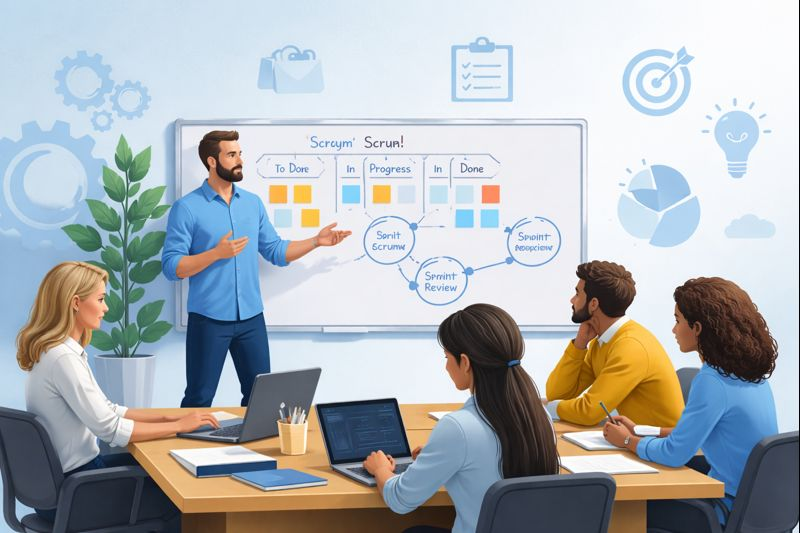
Effective agile and scrum training goes deeper than definitions. It focuses on behavior change, team facilitation, and decision-making under uncertainty.
High-quality programs emphasize:
- Servant leadership mindset
- Conflict resolution in Agile teams
- Metrics such as velocity, burndown, and cycle time
- Continuous improvement through retrospectives
Through guided practice, learners in Scrum Courses Online develop the confidence to apply Scrum principles in live projects.
Scrum Master Training for Real-World Projects
Scrum master training in 2026 must reflect actual organizational challenges. Theory alone is insufficient for career readiness.
Practical elements include:
- Case studies from enterprise Agile transformations
- Sprint simulations using real project data
- Role-play exercises for Scrum ceremonies
- Exposure to Agile tools used in industry
Professionals completing Scrum Courses Online with hands-on components demonstrate stronger job performance and faster role transitions.
What to Expect from Structured Scrum Master Classes
Well-designed Scrum master classes follow a progressive learning path:
- Foundation concepts and Agile mindset
- Scrum framework application
- Advanced facilitation techniques
- Scaling Scrum across teams
- Career readiness and interview preparation
Structured Scrum Courses Online ensure learners can articulate Scrum concepts clearly and apply them confidently in professional settings.
Scrum Project Manager: How the Role Differs from Traditional PM
The role of a scrum project manager differs significantly from traditional project management roles.
Key distinctions include:
- Focus on facilitation rather than command-and-control
- Emphasis on team empowerment and collaboration
- Continuous planning instead of fixed schedules
- Value delivery over documentation
Professionals trained through Scrum Courses Online understand how to balance Scrum principles with organizational expectations.
Certified Scrum Master Certification: What It Validates
A certified scrum master certification demonstrates verified knowledge of Scrum principles and practices. It signals to employers that a professional understands Agile frameworks and can support Scrum teams effectively.
Certification preparation typically includes:
- Scrum theory mastery
- Scenario-based assessments
- Role-specific responsibilities
- Ethical and professional standards
Top Scrum Courses Online integrate certification readiness with applied learning to ensure long-term skill retention.
How Scrum Courses Online Support Career Growth
Career-oriented programs focus not only on knowledge acquisition but also on employability.
Key career benefits include:
- Clear understanding of Scrum roles in organizations
- Confidence in leading Agile ceremonies
- Ability to coach teams and stakeholders
- Stronger performance in interviews
By combining theory, practice, and mentoring, Scrum Courses Online help professionals move into Agile leadership roles.
Scrum Master Training and Placement: What to Look For
Programs that emphasize scrum master training and placement go beyond coursework. They focus on bridging the gap between learning and employment.
Effective placement-oriented features include:
- Resume alignment with Scrum roles
- Mock interviews and scenario discussions
- Exposure to enterprise Agile tools
- Guidance on Agile career pathways
Professionals selecting Scrum Courses Online with placement support gain a clearer transition from training to real job roles.
Evaluating the Quality of Scrum Courses in 2026
Not all courses deliver the same value. When evaluating options, professionals should consider:
- Instructor industry experience
- Live versus recorded content balance
- Hands-on project exposure
- Curriculum alignment with current Agile practices
- Certification preparation depth
High-quality Scrum Courses Online are continuously updated to reflect evolving enterprise Agile environments.
Common Mistakes Learners Make When Choosing Scrum Training
Some professionals select courses based only on price or duration, which can limit long-term value.
Common mistakes include:
- Choosing theory-only programs
- Ignoring instructor credibility
- Overlooking practical exposure
- Skipping career support considerations
Well-structured Scrum Courses Online address these gaps by integrating applied learning and career readiness.
The Role of Scrum in Large-Scale Agile Transformations
Scrum plays a critical role in enterprise Agile adoption, especially when combined with scaling frameworks.
Modern Scrum education addresses:
- Cross-team coordination
- Agile governance
- Hybrid Agile-Waterfall environments
- Organizational change management
Advanced Scrum Courses Online prepare professionals to operate effectively within complex, multi-team ecosystems.
Why Scrum Skills Remain Relevant Beyond 2026
Despite emerging methodologies, Scrum remains foundational to Agile practice. Its principles adapt well to new technologies, distributed teams, and evolving business models.
Professionals trained through Scrum Courses Online develop transferable skills such as:
- Facilitation and leadership
- Collaboration and communication
- Continuous improvement mindset
- Adaptive planning
These competencies ensure long-term career resilience.
Conclusion: Choosing the Right Scrum Learning Path
Selecting the right Scrum education in 2026 requires clarity on career goals, learning preferences, and practical expectations. The most effective programs combine Agile theory, real-world application, certification readiness, and career support.
For working professionals aiming to grow into Agile leadership roles, investing in high-quality Scrum Courses Online provides a structured, future-ready pathway into Scrum Master and Agile delivery careers.