

Artificial Intelligence (AI) is transforming industries and creating new opportunities for career advancement. AI skills are now essential for professionals in technology, healthcare, finance, marketing, and many other sectors. As businesses adopt AI technologies to automate tasks, enhance decision-making, and improve customer experiences, the demand for AI-trained professionals continues to grow. If you’re looking to advance your career in AI, understanding the key skills is crucial. In this we’ll explore the essential AI skills for career advancement and provide insights into how you can acquire them through training and certification.
What is AI and Why Are AI Skills Important for Career Advancement?
Artificial Intelligence (AI) refers to the development of computer systems capable of performing tasks that traditionally required human intelligence. These tasks include speech recognition, problem-solving, decision-making, visual perception, and language translation. With AI technologies becoming increasingly integrated into business operations, professionals who possess AI skills are in high demand.
AI skills are crucial for career advancement because they enable professionals to handle complex data, make data-driven decisions, and automate repetitive tasks. These capabilities improve productivity, efficiency, and innovation within organizations, making AI-skilled workers more valuable in today’s competitive job market.
What Skills Are Required to Learn AI?
To embark on a successful career in AI, you need to acquire a specific set of skills. Below are some essential AI skills you must learn to advance your career:
1. Programming Languages for AI
Programming is the foundation of AI development. Familiarity with key programming languages such as Python, R, and Java is crucial. Python, in particular, is widely used in AI due to its simplicity and the extensive availability of libraries for machine learning (ML), deep learning (DL), and data science.
- Python: Key for machine learning, data analysis, and deep learning. Libraries such as TensorFlow, PyTorch, and Scikit-learn are essential for building AI models.
- R: Used primarily for statistical analysis and data visualization.
- Java: Used for large-scale applications, particularly in enterprise environments.
2. Mathematics and Statistics
AI and machine learning heavily rely on mathematical concepts such as linear algebra, calculus, probability, and statistics. A strong foundation in these areas is essential for developing AI algorithms and understanding how they function.
- Linear Algebra: Important for understanding how algorithms process data.
- Calculus: Used to understand optimization techniques for training machine learning models.
- Probability and Statistics: Crucial for analyzing data, making predictions, and validating models.
3. Machine Learning (ML)
Machine learning is the heart of AI. ML algorithms allow computers to learn from data without being explicitly programmed. Mastering ML involves understanding different types of learning models, such as supervised learning, unsupervised learning, and reinforcement learning.
- Supervised Learning: Used for classification and regression tasks.
- Unsupervised Learning: Applied to discover hidden patterns in data.
- Reinforcement Learning: A type of learning that focuses on optimizing decision-making.
4. Deep Learning (DL)
Deep learning is a subset of machine learning that uses neural networks to model complex patterns in large datasets. Deep learning has revolutionized fields such as computer vision, natural language processing (NLP), and speech recognition.
- Convolutional Neural Networks (CNNs): Primarily used for image and video recognition tasks.
- Recurrent Neural Networks (RNNs): Used for sequential data tasks, such as language modeling and time-series forecasting.
- Generative Adversarial Networks (GANs): Used for generating new data, such as images or videos, by training two networks to compete with each other.
5. Data Science and Data Engineering
AI professionals need a solid understanding of data science and data engineering principles. This involves gathering, cleaning, analyzing, and visualizing data to train AI models effectively.
- Data Wrangling: Cleaning and preparing data for analysis.
- Data Visualization: Communicating insights through visual representation (using tools like Tableau or Matplotlib).
- Big Data Technologies: Working with large datasets using tools such as Hadoop, Spark, and SQL.
6. Natural Language Processing (NLP)
NLP enables machines to understand and interact with human language. AI professionals should be familiar with NLP tasks such as sentiment analysis, language translation, and text classification.
- Text Preprocessing: Techniques such as tokenization and lemmatization.
- Transformers: Advanced models like BERT and GPT-3 for language understanding.
- Speech Recognition: Converting audio into text for applications like voice assistants.
7. AI Frameworks and Tools
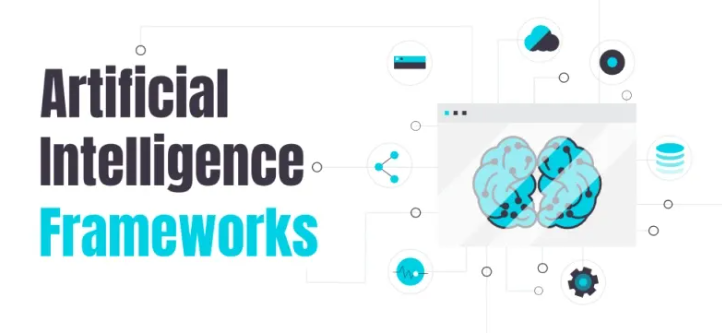
Proficiency in AI frameworks and tools is critical for implementing AI solutions in real-world environments. Some of the most widely used frameworks include:
- TensorFlow: An open-source framework for building machine learning models.
- Keras: A high-level neural networks API, often used with TensorFlow.
- PyTorch: A deep learning framework known for its flexibility and ease of use.
- Scikit-learn: A Python library for machine learning that provides simple tools for data analysis.
How Does AI Work in Real-World IT Projects?
AI plays a pivotal role in various industries, from healthcare to finance and marketing. Below are some real-world scenarios where AI skills are applied:
- Healthcare: AI is used for predictive analytics, medical imaging, drug discovery, and patient care management.
- Finance: AI models are employed for fraud detection, risk assessment, algorithmic trading, and customer support automation.
- Marketing: AI is leveraged for personalized marketing campaigns, customer segmentation, and recommendation systems.
- Supply Chain Management: AI optimizes inventory management, route planning, and demand forecasting.
What Job Roles Use AI Skills Daily?
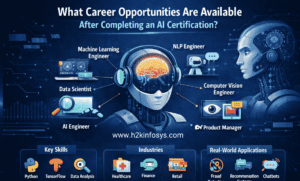
AI skills are highly sought after across various job roles in the IT and business sectors. Some key roles include:
- AI Engineer: Develops and implements AI models and systems for businesses.
- Machine Learning Engineer: Specializes in building machine learning models and optimizing their performance.
- Data Scientist: Analyzes complex data to generate insights and build predictive models.
- AI Researcher: Focuses on advancing AI technologies and creating novel algorithms.
- Business Analyst: Uses AI to analyze business data and generate actionable insights.
What Careers Are Possible After Learning AI?
Learning AI opens up a wide range of career opportunities across industries. Some of the most popular career paths include:
- AI Specialist: Works on AI-driven products and systems in various industries.
- Data Scientist: Analyzes data to inform decisions and improve business processes.
- Machine Learning Engineer: Designs and builds machine learning models and algorithms.
- AI Product Manager: Oversees the development of AI products and ensures they meet customer needs.
How Can H2K Infosys Help You Build AI Skills?
At H2K Infosys, we offer comprehensive AI Training Online programs designed for working professionals. Our courses provide hands-on learning, real-world projects, and certification that equip you with the essential skills needed to advance your career in AI.
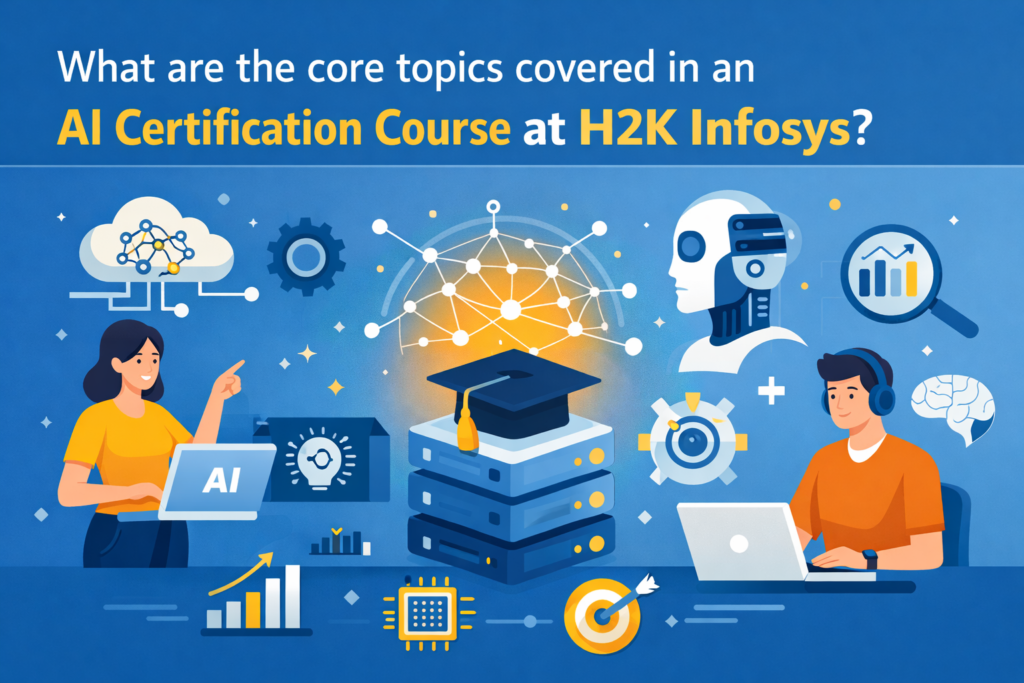
Our curriculum covers the core AI skills discussed in this blog, from programming to deep learning, and is aligned with industry standards. With experienced instructors and flexible online learning options, you can gain practical knowledge that you can immediately apply in the workplace.
FAQ: Common AI Questions
1. What are the best AI certification courses?
Some of the Best AI Certification Courses include machine learning, deep learning, and data science programs offered by platforms like H2K Infosys. These programs provide structured learning paths with hands-on projects.
2. How long does it take to become proficient in AI?
It depends on your prior experience and the amount of time you can dedicate to learning. On average, it may take 6 to 12 months to gain proficiency in AI through consistent study and practice.
3. What is the future of AI in the workplace?
AI is expected to continue revolutionizing industries, enhancing efficiency, and automating routine tasks. Professionals with AI skills will be in high demand, and AI will increasingly be integrated into daily business processes.
Key Takeaways
- AI skills, such as programming, machine learning, and deep learning, are essential for career advancement.
- Proficiency in data science, NLP, and AI tools will make you competitive in the job market.
- AI is widely used across industries, from healthcare to finance and marketing.
- AI careers offer high-paying roles like AI Engineer, Data Scientist, and Machine Learning Engineer.

















One Response
Thank you for this comprehensive overview of the AI skill landscape. As someone who transitioned from traditional data analysis to a more AI‑centric role, I can confirm that a solid grounding in Python, statistics, and machine learning is absolutely essential. Your emphasis on hands‑on projects hits the nail on the head – the moment I built my first end‑to‑end pipeline that cleaned raw logs, trained a gradient‑boosting model, and deployed it on a containerized service, the concepts finally clicked.
One additional dimension I’d stress is staying current with the rapid evolution of transformer‑based models. Even if you’re not diving into deep research, a basic grasp of how BERT‑style or GPT‑style architectures work can give you a competitive edge when discussing product roadmaps with product managers or presenting findings to senior leadership.
Regarding learning resources, I’ve discovered that a curated marketplace of skill modules, such as the openclawskills platform, can accelerate the learning curve. Their practical labs and real‑world case studies helped me bridge the gap between theory and implementation without feeling overwhelmed.
Finally, remember that soft skills – clear communication, storytelling with data, and cross‑functional collaboration – are just as valuable as technical expertise. When you can explain a model’s limitations and assumptions to a non‑technical stakeholder, you become an indispensable bridge between the data science team and business outcomes.