If you’re considering an Artificial Intelligence course online at H2K Infosys, here’s the straightforward answer: the program typically covers a mix of core AI concepts, machine learning frameworks, and practical tools like Python libraries, along with hands-on exposure to real-world AI workflows used in today’s industry.
Now, let’s break that down in a more practical, real-world way because honestly, that’s where most people really want clarity before enrolling in any AI and machine learning courses.
What you actually learn in the AI course
From what I’ve seen across modern AI online classes, including programs like this, the focus isn’t just theory. It’s about building things.
You’ll usually work with tools and frameworks that are actively used in production environments not outdated academic stuff. That matters a lot in 2026, where companies expect job-ready skills rather than just definitions.
Core AI Tools Covered
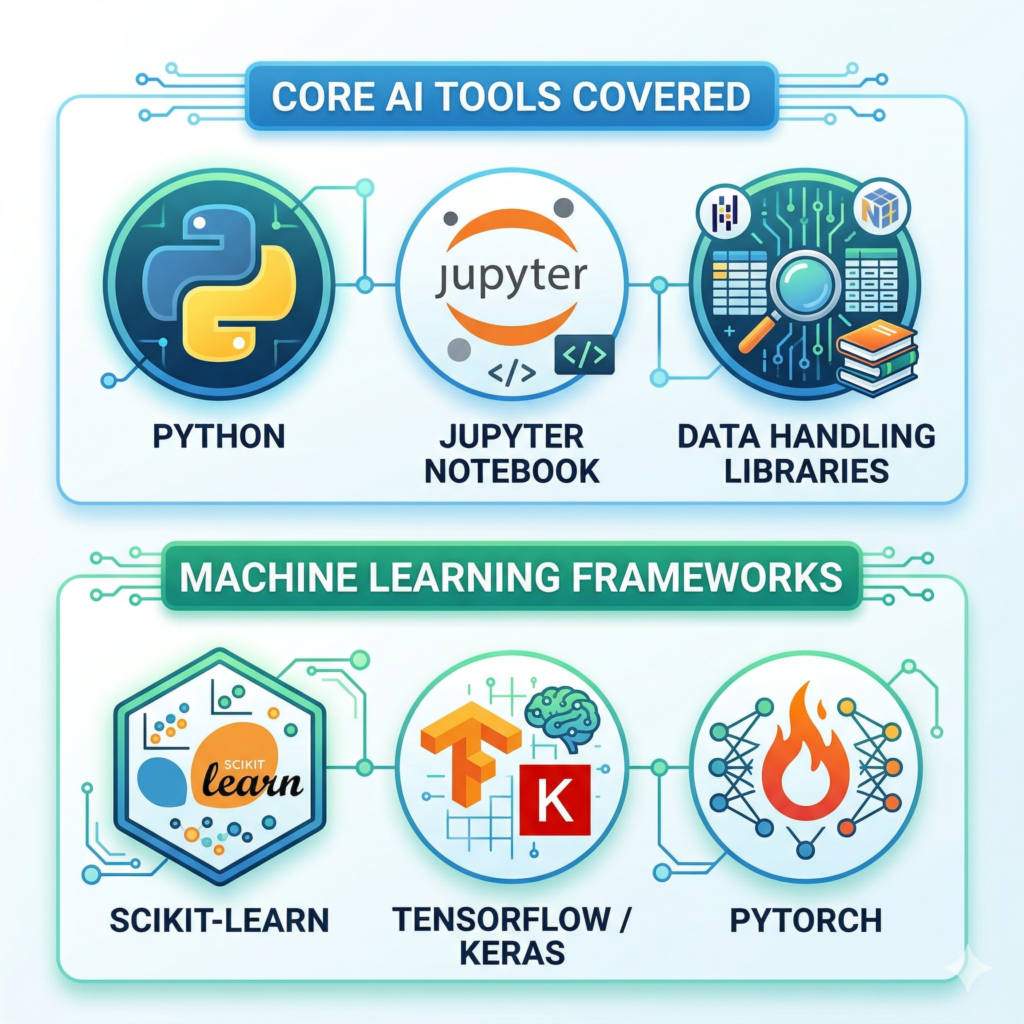
Most Artificial Intelligence course online programs at institutions like H2K Infosys include a toolset similar to this:
1. Python (the backbone)
Not surprising, but worth emphasizing.
Python is the primary language for AI development because of its simplicity and ecosystem. In practice, you’ll use it to:
- Clean and preprocess data
- Build machine learning models
- Run AI pipelines
If you’ve never coded before, this is usually where things start feeling “real.”
2. Jupyter Notebook / Development Environments
You’ll likely work inside:
- Jupyter Notebook
- VS Code or similar IDEs
These tools help you experiment interactively, which is how most AI engineers actually prototype ideas before production.
3. Data Handling Libraries
A big chunk of AI work is data preparation. Expect to use:
- NumPy – for numerical computations
- Pandas – for structured data manipulation
This is where learners often realize: AI isn’t just algorithms it’s a lot of data wrangling.
Machine Learning Frameworks You’ll Encounter
This is where things get more interesting.
1. Scikit-learn
A go-to library for traditional machine learning.
You’ll use it for:
- Classification models
- Regression tasks
- Clustering
- Model evaluation
It’s beginner-friendly but still widely used in real projects.
2. TensorFlow / Keras
For deep learning topics, courses often introduce:
- Neural networks
- Image recognition
- Sequential models
TensorFlow (with Keras API) is especially popular because it simplifies building complex models without writing everything from scratch.
3. PyTorch (in some advanced tracks)
Some AI and machine learning courses also expose learners to PyTorch, which is widely used in research and increasingly in production.
If you’ve been following recent trends, PyTorch has gained a lot of traction in AI startups and research labs due to its flexibility.
Supporting AI Ecosystem Tools
Beyond frameworks, you’ll often see exposure to tools like:
- Matplotlib / Seaborn – for data visualization
- OpenCV – for computer vision tasks
- NLTK / spaCy – for natural language processing
- APIs & deployment basics – to understand how models are integrated into applications
These aren’t just extras, they’re what make AI systems usable in real-world apps.
Real-world scenarios (this is where it clicks)
Let me give you a simple mental picture.
Imagine you’re building a spam email classifier:
- Pandas helps you organize email data
- Scikit-learn trains a classification model
- Python ties everything together
- Visualization tools help you evaluate performance
- Eventually, the model could be deployed as an API
That entire workflow is the kind of thing you practice in structured AI online classes.
Why this matters in today’s AI landscape
AI isn’t static anymore. With the rise of generative AI tools, LLMs, and automation platforms, companies now expect practitioners to:
- Understand both classical ML and modern deep learning
- Be comfortable with frameworks, not just theory
- Know how to move from model → deployment
Courses like the one at H2K Infosys aim to bridge that gap by combining foundational learning with applied tools.
A small reality check (based on experience)
One thing many learners don’t expect at first:
You don’t become “good at AI” just by learning tools you get there by using them repeatedly on real datasets.
At some point, concepts like overfitting, feature engineering, or model tuning stop feeling abstract and start becoming intuitive. That shift usually happens during hands-on labs or projects not lectures.
Final thoughts
So, if you’re exploring Artificial Intelligence course online options or comparing different ai online classes, the key takeaway is this:
A solid program like the one offered by H2K Infosys typically equips you with:
- Python and data handling skills
- Machine learning frameworks like Scikit-learn
- Deep learning tools such as TensorFlow/Keras
- Supporting libraries for visualization, NLP, and computer vision
- Practical, project-based experience
And that combination is what actually prepares you for roles across AI And Machine Learning Courses pathways not just theory, but applied understanding.