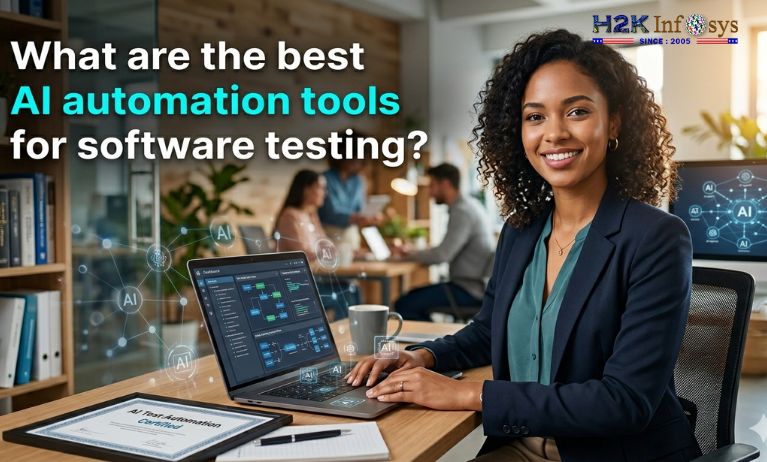
The best AI automation tools for software testing are platforms like Testim, Mabl, Applitools, and QA Wolf, tools that use AI to create, maintain, and optimize tests automatically, saving teams massive time while improving accuracy.
Now, that’s the short answer. But if you’ve actually worked in QA or development, even for a few months, you already know the real question isn’t what tools exist; it’s which ones actually make your life easier without creating new headaches.
Let’s break this down the way someone in the trenches would.
What Are the Best AI Automation Tools for Software Testing?
A couple of years ago, I remember spending hours fixing broken Selenium tests because a single button ID changed. That kind of work drains you. Fast forward to today, and AI-powered testing tools can fix those issues on their own. Not perfectly, but enough to make a noticeable difference.
That’s why AI automation tools for software testing are getting so much attention right now. They’re not just faster, they’re smarter in ways traditional automation never was.
Why AI Testing Tools Actually Matter (Beyond the Hype)
Let’s be real, every tool claims to “revolutionize testing.” Most don’t.
But AI tools are different for one simple reason: they reduce the maintenance pain. And if you’ve done test automation, you know maintenance is 70% of the work.
Here’s what changed recently, especially in 2025 and 2026:
- Teams are shipping code daily, sometimes hourly
- UI changes constantly (thanks to micro-frontends, design systems, etc.)
- AI-generated code (like from Copilot or ChatGPT) introduces unpredictable patterns
Traditional automation struggles here. AI doesn’t eliminate the chaos, but it adapts to it.
I’ve seen teams cut test maintenance effort almost in half just by switching to tools with self-healing capabilities.
What Makes a Good AI Testing Tool (From Real Experience)
Before jumping into the tools, here’s something I wish someone had told me earlier:
Not all “AI-powered testing tools” are equally useful.
Some just slap “AI” on top of basic automation.
The ones worth your time usually do at least one of these really well:
- Fix broken locators automatically (self-healing)
- Generate test cases from real user flows
- Detect visual bugs humans miss
- Let non-devs write tests in plain English
If a tool doesn’t meaningfully reduce manual effort, it’s probably not worth adopting.
Best AI Automation Tools for Software Testing (2026 Edition)
Let’s go through the tools that are actually making an impact right now.
1. Testim Best for Reducing Flaky Tests
Testim is one of those tools you appreciate after dealing with unstable test suites.
It uses AI to identify elements based on multiple attributes, not just IDs, so when something changes, your test doesn’t immediately break.
Where it shines:
- Stabilizing flaky tests
- Fast test creation
- Easy CI/CD integration
I’ve seen teams move from “tests fail every other run” to “tests mostly just work,” which honestly feels like magic when you first see it.
2. Mabl Built for Continuous Testing
Mabl feels like it was designed for modern DevOps teams.
It runs tests continuously and adapts as your app evolves. Plus, it combines functional, performance, and visual testing in one place, which reduces tool overload.
Best for:
- Teams are doing frequent releases
- CI/CD-heavy environments
One thing I like? It doesn’t force you to babysit your tests constantly.
3. Applitools The Gold Standard for Visual Testing
If your app has a UI (and most do), visual bugs are inevitable.
Applitools uses AI-based visual comparison to catch issues like:
- Misaligned buttons
- Missing elements
- Layout shifts across devices
And honestly, humans miss these all the time.
I once worked on a project where everything “passed,” but the checkout button was slightly off-screen on iPhones. Applitools caught it instantly.
4. ACCELQ No-Code Testing That Actually Works
No-code tools usually sound great until you try them.
ACCELQ is one of the few that actually delivers.
You can create tests in a structured, readable format without writing code, and it still handles complex scenarios.
Good for:
- Mixed teams (QA + non-technical stakeholders)
- Faster onboarding
5. Tricentis Tosca Enterprise-Level Power
This one is heavy-duty.
If you’re working in banking, healthcare, or any regulated environment, Tosca is often part of the stack.
It uses AI for risk-based testing, meaning it prioritizes what to test based on impact.
Best for:
- Large enterprises
- Complex systems
It’s not lightweight, but it’s powerful.
6. Functionalize Natural Language Testing Done Right
Functionize lets you write tests in plain English.
Not “kind of English,” but actual, readable instructions.
Example:
“Click the login button and verify the dashboard loads.”
The tool converts that into automation behind the scenes.
It’s surprisingly useful, especially when collaborating with non-dev team members.
7. Virtuoso QA Autonomous Testing Direction
Virtuoso is interesting because it leans toward autonomous testing.
It doesn’t just execute tests; it helps create and maintain them with minimal input.
This is where things are heading: less scripting, more guidance.
8. testRigor Simplicity Over Everything
testRigor takes the “plain English testing” idea even further.
You write tests like:
- “User logs in and sees welcome message”
- That’s it.
- No selectors, no code.
- It’s not perfect for highly complex workflows, but for many use cases, it drastically reduces effort.
9. QA Wolf AI + Real Code (Best of Both Worlds)
QA Wolf is a bit different.
Instead of replacing code, it generates real Playwright-based test scripts using AI.
So you get:
- AI speed
- Developer-level control
This hybrid approach is gaining traction in 2026 because teams don’t want to be locked into black-box systems.
10. Katalon Platform All-in-One Solution
Katalon has been around for a while, but its AI features have improved significantly.
It handles:
- Web testing
- API testing
- Mobile testing
All in one place.
If you don’t want to juggle multiple tools, this is a solid option.
11. LambdaTest (with AI Enhancements)
LambdaTest focuses on cross-browser testing, but now with AI support.
You can run tests across hundreds of environments and use AI insights to identify failures faster.
Great for frontend-heavy teams.
12. AI-Powered Test Management Tools (TestRail, Testomat.io)
These tools don’t run tests; they manage them.
But with AI, they now:
- Suggest test cases
- Identify gaps in coverage
- Analyze failure trends
Honestly, this layer is underrated. Good management tools can save just as much time as automation tools.
The Role of Generative AI (And Why It’s a Big Deal)
Here’s something interesting: a lot of teams aren’t relying on just one tool anymore.
They’re combining:
- AI test tools
- Frameworks like Playwright
- Generative AI (like ChatGPT)
For example, I’ve personally used AI to:
- Turn user stories into test cases
- Debug failing scripts
- Generate edge-case scenarios
It’s not always perfect, but it speeds things up in a very real way.
How to Choose the Right Tool (Without Overthinking It)
If you’re feeling overwhelmed by options, here’s a simple way to decide:
- Small team/startup? Go with testRigor or Testim
- DevOps-heavy workflow? Mabl or QA Wolf
- UI-heavy product? Applitools
- Enterprise environment? Tricentis Tosca
- Non-technical testers involved? ACCELQ or Functionize
Don’t try to pick the “best tool overall.” Pick the one that solves your biggest pain point.
Benefits You’ll Actually Notice
Once you start using AI in software testing, a few things become obvious pretty quickly:
- You spend less time fixing broken tests
- Releases feel less stressful
- Bugs get caught earlier
- You can scale testing without scaling your team
And maybe the biggest one, you stop dreading test maintenance.
But It’s Not All Perfect
AI tools aren’t magic.
Some common challenges:
- Initial setup can be messy
- You still need a good test strategy
- AI decisions aren’t always transparent
Also, over-relying on automation can backfire. Human intuition still matters a lot.
Where Things Are Headed (And It’s Kind of Wild)
Looking at current trends, especially with agentic AI systems, we’re moving toward:
- Fully autonomous test generation
- Self-improving test suites
- AI systems that predict bugs before code is even deployed
It sounds futuristic, but parts of this are already happening.
Final Thoughts
These tools in the field of AI automation are changing the face of software testing by transforming it from a time-consuming and labor-intensive process to a smart and intelligent system. There are many tools in the field, ranging from Testim and Mabl to more powerful tools such as Applitools and QA Wolf.
The best strategy, however, is to create a smart system for software testing by using a mix of generative AI, reliable automation frameworks, and human expertise.
As the field of software continues to grow and change, the role of AI-powered testing will be instrumental in creating quality, speed, and innovation in the field.