If you’re wondering what the features of Salesforce AI actually do, the short answer is this: they help businesses predict customer behavior, automate decisions, and personalize experiences at scale something platforms like H2kinfosys often emphasize when teaching modern CRM skills.
Artificial intelligence inside CRM systems used to feel like a futuristic concept. Today, it’s quietly doing a lot of the heavy lifting behind sales predictions, customer service automation, and marketing personalization. If you’ve worked with CRM tools long enough, you’ve probably noticed how Salesforce Einstein keeps appearing in dashboards, reports, and automation flows.
And honestly, the features of Salesforce AI aren’t just about fancy algorithms. They’re about making everyday business decisions easier, things like identifying the right sales lead, predicting customer churn, or recommending the next action in a support ticket.
Let’s walk through the real capabilities behind Einstein AI Salesforce and why companies are investing heavily in AI Salesforce solutions right now.
Predictive Lead Scoring
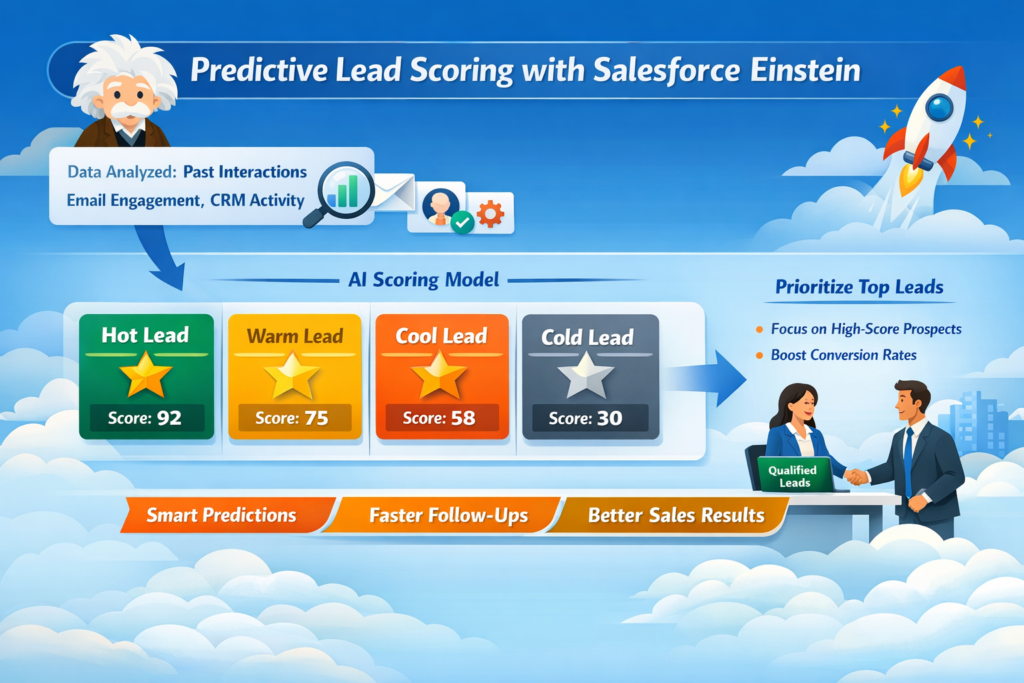
One of the most practical features of Salesforce AI is predictive lead scoring. Sales teams deal with hundreds, sometimes thousands of leads. Not all of them are worth the same attention.
Einstein analyzes past conversion data, engagement history, and customer patterns to assign a score to each lead. In simple terms, it tells sales reps: “Start here. This person is most likely to buy.”
I’ve seen companies dramatically change their sales workflow because of this. Instead of guessing which prospects to prioritize, teams simply sort leads by score and begin outreach.
This is where Salesforce and AI work beautifully together. The AI studies years of CRM data and turns it into a daily decision-making tool.
Opportunity Insights and Sales Predictions
Another major advantage among the features of Salesforce AI is opportunity prediction.
Sales pipelines often look healthy on the surface. But some deals are quietly dying while others are about to close. Einstein identifies these patterns automatically.
It might inform you, for example, of the following:
- Deals tend to close faster when a demo is booked in the next 48 hours
- Customers from a particular industry vertical are converting 30% better
- Certain product bundles are performing better in some regions than others
Instead of having to manually comb through spreadsheets, teams receive guidance right in Salesforce.
This predictive layer is one reason professionals enrolling in Salesforce certification training today are also learning how AI insights influence pipeline management.
Automated Data Insights
One underrated feature of Salesforce AI is automated insights.
Anyone who has managed CRM data knows the struggle: reports everywhere, dashboards everywhere, and still no clear answer.
Einstein solves this by scanning the data continuously and highlighting patterns automatically.
For example, it might notify you that:
- Deals close faster when a demo is scheduled within 48 hours
- Customers in a specific industry segment are converting 30% higher
- A certain product bundle performs better in specific regions
Instead of manually analyzing spreadsheets, teams receive insights directly in Salesforce.
It’s subtle, but this is one of those features of Salesforce AI that quietly changes how businesses analyze data.
AI-Powered Email and Activity Capture
Salespeople spend a surprising amount of time logging emails and meetings into CRM systems. That’s where another of the features of Salesforce AI becomes incredibly useful.
Einstein Activity Capture automatically records emails, calendar events, and interactions. It keeps the CRM updated without manual data entry.
Think about the productivity boost here.
Instead of spending 20 minutes updating records after every call, reps can move directly to the next conversation. Over time, this automation builds richer data something AI models need to get even smarter.
Personalized Customer Recommendations
Customer expectations have changed dramatically over the last few years.
People expect businesses to understand their preferences instantly. And this is exactly where the features of Salesforce AI shine.
Analytics learns what similar customers are buying and recommends personalized offers, products or content.
A simple example:
A returning customer comes to an e-commerce store. Salesforce AI combs through prior purchases and browsing activity and makes product recommendations that they’re most likely to purchase.
This sort of personalization once needed huge analytics teams. And now, it’s built directly into Einstein AI Salesforce.
AI-Powered Chatbots for Customer Service
Customer service teams are pressured to respond more quickly. Chatbots are a key part of that strategy.
Einstein Bots is one of the most popular features of Salesforce AI.
These bots can:
- Answer common support questions
- Guide customers through troubleshooting
- Route complex issues to human agents
And they keep getting smarter over time, learning from customer interactions.
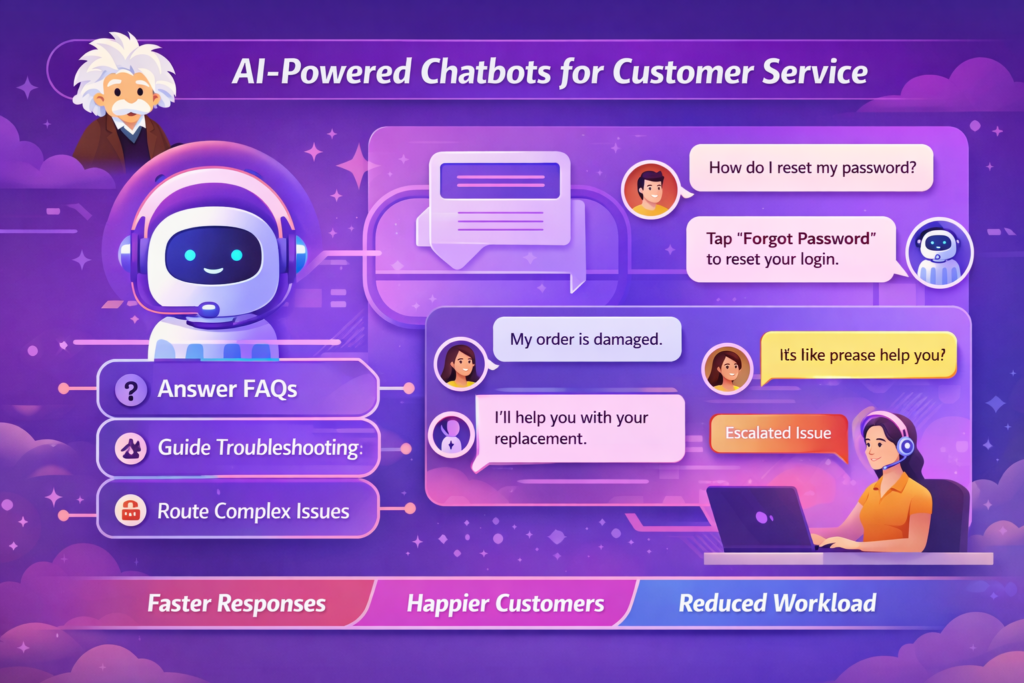
Companies that use AI Salesforce tools often find shorter wait times and higher scores on customer satisfaction. From the user’s view, it merely feels like immediate assistance.
Intelligent Case Classification
The support team manages thousands of service requests every day. It can take hours to manually sort them, which slows everything else down.
Case classification is one of Salesforce AI’s more down-to-earth capabilities.
Automatically processing the incoming support tickets, Einstein figures out:
- The issue category
- Priority level
- Which agent should handle it
This panel step removes response delays by orders of magnitude.
When organizations combine this with strong Salesforce certification, teams learn how to configure these models to match real business workflows.
AI-Driven Forecasting
Sales forecasting used to rely heavily on managers’ intuition. Sometimes it still does.
But modern forecasting tools are far more data-driven thanks to the features of Salesforce AI.
Einstein Forecasting analyzes pipeline data, historical deals, seasonal trends, and rep performance to predict revenue outcomes.
What makes it powerful is its ability to identify risk factors automatically.
For instance:
- Deals stuck too long in one stage
- Unusual pipeline growth patterns
- Sudden drop in engagement
The AI surfaces these signals early so leaders can intervene.
Next Best Action Recommendations
One of the smartest features of Salesforce AI is something called “Next Best Action.”
Instead of just showing data, the system recommends what to do next.
Example:
A customer recently contacted support about a product issue. Einstein might suggest offering a discount on a service upgrade to retain the relationship.
Or in a sales scenario:
If a prospect downloads a whitepaper and attends a webinar, the AI might recommend scheduling a demo.
These guided recommendations are becoming a core component of Salesforce and AI strategy.
Marketing Personalization with Einstein AI
Marketing teams are increasingly relying on AI for segmentation and targeting.
Another key part of the features of Salesforce AI is its marketing intelligence capabilities.
Einstein can analyze massive marketing datasets to determine:
- Which email subject lines perform best
- When customers are most likely to engage
- Which audience segments respond to certain campaigns
The system then automatically adjusts marketing strategies.
In many organizations, this level of automation was unimaginable five years ago.
AI Analytics with Einstein Discovery
Data analysis used to require data scientists. Now it’s accessible to everyday users.
Einstein Discovery is another standout among the features of Salesforce AI.
It uses machine learning to analyze business datasets and explain the “why” behind results.
For example:
- Why did customer churn increase last quarter
- Why do certain regions outperform others
- Which product bundles drive the highest revenue
It doesn’t just show correlations it suggests actions.
This is one of the reasons a large number of professionals pursuing a Salesforce certification course today are also learning AI-based analytics.
Voice and Conversational AI
Salesforce has been expanding into voice-enabled features as well.
Some of the newer features of Salesforce AI include voice assistants integrated into CRM workflows.
Sales reps can ask questions like:
- “Show my top opportunities this week.”
- “What deals are at risk?”
The AI retrieves insights instantly.
This trend reflects a broader shift in enterprise technology, as interfaces are becoming conversational.
Real-Time Customer Insights
Speed matters in customer experience. Businesses need insights immediately.
One of the evolving features of Salesforce AI is real-time decision intelligence.
Einstein acts upon real-time data streams from customers’ web activity, CRM updates, service interactions, etc. and takes action in real time.
Consider this example:
A customer frequently views a pricing page without making a purchase. The system notifies a sales rep and recommends that they reach out.
More often than not, these micro-moments are what solidify a deal or make it slip away.
Why Salesforce AI Is Growing So Fast
AI adoption in CRM platforms has accelerated over the past few years. A lot of it comes down to data availability.
Companies have years of customer data stored in Salesforce. When AI tools analyze that data, they unlock patterns businesses never noticed.
That’s why the features of Salesforce AI are becoming central to sales, marketing, and service strategies.
And considering the current trends in technology generative AI and predictive analytics are both growing rapidly the demand for people who can interpret Einstein AI Salesforce has only increased.
Most of the new learners starting on Salesforce certification training today are especially interested in how AI models are integrated with CRM workflows.
Skills Needed To Work With Salesforce AI
If you plan on a career built around features of Salesforce AI technologies, there are some good practical skills to develop:
1. Data Understanding
Data quality is everything for AI models. Understanding how to format CRM data is vital.
2. Salesforce Automation
Flow, Process Builder, and AI recommendations are more powerful when used together.
3. AI Interpretation
Skim reading AI insights and implementing them without a money context is a formula for disaster.
That’s also why an up-to-date Salesforce certification course often comes with AI modules.
Case Study: AI-Enabled Sales Teams
Salesforce Einstein recently found a home on the sales team of a mid-sized SaaS company.
Before AI:
- Reps spent hours qualifying leads
- Pipeline accuracy was inconsistent
- Managers struggled to forecast revenue
They started to use the features of Salesforce AI and it began to show results:
- 30% faster lead response time
- Higher close rates
- More accurate revenue forecasting
What changed was not just technology but the speed of decision-making.
Coclusion
The capabilities of AI in CRM are usually linked with elaborate machine learning technologies that work in a black box and process streams of data.
The real worth, however, is in routine practice. With features of Salesforce AI, teams are able to streamline workflows and create a more personalized experience for customers by predicting and automating outcomes based on data and task inputs.
So in practical terms, that means fewer guesses and more informed decisions.”
The use of Salesforce and other AI tools will only increase as businesses adopt more systems, meaning the role of platforms like Salesforce Einstein will become even larger. And for any professional considering Salesforce certification training, knowledge of how these AI features operate is increasingly the key information that employers want.
The truth is that CRM systems are not just simple databases anymore; they are advanced systems that drive how businesses sell, market, and support their customers.