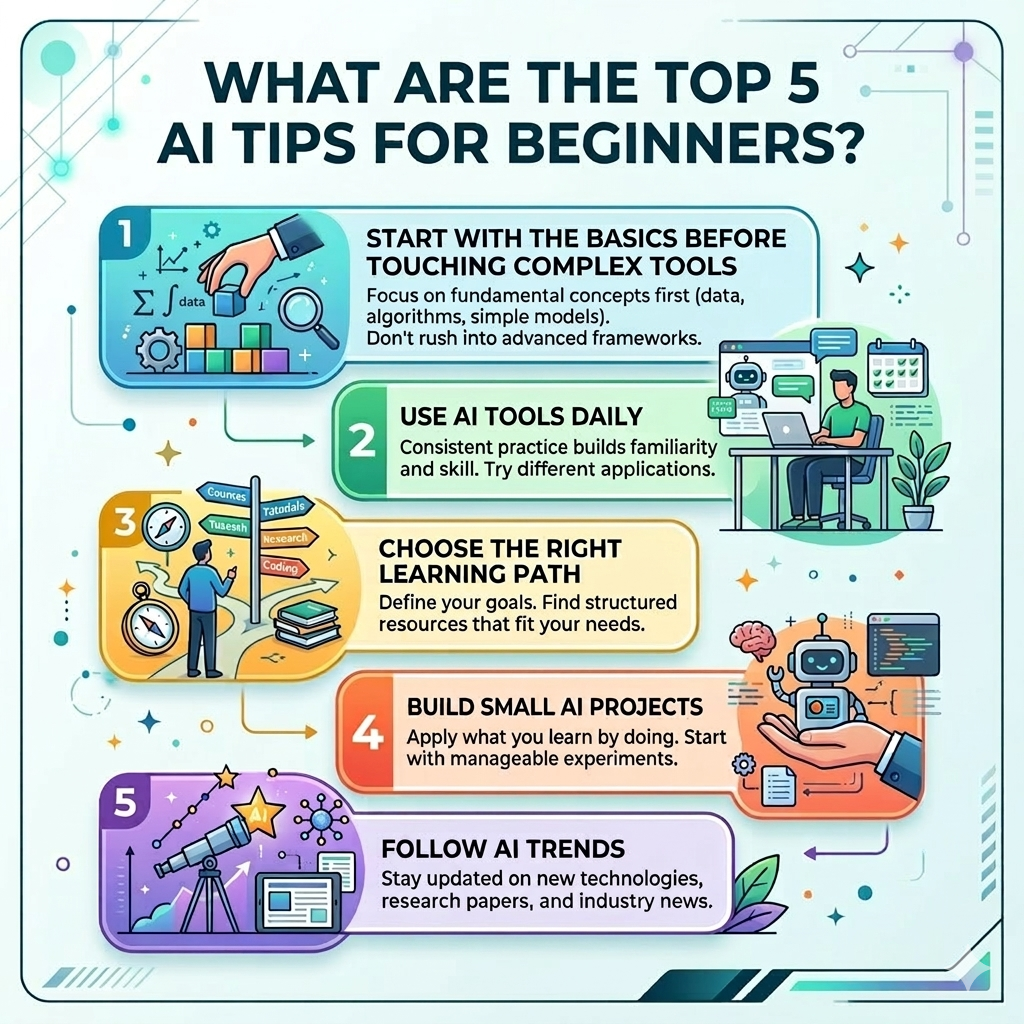
Here are 5 AI tips for beginners, If you’re just starting with AI, focus on learning the basics of how AI works, practice using real AI tools, take structured AI courses for beginners, work on small real-world projects, and stay updated with the rapidly changing AI landscape.
Now let’s slow down for a minute.
A lot of people jump into AI thinking they need to become machine-learning experts overnight. Truth is… most beginners get overwhelmed in the first week. I’ve seen it happen with friends, colleagues, even people who already work in tech. The AI space moves fast, but the fundamentals are still the best place to start.
So if you’re new to AI in 2026, here are AI tips for beginners that actually help beginners succeed the kind I wish someone had explained earlier.
1. Start With the Basics Before Touching Complex Tools
It’s tempting to jump straight into building chatbots or training models. But honestly, skipping the basics creates confusion later.
You don’t need a PhD-level understanding. Just learn the AI tips for beginners
- What artificial intelligence actually means
- The difference between AI, machine learning, and deep learning
- How data training works
- Where AI is used in real industries
Think of it like learning to drive. You don’t start with Formula 1 racing you first understand the steering wheel and brakes.
Most beginners today start with structured AI courses for beginners because they explain concepts step-by-step instead of throwing technical jargon at you.
A good course usually covers things like:
- AI fundamentals
- Python basics for AI
- Intro to machine learning
- Real industry use cases
Once those ideas click, the rest becomes much easier.
2. Use AI Tools Daily
Here’s something people underestimate: using AI tools daily teaches you faster than theory alone.
Even simple tools help build intuition.
For example:
- Use ChatGPT or Claude to practice prompt engineering
- Try AI image generators like Midjourney or DALL-E
- Experiment with AI coding assistants
- Explore no-code AI builders
At first it feels like you’re just “playing around”. But over time you start noticing patterns how prompts change results, how models behave, where AI struggles.
A small personal habit I recommend:
Spend 20 minutes a day testing AI tools.
Ask unusual questions. Try business tasks. Generate ideas.
You’ll be surprised how quickly you start thinking in an “AI workflow”.
3. Choose the Right Learning Path
Here’s the reality, AI is huge now. And random YouTube tutorials can easily lead you down a confusing path.
That’s why many beginners prefer structured programs like
- AI courses for beginners
- AI course online in USA
- AI course with placement
The reason is simple structure.
A good course usually includes
- guided learning paths
- real projects
- mentorship
- industry tools
- career support
Some programs like those offered by H2K Infosys USA focus heavily on job-oriented AI training, which is especially helpful if you’re switching careers.
Instead of learning random concepts, you follow a roadmap toward practical AI roles like:
- AI analyst
- machine learning engineer
- data scientist
- AI automation specialist
And in 2026, companies are hiring for these roles faster than universities can produce graduates.
4. Build Small AI Projects
If there’s one thing that separates beginners who succeed from those who quit… it’s projects.
Learning AI tips for beginners without building something is like learning cooking by reading recipes but never touching a stove.
Start small.
Here are beginner-friendly AI projects:
- A chatbot using GPT APIs
- A simple image classifier
- An AI resume analyzer
- AI-powered data visualization dashboards
- A recommendation system for movies or products
Nothing fancy.
The goal is to experience the full process:
- Finding data
- Cleaning data
- Training a model
- Testing results
- Improving performance
That cycle teaches you more than dozens of lectures.
And honestly, employers care about projects more than certificates.
5. Follow AI Trends
AI isn’t like traditional tech fields where tools stay stable for years.
In the past 12 months alone we’ve seen:
- Massive improvements in generative AI
- AI copilots integrated into business software
- New open-source AI models competing with big tech
- Companies investing billions in AI infrastructure
Just recently, tech giants and startups have been racing to release more powerful AI assistants, multimodal models, and AI development platforms.
For beginners, this means one thing:
Stay curious.
Some easy ways to stay updated:
- Follow AI newsletters
- Watch industry breakdowns on YouTube
- Read AI research summaries
- Join AI communities or forums
Even 10 minutes of weekly updates keeps your knowledge fresh.
Bonus Tip: Don’t Try to Learn Everything at Once
This is the mistake I see most often.
AI includes:
- machine learning
- deep learning
- NLP
- computer vision
- generative AI
- reinforcement learning
Trying to master all of that immediately leads to burnout.
Instead:
Pick one path and go deeper.
For example:
- Data-focused AI
- AI automation tools
- Generative AI applications
- AI development with Python
Once you gain confidence in one area, expanding becomes much easier.
A Quick Real-World Example
A colleague of mine started learning AI last year with zero coding background.
At first, he only experimented with AI writing tools.
Then he enrolled in an AI course online in USA that focused on real business applications. Within months he was building small automation scripts and simple machine-learning models.
Today he works as an AI automation analyst, helping companies integrate AI into marketing workflows.
What changed?
Not intelligence.
Not talent.
Just consistent practice and structured learning.
Final Thoughts
AI can look intimidating from the outside. But beginners who approach it step-by-step usually progress much faster than expected.
So if you’re just starting, remember the AI tips for beginners
- Learn the basics first
- Use AI tools regularly
- Enroll in structured AI courses for beginners
- Build small real-world projects
- Stay updated with AI trends
If your goal is to turn AI skills into a career, programs like those offered by H2K Infosys USA or other industry-focused platforms that provide an AI course with placement can give beginners a much clearer roadmap.
And honestly… the best time to start learning AI was a few years ago.
The second-best time is right now.