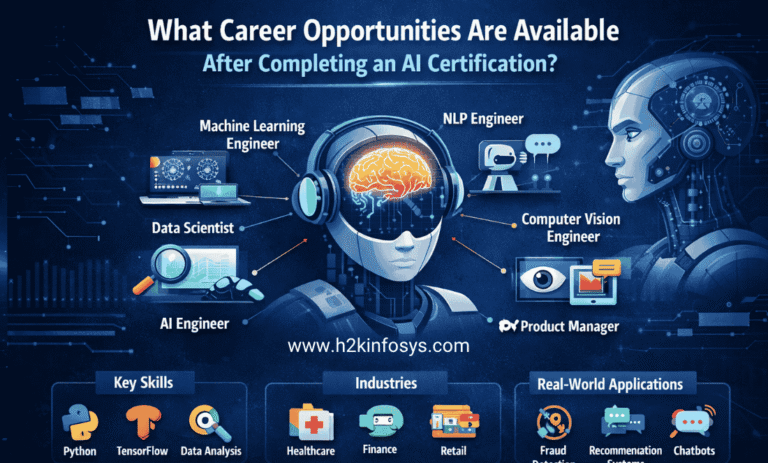
Artificial Intelligence (AI) certification, including programs offered by H2K Infosys, prepares professionals for a wide range of technical and business-oriented roles that involve designing, deploying, and managing intelligent systems. These roles span across data science, machine learning engineering, automation, analytics, and AI driven application development. With the growth of Ai Training Online professionals can transition into AI-focused careers or enhance their existing IT roles with AI capabilities.
What is AI Certification?
AI certification is a structured learning program that validates a professional’s knowledge of artificial intelligence concepts, tools, and practical applications. It typically covers:
- Machine learning algorithms
- Deep learning fundamentals
- Natural language processing (NLP)
- Computer vision
- Data preprocessing and model evaluation
These certifications are often delivered through Online Ai Certification Courses, allowing working professionals to learn at their own pace while applying concepts in real-world scenarios.
Why is AI Certification Important for Working Professionals?
AI is increasingly integrated into enterprise systems, from automation pipelines to customer analytics platforms. For working professionals, AI certification provides:
- Skill relevance: Aligns with evolving IT and data-driven job roles
- Career transition support: Enables movement into AI and data science domains
- Practical exposure: Hands-on experience with tools like Python, TensorFlow, and cloud AI services
- Cross-functional value: Applicable in DevOps, QA, business analysis, and more
Organizations commonly expect professionals to understand how AI models interact with production systems, data pipelines, and APIs.
How Does AI Work in Real-World IT Projects?
In enterprise environments, AI systems are not standalone models but part of larger workflows.
Typical AI Workflow in Production
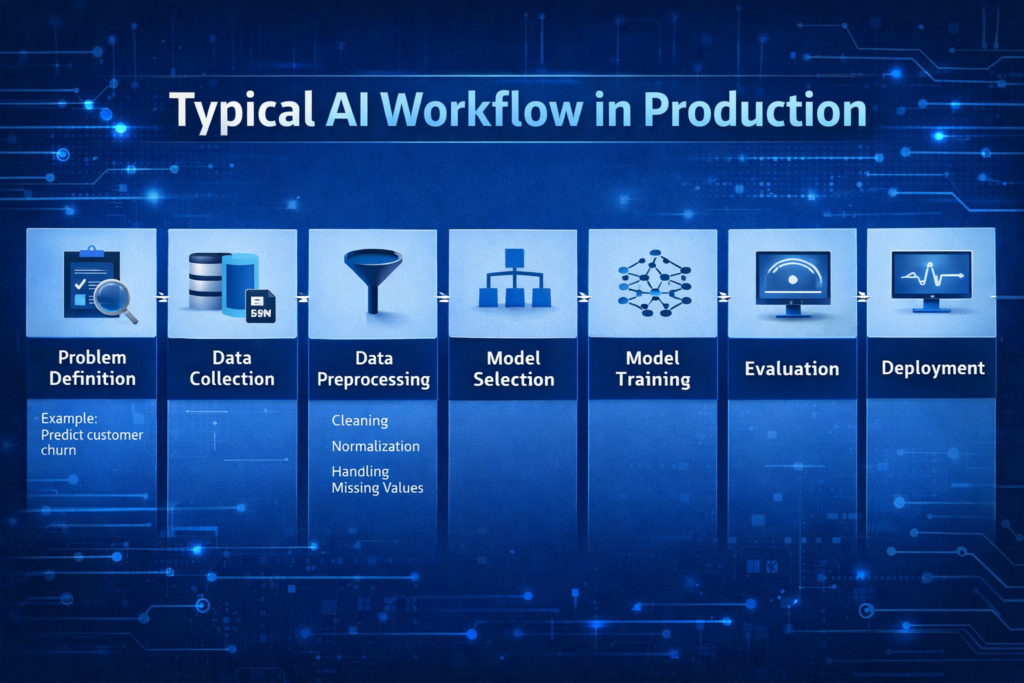
- Data Collection
- Sources: databases, APIs, logs, IoT devices
- Data Preprocessing
- Cleaning, normalization, feature engineering
- Model Development
- Using frameworks like:
- TensorFlow
- PyTorch
- Scikit-learn
- Using frameworks like:
- Model Evaluation
- Accuracy, precision, recall, F1-score
- Deployment
- REST APIs or microservices
- Cloud platforms (AWS, Azure, GCP)
- Monitoring & Maintenance
- Performance tracking
- Model retraining
Example Scenario
A retail company uses AI to recommend products:
- Data engineers prepare transaction data
- ML engineers build recommendation models
- DevOps teams deploy models into APIs
- Business teams analyze outcomes
What Skills Are Required to Learn AI?
To successfully complete ai training online, professionals need a combination of technical and analytical skills.
Core Skills
| Skill Area | Description |
|---|---|
| Programming | Python, R |
| Mathematics | Linear algebra, probability, statistics |
| Data Handling | Pandas, NumPy |
| Machine Learning | Regression, classification, clustering |
| Deep Learning | Neural networks, CNNs, RNNs |
| Tools & Frameworks | TensorFlow, PyTorch, Scikit-learn |
| Cloud Platforms | AWS SageMaker, Azure ML |
Supporting Skills
- SQL for data querying
- Data visualization (Power BI, Tableau)
- Version control (Git)
- API integration
How is AI Used in Enterprise Environments?
AI is integrated into various enterprise systems to improve efficiency, decision-making, and automation.
Common Use Cases
- Fraud detection in banking systems
- Predictive maintenance in manufacturing
- Customer segmentation in marketing
- Chatbots and virtual assistants in customer support
- Document processing automation using NLP
Enterprise Considerations
- Data privacy and compliance (GDPR, HIPAA)
- Scalability of models
- Integration with existing systems
- Model explainability
What Job Roles Use AI Daily?
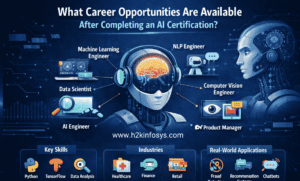
After completing online ai certification courses, professionals can pursue multiple roles depending on their background and specialization.
Core AI Job Roles
| Role | Responsibilities | Tools Used |
|---|---|---|
| Machine Learning Engineer | Build and deploy ML models | TensorFlow, PyTorch |
| Data Scientist | Analyze data and create predictive models | Python, R |
| AI Engineer | Develop AI-based applications | Python, APIs |
| Data Analyst (AI-focused) | Interpret AI outputs | SQL, Tableau |
| NLP Engineer | Work on text-based AI systems | SpaCy, NLTK |
| Computer Vision Engineer | Image and video processing | OpenCV |
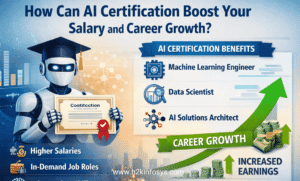
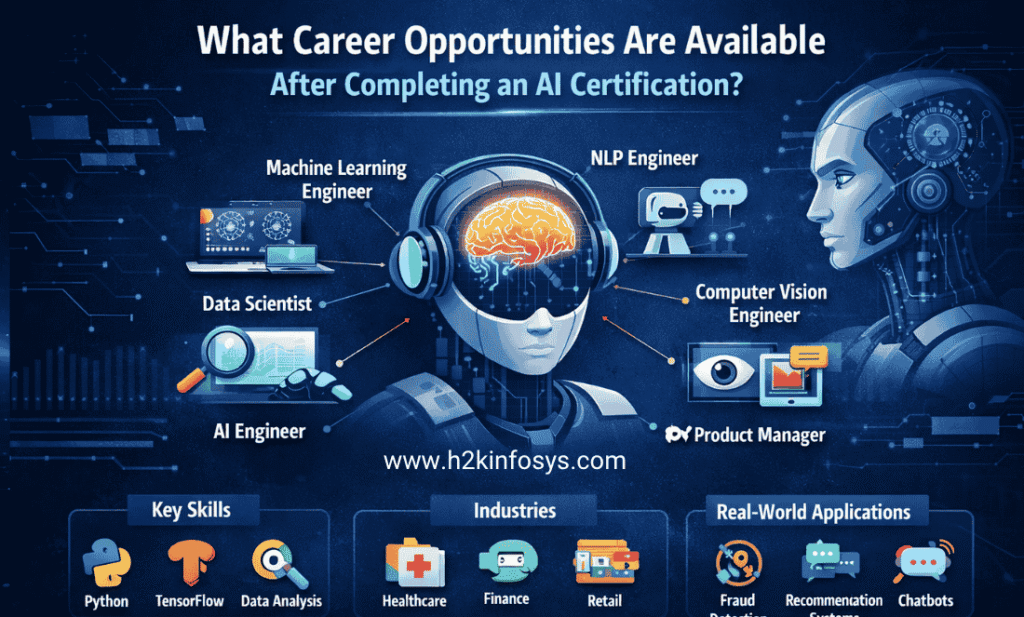
What Careers Are Possible After Learning AI?
AI certification opens multiple career paths across industries.
1. Machine Learning Engineer
Focuses on:
- Model development
- Model optimization
- Deployment pipelines
Common in:
- Tech companies
- E-commerce platforms
2. Data Scientist
Responsibilities:
- Data analysis
- Predictive modeling
- Business insights
Often works with:
- Business stakeholders
- Data engineering teams
3. AI Engineer
Works on:
- AI-powered applications
- Integration of AI into software systems
Example:
- Chatbots
- Recommendation engines
4. Business Intelligence Analyst (AI-Enhanced)
Uses AI outputs for:
- Reporting
- Decision-making
Tools:
- Power BI
- Tableau
5. NLP Engineer
Specializes in:
- Text processing
- Sentiment analysis
- Chatbot development
6. Computer Vision Engineer
Works with:
- Image recognition
- Video analytics
Used in:
- Healthcare imaging
- Autonomous vehicles
7. AI Product Manager
Combines:
- Technical understanding
- Business strategy
Responsibilities:
- Define AI product roadmap
- Coordinate with technical teams
Role vs Skill Mapping
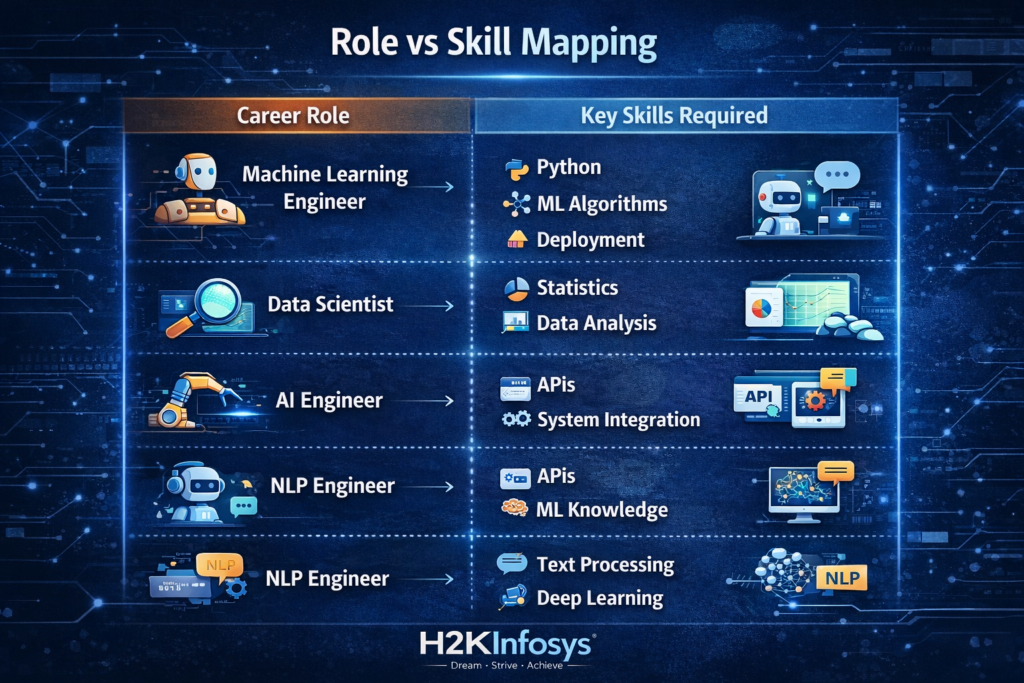
| Career Role | Key Skills Required |
|---|---|
| ML Engineer | Python, ML algorithms, deployment |
| Data Scientist | Statistics, data analysis, visualization |
| AI Engineer | APIs, system integration, ML |
| NLP Engineer | Text processing, deep learning |
| BI Analyst | Reporting tools, SQL, analytics |
Learning Path for AI Certification
Step-by-Step Path
- Learn Python basics
- Understand statistics and probability
- Study machine learning concepts
- Practice with datasets
- Learn deep learning frameworks
- Work on real-world projects
- Deploy models using cloud platforms
Common Challenges Professionals Face
- Understanding mathematical foundations
- Handling large datasets
- Model overfitting and underfitting
- Deployment complexities
- Integrating AI into legacy systems
Best Practices
- Start with small datasets
- Use pre-built libraries
- Focus on problem-solving, not just tools
- Practice model evaluation techniques
Tools Commonly Used in AI Careers
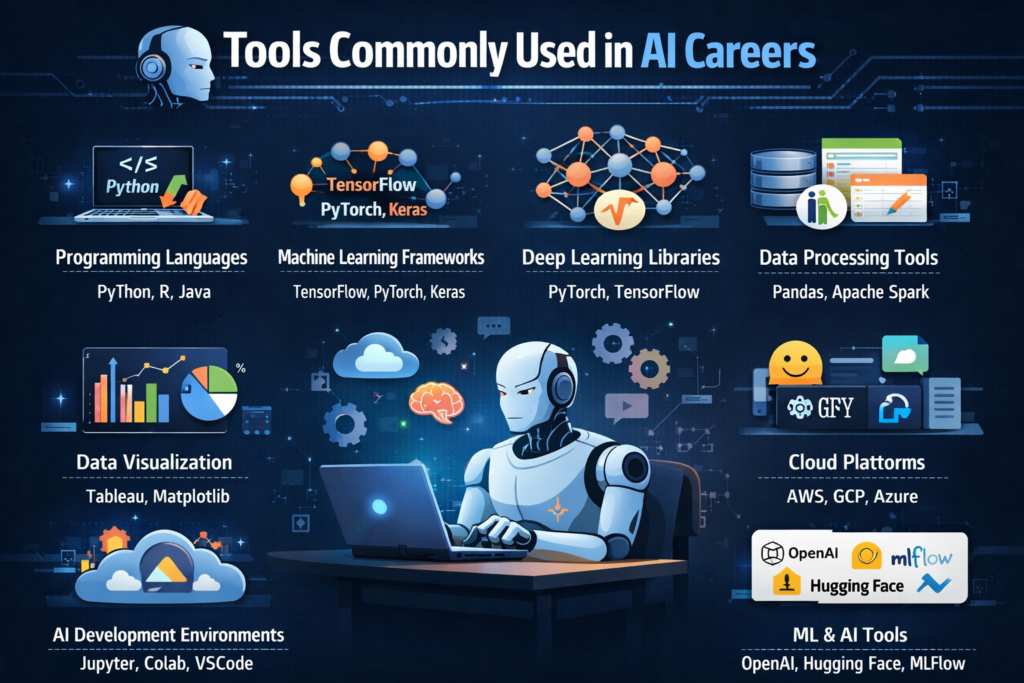
| Category | Tools |
|---|---|
| Programming | Python, R |
| ML Frameworks | TensorFlow, PyTorch |
| Data Tools | Pandas, NumPy |
| Visualization | Tableau, Power BI |
| Cloud | AWS, Azure, GCP |
| Version Control | Git |
Real-World Project Examples
Example 1: Fraud Detection System
- Input: Transaction data
- Process: ML classification model
- Output: Fraud risk score
Example 2: Recommendation System
- Input: User behavior
- Process: Collaborative filtering
- Output: Product suggestions
Example 3: Chatbot System
- Input: User queries
- Process: NLP model
- Output: Automated responses
Frequently Asked Questions (FAQ)
What jobs can I get after AI certification?
You can pursue roles such as machine learning engineer, data scientist, AI engineer, NLP engineer, or BI analyst depending on your skills and experience.
Is AI certification enough to get a job?
Certification provides foundational knowledge, but practical project experience and tool proficiency are typically required for job readiness.
How long does it take to learn AI?
For working professionals, it usually takes 3–6 months of consistent learning through ai training online programs.
Do I need coding skills for AI?
Yes, programming (especially Python) is essential for implementing AI models and working with data.
Which industries hire AI professionals?
Key Takeaways
- AI certification enables careers in machine learning, data science, and AI engineering
- Enterprise AI involves data pipelines, model deployment, and monitoring
- Hands-on skills with tools like Python and TensorFlow are essential
- AI roles exist across multiple industries and domains
- Practical experience is critical alongside certification
Advance your career with structured, hands-on AI learning designed for real-world applications.
Explore H2K Infosys courses to build practical skills and prepare for AI-driven roles.