Beginners face multiple technical, educational, and practical challenges when entering artificial intelligence (AI) careers, including gaps in foundational knowledge, lack of hands on project experience, understanding complex tools, and navigating unclear learning paths. Artificial intelligence requires a combination of programming, mathematics, data handling, and system design skills, which can be difficult to acquire without structured learning and real-world practice. Many learners pursue structured Machine learning Training Courses to build these competencies systematically and align their skills with industry expectations.
What Is Artificial Intelligence (AI)?
Artificial intelligence is a branch of computer science that focuses on building systems capable of performing tasks that typically require human intelligence. These tasks include pattern recognition, decision-making, language understanding, and prediction.
AI systems use algorithms and data to learn patterns and make predictions or automate decisions. AI includes several subfields:
| Subfield | Description | Example Use Case |
|---|---|---|
| Machine Learning (ML) | Algorithms that learn from data | Fraud detection systems |
| Deep Learning | Neural network-based learning | Image recognition |
| Natural Language Processing (NLP) | Understanding human language | Chatbots, document analysis |
| Computer Vision | Processing visual data | Facial recognition |
| Reinforcement Learning | Learning via trial and error | Robotics, game AI |
In enterprise environments, AI is typically integrated into business workflows rather than operating independently.
Why Is Artificial Intelligence Important for Working Professionals?
AI is commonly used across industries to automate repetitive tasks, improve decision-making, and extract insights from large datasets. Professionals with AI skills help organizations build predictive models, automate workflows, and enhance operational efficiency.
Common enterprise use cases include:
- Customer churn prediction in telecom
- Fraud detection in banking
- Predictive maintenance in manufacturing
- Recommendation systems in e-commerce
- Automated document processing in insurance
AI is often implemented using structured pipelines involving data ingestion, preprocessing, model training, deployment, and monitoring.
What Challenges Do Beginners Face When Entering AI Careers?
1. Lack of Strong Programming Foundations
Programming is essential for implementing AI models. Python is the most commonly used language in AI due to its extensive ecosystem.
Common beginner challenges include:
- Understanding syntax and logic
- Working with libraries such as:
- NumPy
- Pandas
- Scikit-learn
- TensorFlow
- PyTorch
- Writing clean, modular code
Example beginner task in AI workflow:
import pandas as pd
from sklearn.linear_model import LinearRegressiondata = pd.read_csv("sales_data.csv")
model = LinearRegression()
model.fit(data[['marketing_spend']], data['sales'])
Beginners often struggle to understand how code connects to real-world business problems.
2. Difficulty Understanding Mathematical Concepts
AI relies heavily on mathematics, particularly:
- Linear algebra
- Probability
- Statistics
- Calculus (basic understanding)
These concepts support key operations such as:
- Model optimization
- Gradient descent
- Feature transformation
Example concept:
Gradient descent adjusts model parameters to minimize prediction error.
Beginners frequently encounter difficulty interpreting mathematical notation and connecting theory to implementation.
3. Lack of Structured Learning Path
AI is a broad field. Beginners often do not know where to start.
Typical confusion areas:
- Should they learn Python first?
- When to learn machine learning algorithms?
- When to learn deep learning?
- When to focus on projects?
A structured learning path usually includes:
| Stage | Focus |
|---|---|
| Stage 1 | Programming fundamentals |
| Stage 2 | Data analysis |
| Stage 3 | Machine learning algorithms |
| Stage 4 | Model deployment |
| Stage 5 | Real-world projects |
Many professionals use Artificial Intelligence Certification Online programs to follow structured progression.
4. Limited Hands-On Experience
Employers expect candidates to demonstrate practical experience, not just theoretical knowledge.
Common beginner gaps:
- No real datasets experience
- No model deployment experience
- No GitHub project portfolio
- No experience working with enterprise tools
Typical enterprise project workflow:
- Collect data from databases
- Clean and preprocess data
- Train machine learning models
- Evaluate model performance
- Deploy models into production
Beginners often only learn theory without implementing full workflows.
5. Understanding Industry Tools and Frameworks
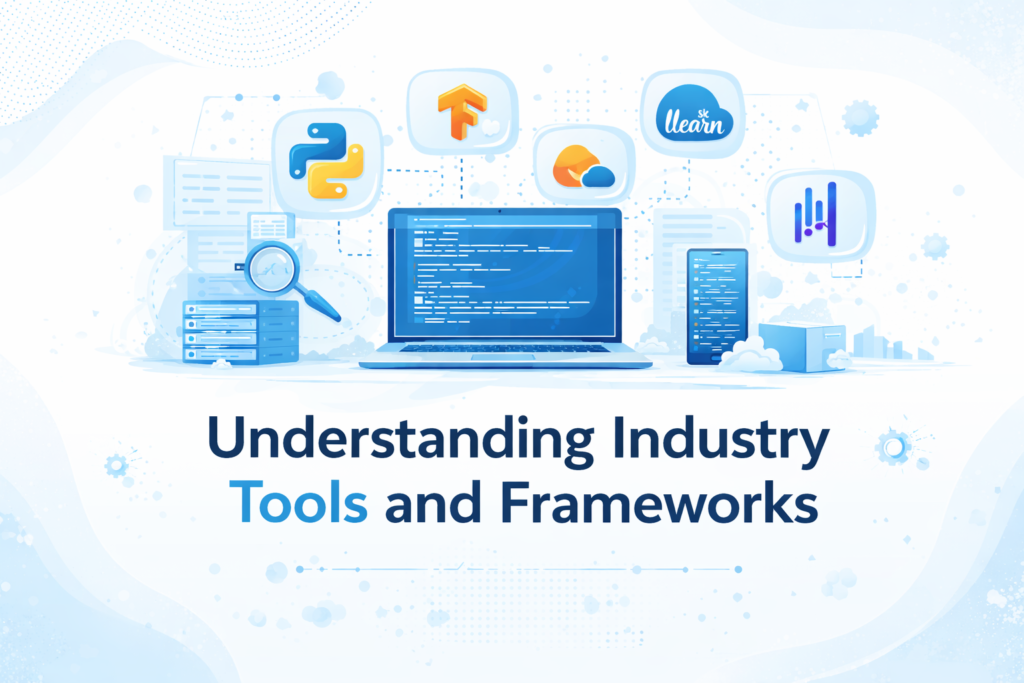
AI professionals use specialized tools in real environments.
Common tools include:
| Tool | Purpose |
|---|---|
| Python | Programming |
| Pandas | Data manipulation |
| Scikit-learn | Machine learning |
| TensorFlow | Deep learning |
| PyTorch | Neural networks |
| Jupyter Notebook | Experimentation |
| Git | Version control |
| Docker | Model deployment |
| AWS / Azure | Cloud-based AI |
Beginners may not understand:
- When to use which tool
- How tools integrate
- How tools are used in production systems
6. Lack of Real-World Problem Understanding
Enterprise AI focuses on solving business problems, not just building models.
Example business problem:
Predict customer churn.
AI workflow:
- Extract customer usage data
- Train classification model
- Predict which customers may leave
- Alert business teams
Beginners often focus on algorithms rather than problem-solving.
7. Difficulty Understanding Machine Learning Algorithms
Common algorithms include:
- Linear regression
- Logistic regression
- Decision trees
- Random forests
- Neural networks
Beginners often struggle with:
- When to use each algorithm
- Model tuning
- Model evaluation metrics
Example evaluation metrics:
| Metric | Purpose |
|---|---|
| Accuracy | Overall correctness |
| Precision | Correct positive predictions |
| Recall | Coverage of actual positives |
| F1-score | Balance between precision and recall |
8. Lack of Deployment Knowledge
In real enterprise environments, AI models must be deployed.
Deployment involves:
- Saving trained models
- Creating APIs
- Integrating with applications
Example workflow:
Train model → Save model → Deploy API → Application uses model
Tools used:
- Flask
- FastAPI
- Docker
- Kubernetes
Beginners often only train models but do not deploy them.
9. Managing Large Datasets
Real-world datasets are large and complex.
Beginners face challenges in:
- Data cleaning
- Missing values
- Data normalization
- Feature engineering
Example preprocessing steps:
- Remove duplicate data
- Handle missing values
- Convert categorical variables
- Scale numeric features
10. Lack of Industry Exposure
Many beginners do not understand how AI fits into enterprise systems.
Typical enterprise AI architecture:
Data source → Data pipeline → Model training → Deployment → Monitoring
Beginners benefit from machine learning training courses that include enterprise workflows.
How Does Artificial Intelligence Work in Real-World IT Projects?
Enterprise AI projects follow structured workflows.
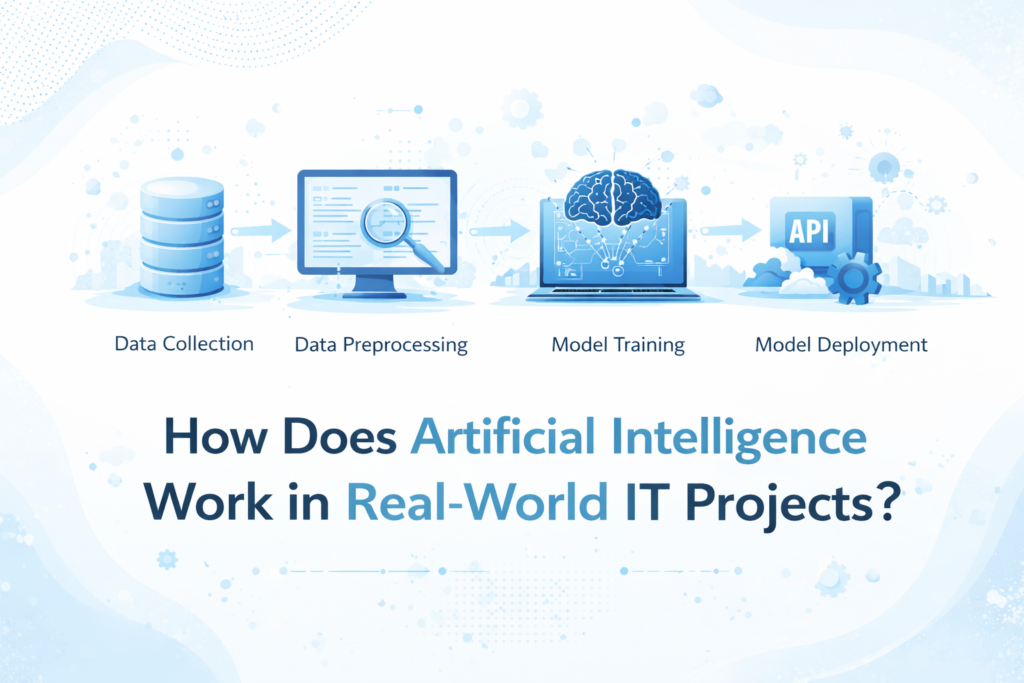
Step 1: Data Collection
Data sources include:
- Databases
- APIs
- Sensors
- Logs
Example:
Customer purchase data from SQL database.
Step 2: Data Preprocessing
Tasks include:
- Cleaning
- Feature engineering
- Data transformation
Tool example:
Pandas
Step 3: Model Training
Algorithm example:
Random forest classifier.
Tool example:
Scikit-learn
Step 4: Model Evaluation
Metrics example:
- Accuracy
- Precision
- Recall
Step 5: Model Deployment
Deployment tools:
- Flask API
- Docker container
- Cloud platforms
Step 6: Monitoring and Maintenance
Teams monitor:
- Model accuracy
- Data drift
- Performance
How Is AI Used in Enterprise Environments?
AI is integrated into enterprise systems to automate and improve processes.
Examples include:
Banking
- Fraud detection
- Risk assessment
Healthcare
- Disease prediction
- Medical imaging analysis
Retail
- Recommendation engines
- Inventory forecasting
IT Operations
- Log anomaly detection
- Predictive maintenance
What Skills Are Required to Learn AI?
AI careers require multiple technical skills.
Programming Skills
Languages:
- Python
- SQL
Data Skills
- Data cleaning
- Data analysis
Machine Learning Skills
- Model training
- Model evaluation
Tools Skills
- TensorFlow
- Scikit-learn
- Pandas
Deployment Skills
- APIs
- Docker
- Cloud platforms
Role vs Skill Mapping in AI Careers
| Job Role | Required Skills |
|---|---|
| AI Engineer | Python, TensorFlow, deployment |
| Machine Learning Engineer | ML algorithms, data pipelines |
| Data Scientist | Statistics, ML, visualization |
| AI Developer | Programming, integration |
| AI Analyst | Data analysis, model interpretation |
How Is Machine Learning Training Applied in Real Projects?
Example real-world workflow:
Scenario: Predict Customer Churn
Step 1: Load data
data = pd.read_csv("customer_data.csv")Step 2: Preprocess data
data.fillna(0, inplace=True)
Step 3: Train model
from sklearn.ensemble import RandomForestClassifier
model = RandomForestClassifier()
model.fit(X_train, y_train)
Step 4: Evaluate
model.score(X_test, y_test)
Step 5: Deploy
Expose model via API.
How Is Artificial Intelligence Certification Online Helpful for Beginners?
Structured certification programs help beginners overcome learning challenges by providing:
- Structured curriculum
- Hands-on labs
- Real-world projects
- Tool experience
- Mentorship
These programs typically include:
| Module | Topics |
|---|---|
| Programming | Python |
| Data analysis | Pandas, NumPy |
| Machine learning | Algorithms |
| Deep learning | Neural networks |
| Deployment | APIs, cloud |
What Careers Are Possible After Learning Artificial Intelligence?
Common AI career paths include:
Entry-Level Roles
- Junior Data Scientist
- AI Developer
- Machine Learning Engineer (Junior)
- AI Analyst
Mid-Level Roles
- Machine Learning Engineer
- AI Engineer
- Data Scientist
Advanced Roles
- AI Architect
- Deep Learning Engineer
- AI Researcher
Enterprise AI Workflow Overview
| Stage | Tools Used |
|---|---|
| Data collection | SQL, APIs |
| Data processing | Python, Pandas |
| Model training | Scikit-learn, TensorFlow |
| Model deployment | Flask, Docker |
| Monitoring | Cloud tools |
FAQ: Artificial Intelligence Careers for Beginners
Is AI difficult to learn for beginners?
AI can be challenging because it combines programming, mathematics, and data analysis. However, structured learning and consistent practice make it manageable.
Do beginners need programming experience?
Yes. Python is essential for implementing AI models and working with data.
How long does it take to learn AI?
It typically takes 6–12 months to learn foundational AI skills with consistent study and hands-on practice.
Do beginners need mathematics knowledge?
Basic statistics and linear algebra are important for understanding machine learning models.
Are certifications useful for AI careers?
Certifications help provide structured learning and demonstrate skills to employers, especially when combined with project experience.
What industries hire AI professionals?
Industries include:
- Finance
- Healthcare
- Retail
- Technology
- Manufacturing
Key Takeaways
- Beginners face challenges in programming, mathematics, tools, and practical experience.
- Structured learning paths help overcome confusion and skill gaps.
- Enterprise AI involves data collection, model training, deployment, and monitoring.
- Hands-on projects are essential for career readiness.
- Artificial intelligence certification online and machine learning training courses help build real-world skills.
- AI careers include roles such as AI engineer, machine learning engineer, and data scientist.
Explore H2K Infosys artificial intelligence certification online and machine learning training courses to gain hands-on experience with real-world tools and enterprise workflows.
Build practical AI skills aligned with industry requirements through structured, project-based learning.