In today’s fast-changing digital economy, organizations can no longer rely on rigid plans and slow delivery cycles. Speed, adaptability, and continuous value delivery are essential. This is where an Agile Project approach becomes critical for modern software development and IT-driven initiatives.
At H2K Infosys, we train working professionals to master Agile frameworks through hands-on learning, real-time projects, and career-focused certifications. In this in-depth guide, we’ll explore what an Agile Project is, how it works, its lifecycle, and practical examples while also explaining how Agile Scrum Master skills and certifications can accelerate your career.
What Is an Agile Project?
An Agile Project is a project managed using Agile principles that emphasize iterative development, customer collaboration, flexibility, and rapid delivery of working solutions. Instead of delivering a final product at the end of a long cycle, Agile breaks work into smaller increments called iterations or sprints, each delivering measurable value.
Unlike traditional project management methods, Agile adapts to change rather than resisting it. Requirements evolve based on stakeholder feedback, market trends, and real user needs, making Agile ideal for software and technology-driven initiatives.
Why Agile Projects Matter in Modern IT
The rise of cloud computing, mobile apps, AI, and DevOps has made adaptability a competitive advantage. Companies now expect faster releases, higher quality, and better alignment with business goals. Agile meets these expectations by:
- Encouraging collaboration between business and technical teams
- Reducing risk through early and frequent delivery
- Improving transparency and accountability
- Enhancing customer satisfaction
Professionals trained in agile and scrum training programs are therefore in high demand across industries.
Agile vs Traditional Project Management
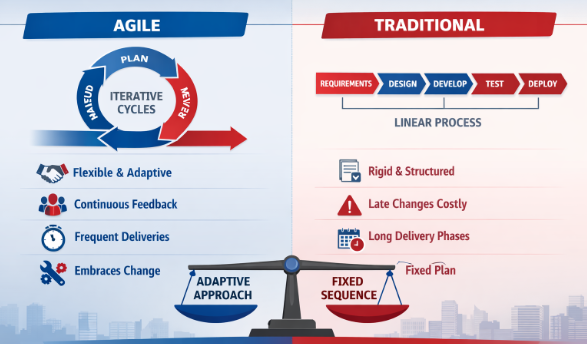
Traditional (Waterfall) project management follows a linear sequence: requirements → design → development → testing → deployment. Once a phase is completed, revisiting it is costly and time-consuming.
Agile, on the other hand, is iterative and incremental. Work is continuously planned, executed, reviewed, and improved. This flexibility makes Agile suitable for environments where change is constant.
For aspiring scrum project manager or Scrum Master roles, understanding this distinction is foundational.
Core Principles Behind Agile
Agile is rooted in the Agile Manifesto, which values:
- Individuals and interactions over processes and tools
- Working software over comprehensive documentation
- Customer collaboration over contract negotiation
- Responding to change over following a plan
These principles guide every Agile Project, ensuring that teams remain focused on delivering real value.
Popular Agile Frameworks
Agile is not a single methodology but a collection of frameworks and practices. The most widely adopted include:
Scrum
Scrum is the most popular Agile framework, structured around roles (Scrum Master, Product Owner, Development Team), events (Sprint Planning, Daily Scrum, Sprint Review, Retrospective), and artifacts (Product Backlog, Sprint Backlog, Increment).
Professionals pursuing scrum master training often start with Scrum because of its clarity and industry acceptance.
Kanban
Kanban focuses on visualizing work, limiting work in progress, and optimizing flow. It is commonly used in operations and support teams.
SAFe (Scaled Agile Framework)
SAFe is designed for large enterprises managing multiple teams working on complex products.
The Agile Project Lifecycle Explained
An Agile Project does not follow a rigid step-by-step path. Instead, it moves through a continuous cycle of planning, execution, and improvement.
1. Concept and Initiation
The project begins with a vision or business problem. Stakeholders define high-level goals, success metrics, and feasibility.
2. Product Backlog Creation
Requirements are captured as user stories in a prioritized backlog. This Product backlog evolves throughout the project based on feedback and changing needs.
3. Sprint Planning
Teams select high-priority items from the backlog and commit to delivering them in a time-boxed sprint, usually lasting 2–4 weeks.
4. Sprint Execution
Development, testing, and integration happen collaboratively. Daily stand-up meetings help track progress and remove impediments.
5. Review and Feedback
At the end of each sprint, teams demonstrate working increments to stakeholders and collect feedback.
6. Retrospective and Improvement
Teams reflect on what went well, what didn’t, and how to improve in the next sprint.
This lifecycle repeats until the product meets its objectives.
Roles in an Agile Project Team
A successful Agile initiative depends on clearly defined roles:
- Product Owner: Represents stakeholders and prioritizes the backlog
- Scrum Master: Facilitates Agile practices, removes blockers, and coaches the team
- Development Team: Cross-functional professionals who design, build, and test solutions
Our Agile Scrum Master program at H2K Infosys prepares learners to confidently step into these roles with real-world project exposure.
Tools Commonly Used in Agile Projects
Agile teams rely on modern tools to enhance collaboration and transparency, such as:
- Jira and Azure DevOps for backlog and sprint management
- Confluence for documentation
- Slack and Microsoft Teams for communication
- Git-based tools for version control
Hands-on experience with these tools is a key component of our agile software certification training approach.
Business Benefits of Agile Projects
Organizations that adopt Agile consistently report:
- Faster time-to-market
- Higher product quality
- Improved team morale
- Better alignment between IT and business
These benefits explain why Agile project management certification holders are increasingly sought after by employers worldwide.
Real-World Examples of Agile in Action
Agile methodologies are widely used across industries to deliver high-quality solutions with speed and flexibility. Below are practical scenarios that show how an Agile Project approach helps teams respond to change, manage complexity, and deliver continuous value.
- An Agile Project for developing a mobile banking application, enabling frequent feature releases and faster customer feedback
- An Agile Project in e-commerce platforms to improve checkout experiences, payment processing, and conversion rates
- SaaS product enhancement initiatives driven by iterative development and user analytics to prioritize high-impact features
- An Agile Project in healthcare software development to manage regulatory updates while maintaining system stability
- CRM customization for enterprise sales teams, allowing continuous improvement based on evolving business needs
- Cloud migration efforts executed incrementally to reduce risk and ensure seamless system transitions
- Cybersecurity monitoring solutions enhanced through frequent updates to address emerging threats
- Fintech platforms introducing digital wallet and payment integrations through iterative releases
- AI-based recommendation engines refined continuously using real-time data insights
- An Agile Project focused on DevOps pipeline optimization to improve deployment speed and system reliability
Why Scrum Masters Are Critical to Agile Success
The Scrum Master acts as a servant leader, ensuring the team follows Agile values and Scrum practices. They remove impediments, facilitate collaboration, and foster continuous improvement.
With demand rising globally, scrum master training and placement programs like those offered by H2K Infosys help professionals transition into high-growth Agile roles.
Certifications That Boost Agile Careers
Earning an Agile certification validates your skills and improves job prospects. Popular options include:
- Certified ScrumMaster (CSM)
- Professional Scrum Master (PSM)
- SAFe Scrum Master
Combining certification with hands-on learning through Agile certification programs significantly increases employability.
How H2K Infosys Prepares You for Agile Roles
At H2K Infosys, our Agile Scrum Master course is designed for real-world success:
- Live instructor-led sessions
- Industry-aligned curriculum
- Hands-on Agile projects and case studies
- Interview preparation and resume support
- Dedicated career guidance
Our learners gain both conceptual clarity and practical exposure essential for thriving as a Scrum Master or Agile leader.
Career Opportunities After Agile Training
Professionals skilled in Agile can pursue roles such as:
- Scrum Master
- Agile Coach
- Product Owner
- Project Manager
- Business Analyst
With the right scrum project manager mindset and Agile expertise, career growth is both rapid and sustainable.
Conclustion
An Agile Project approach is no longer optional it is a strategic necessity for organizations and professionals alike. By embracing Agile principles, mastering Scrum practices, and earning recognized certifications, you position yourself at the forefront of modern project management.
If you’re ready to elevate your career with industry-relevant skills, H2K Infosys’ Agile Scrum Master training delivers the knowledge, experience, and career support you need to succeed in today’s Agile-driven world.