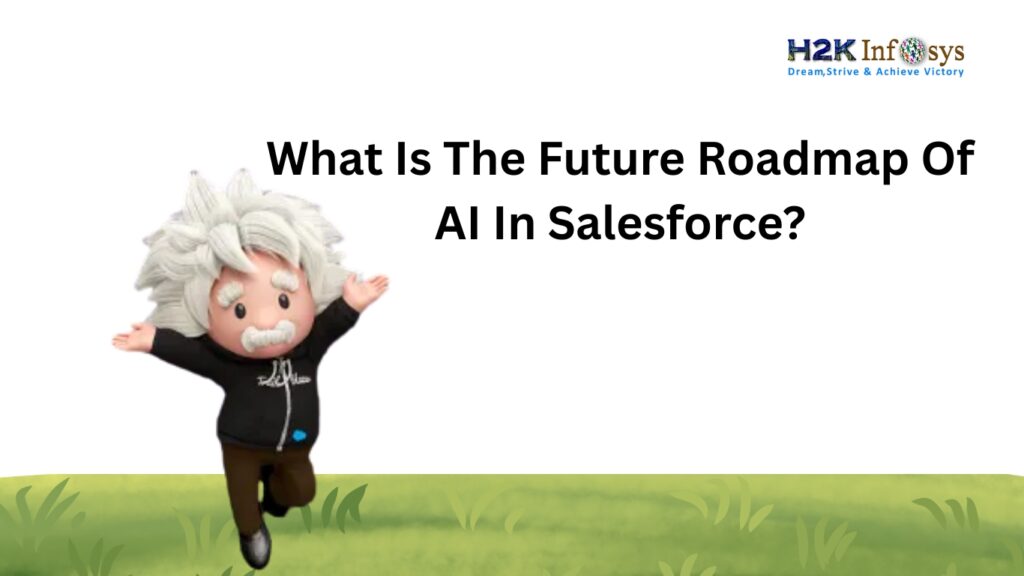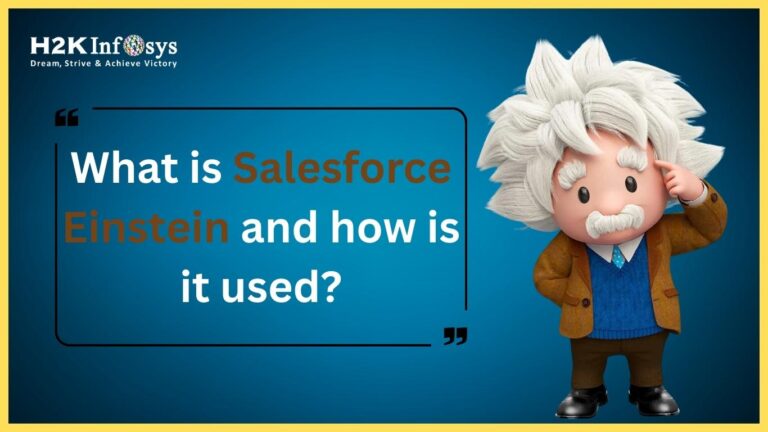
Salesforce Einstein is an AI-based tool that is built into the Salesforce system, aiming to assist companies in analyzing data, predicting outcomes, automating tasks, and making better decisions without having to be experts in the field.
So, if you’re one of those people who has ever used Salesforce before, looked at all that data, and said to yourself, “There has to be a better way to do all this,” then that’s basically what Salesforce Einstein is all about. It’s not this futuristic thing that’s just floating around somewhere, waiting to be harnessed. No, it’s very much alive, very much practical, and quite honestly, when you start using it, it’s like you’ve been doing without it this whole time.
And trust me, that’s not just something that’s easily said.
What is Salesforce Einstein?
Salesforce Einstein is basically that brain inside your Salesforce system that’s always monitoring your activity, always learning, always guiding.
Salesforce Einstein is part of that larger phenomenon that’s seen with both Salesforce and AI coming together, with CRM becoming more than just a tool that’s used to track sales, but one that’s used to make decisions.
So, instead of having to go through all that work trying to figure out what’s going on or what’s next, with Salesforce Einstein, things get done by:
- Predicting which leads are more likely to convert
- Figuring out when is the best time to contact that customer
- Scoring opportunities
- Analyzing customer sentiment
- Determining what to do next
And all this is done using your existing Salesforce data.
No complex set-up required. No building your own AI required.
Why Salesforce Einstein Matters (More Than You Thought)
So, a few years ago, CRM was basically just that tool that reacted.
Now?
Businesses demand much more.
They demand:
- Predictions, not reports
- Automation, not workflows
- Personalization, not segmentation
That is where Salesforce Einstein comes in.
In fact, when I was working with a sales manager, he said:
“Before we had Einstein, we were guessing. After we had Einstein, we were prioritizing.”
That is a big deal, especially when we are talking about hundreds, if not thousands, of leads.
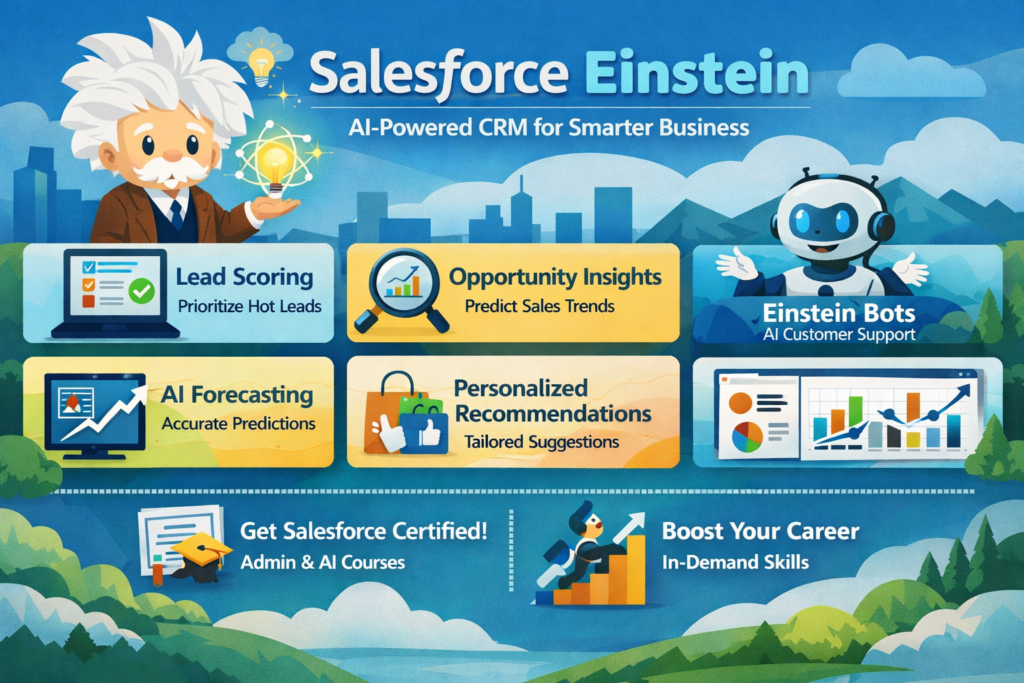
Core Features of Salesforce Einstein
Now, let us get into the nitty-gritty of what exactly is Salesforce Einstein.
Well, Salesforce Einstein is not just a feature; it is a collection of AI-related features across the entire Salesforce platform.
1. Einstein Lead Scoring
Well, this is a game-changer.
Instead of treating every lead as if it were the same, Salesforce Einstein actually scores them according to their possibility of converting.
For instance, it analyzes:
- Past successful deals
- Customer behavior
- Engagement
Therefore, the sales team is only focused on the leads that actually have a chance of converting.
Now, that alone is a productivity boost of a magnitude that is difficult to put into words.
2. Einstein Opportunity Insights
Have you ever had that feeling that things are not going right with a deal, but you just could not put your finger on it?
Well, this feature helps with that.
For instance, it analyzes:
- Email interactions
- Deal activity
- Time gaps
Therefore, instead of reacting too late, we actually get a chance to act early.
3. Einstein Forecasting
Well, forecasting is a feature that has been around, but it has been a bit of a mess.
Spreadsheets, guessing, overly optimistic forecasting, yeah, we know the drill.
Therefore, with Salesforce Einstein, forecasting is actually data-driven.
For instance, it:
- Uses historical data
- Adjusts forecasting dynamically
- Highlights anomalies
Therefore, we do not get any surprises at the end of the quarter.
4. Einstein Bots
Well, this is actually a favorite of the customer service team.
For instance, the feature actually creates AI-powered chatbots that:
- Handle basic queries
- Guide customers through processes
- Escalate complex issues
- And they work 24/7.
I’ve seen companies reduce support workload significantly just by deploying these bots properly.
5. Einstein Analytics (now part of the Tableau ecosystem)
This is where things get deeper.
Instead of dashboards, you get:
- Smart Insights
- Trend Detection
- Automated Analysis
It doesn’t just show you data it tells you what the data means.
6. Einstein Recommendation Builder
This feature allows you to personalize experiences.
For example:
- Products to customers
- Recommendations to customers
- Customized marketing communications
It’s basically how you scale up personalization without having to build a massive team.
Real-World Use Cases of Salesforce Einstein
Let’s move away from features and talk about use cases.
Because this is where things get interesting.
Sales Teams
Sales Teams use Salesforce Einstein to:
- Prioritize leads
- Predict deal success
- Reminders for follow-ups
One of the companies I worked with reduced its sales cycle by almost 20%. Not because they worked harder but because they worked smarter.
Marketing Teams
Marketing Teams use Einstein to:
- Predictive audience segmentation
- Campaign optimization
- Email scoring
Instead of sending out marketing campaigns to everyone, they target the right audience at the right time.
Customer Support
Customer Support Teams use Einstein to:
- Respond to customers faster
- Identify frustrated customers
- Improve satisfaction
And customers? Well, they notice.
E-commerce
This is where AI comes into play.
Einstein helps you:
- Recommend products
- Predict buying behavior
- Personalize experiences
If you’ve ever seen “You might also like” suggestions, yep, that’s the idea.
Salesforce Einstein and AI: The Bigger Picture
Here’s something worth thinking about.
We’re moving into a phase where Salesforce and AI aren’t optional they’re expected.
Businesses that don’t adopt AI tools like Salesforce Einstein risk falling behind.
Not dramatically overnight, but gradually quietly until competitors start outperforming them.
And with recent advancements in generative AI (especially after 2023–2025), Salesforce has been integrating even more intelligence into Einstein, like AI-generated content, automated summaries, and smarter workflows.
Learning Salesforce Einstein (Where to Start)
If you’re thinking, “Okay, this sounds useful… but how do I actually learn it?” you’re not alone.
The good news? You don’t need to be a data scientist.
Most people start with:
- Salesforce training certification programs
- Hands-on practice in sandbox environments
- Real-world project simulations
Some platforms go deeper into practical learning like H2kinfosys, which many learners use to bridge the gap between theory and actual implementation.
And honestly, that practical exposure makes a huge difference.
Salesforce Certification Courses and Einstein
Here’s something people often overlook:
You don’t need a separate certification just for Einstein (at least not always).
Instead, Einstein’s concepts are integrated into:
- Salesforce certification courses
- Admin-level certifications
- Advanced developer tracks
If you’re starting, the Salesforce administrator certification course is usually the best entry point.
It covers:
- Core Salesforce concepts
- Data management
- Basic AI features (including Einstein)
Once you’re comfortable, you can move into more specialized roles.
Skills You’ll Actually Need
Let’s be real for a second.
You don’t need hardcore AI skills to use Salesforce Einstein effectively.
What you do need:
- Basic understanding of Salesforce
- Data interpretation skills
- Business thinking (this is underrated)
- Curiosity to experiment
Because Einstein gives insights, but you still decide what to do with them.
Challenges (Because It’s Not All Perfect)
Okay, quick reality check.
Salesforce Einstein is an incredibly powerful tool, but it’s not magic.
Some challenges I’ve encountered:
- Poor quality data = poor quality predictions
- Over-reliance on the power of AI without the power of human judgment
- Initial learning curve for new users
- So yeah, it’s not plug and play, perfect out of the box.
But once it’s set up correctly, it’s incredibly effective.
A Small Personal Observation
I once worked with a team that was resistant to the idea of using AI tools.
They thought it would replace them.
What it did was remove the drudgery of analyzing spreadsheets.
They got to spend more time engaging with customers.
And that, in turn, made their jobs more interesting, not less.
The Future of Salesforce Einstein
Looking to the future, Salesforce Einstein is only getting smarter.
We’re already seeing:
- Generative AI integration
- Real-time decision-making
- Deeper automation
Salesforce is heavily investing in AI, and Salesforce Einstein is right in the middle of that.
So, if you’re learning Salesforce today, you’re also, whether you realize it or not, learning AI.
Final Thoughts
If I had to summarize it all in simple terms:
Salesforce Einstein makes Salesforce no longer just a data storage tool, but a decision-making tool.
It helps teams:
- Work faster
- Make smarter decisions
- Deliver better customer experiences
And the best part? You don’t need to be an AI expert to use it.
If you’re thinking of getting Salesforce training certification or taking a Salesforce administrator certification course, well, it’s actually an interesting time.
AI is no longer just a nice-to-have skill but is becoming an everyday skill.
And tools like Salesforce Einstein are at the forefront of that.