Java is an object-oriented programming language built around concepts such as classes, objects, inheritance, polymorphism, and method invocation. Two important mechanisms that influence how Java executes method calls are static binding and dynamic Binding in Java. Understanding these concepts is essential for developers who want to strengthen their Java programming skills. H2K Infosys offers comprehensive Java online Training designed to help learners master core Java, object-oriented programming, advanced Java concepts, and practical application development.
Binding in Java refers to the process of connecting a method call with the actual method implementation that should execute. Depending on when this connection is established, Binding in Java can be classified as either static or dynamic.
Static Binding in Java occurs during compilation, while dynamic binding occurs at runtime. This distinction affects method overloading, method overriding, performance, polymorphism, and the overall design of Java applications.
This article explains static binding and dynamic Binding in Java their differences, practical examples, advantages, limitations, and common use cases.
What Is Binding in Java?
In Java, Binding in Java is the process of associating a method, variable, or constructor call with its corresponding declaration or implementation.
Consider the following method call:
object.display();Before Binding in Java can execute this statement, it must determine which display() method should be called. The answer may be determined either during compilation or while the program is running.
The timing of this decision creates two types of binding:
- Static binding, also called early binding or compile-time binding
- Dynamic binding, also called late binding or runtime binding
The key question is simple: When does Java decide which method implementation to execute?
What Is Static Binding in Java?
Static binding occurs when the Binding in Java compiler determines the method or member to be called during compilation.
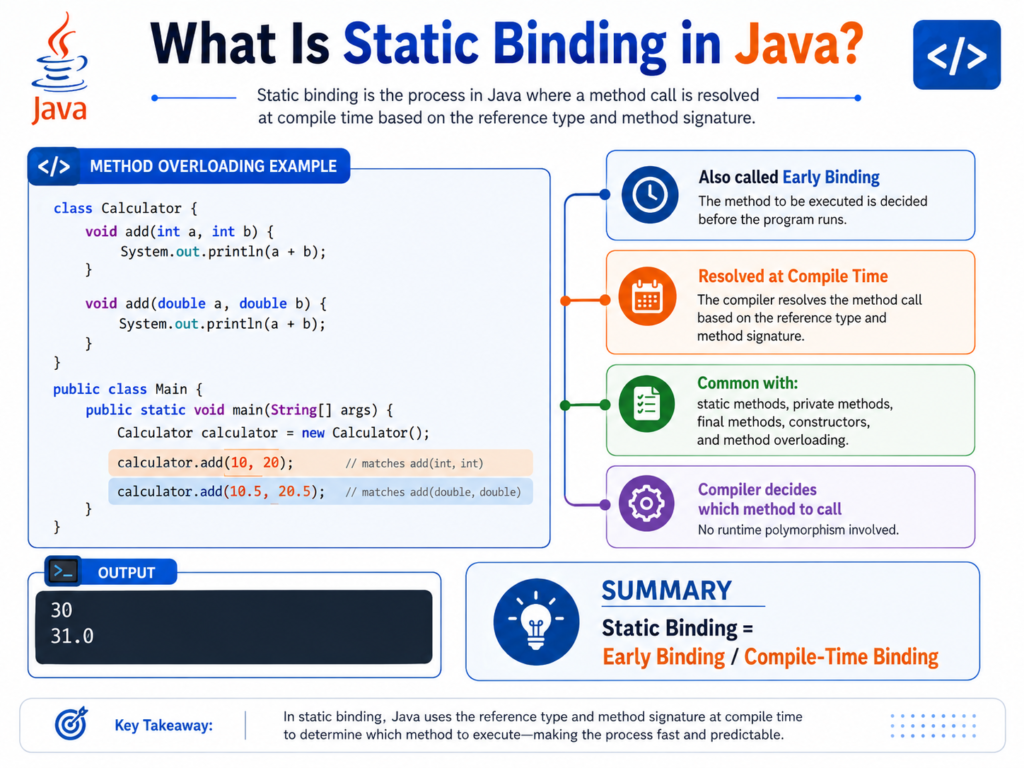
Because the binding decision is made before the program runs, static binding is also known as:
- Early binding
- Compile-time binding
- Compile-time polymorphism
Static binding is generally used for:
- Static methods
- Final methods
- Private methods
- Constructors
- Method overloading
- Instance variables
These members cannot participate in runtime method overriding in the same way as ordinary instance methods. Therefore, the compiler can identify the correct target in advance.
Static Binding Example
Consider the following example:
class Calculator {

    void add(int a, int b) {
        System.out.println(a + b);
    }

    void add(double a, double b) {
        System.out.println(a + b);
    }
}

public class Main {

    public static void main(String[] args) {
        Calculator calculator = new Calculator();

        calculator.add(10, 20);
        calculator.add(10.5, 20.5);
    }
}
Output:
30
31.0
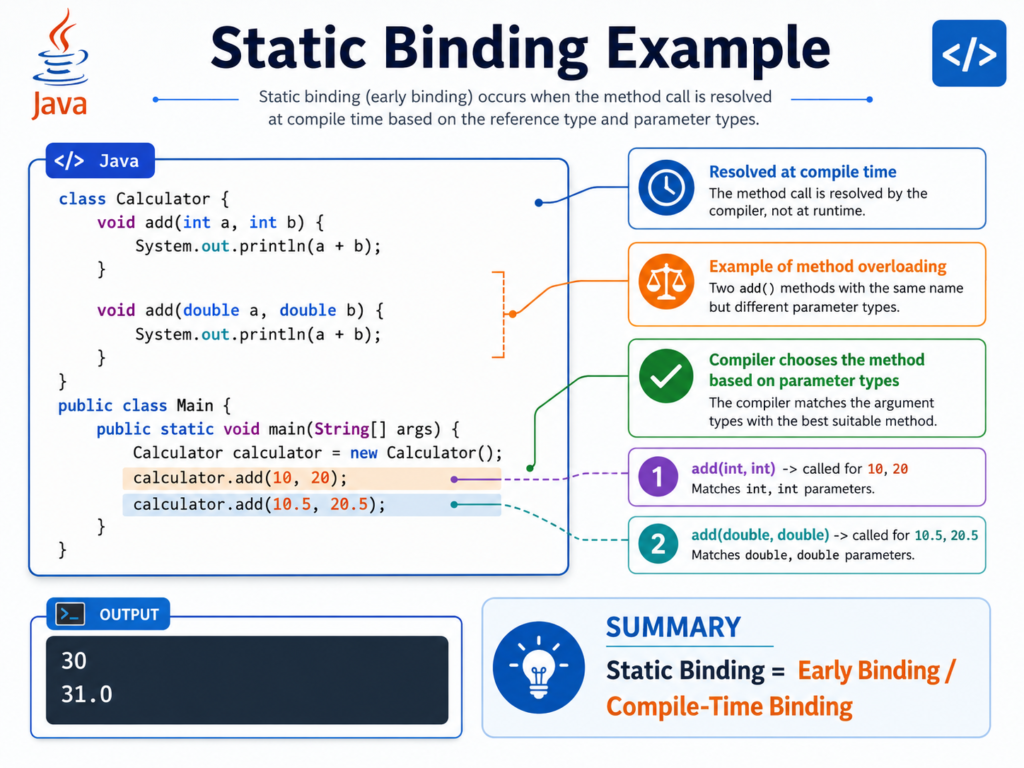
The Calculator class contains two methods with the same name but different parameter types. This is method overloading.
When the compiler encounters:
calculator.add(10, 20);it identifies the version that accepts two integer arguments.
For this call:
calculator.add(10.5, 20.5);the compiler selects the method that accepts two double arguments.
The method selection is completed during compilation, so this is static binding.
Static Methods and Static Binding
Static methods are associated with a class rather than an individual object. Their method calls are resolved using the reference type.
class Parent {

    static void show() {
        System.out.println("Parent static method");
    }
}

class Child extends Parent {

    static void show() {
        System.out.println("Child static method");
    }
}

public class Main {

    public static void main(String[] args) {
        Parent reference = new Child();
        reference.show();
    }
}
Output:
Parent static methodAlthough the object is created from the Child class, the reference type is Parent. Because show() is static, Java resolves the call using the reference type during compilation.
The child method does not override the parent method. Instead, it hides it. This behavior is called method hiding.
Calling static methods with the class name is clearer:
Parent.show();
Child.show();
Private and Final Methods
Private methods use static binding because they are not inherited by subclasses and therefore cannot be overridden.
class Example {

    private void printMessage() {
        System.out.println("Private method");
    }
}
Final methods also use static binding because the final keyword prevents subclasses from overriding them.
class Parent {

    final void display() {
        System.out.println("Final method");
    }
}
Since Java knows that no subclass can replace the method implementation, the method target can be resolved early.
What Is Dynamic Binding in Java?
Dynamic Binding in Java occurs when the method implementation is selected at runtime rather than during compilation.
It is also known as:
- Late binding
- Runtime binding
- Runtime polymorphism
- Dynamic method dispatch
Dynamic binding is primarily associated with method overriding.
When a parent-class reference points to a child-class object, Binding in Java determines the overridden method to execute based on the actual object type.
Dynamic Binding in Java Example
Consider this example:
class Animal {

    void makeSound() {
        System.out.println("Animal makes a sound");
    }
}

class Dog extends Animal {

    @Override
    void makeSound() {
        System.out.println("Dog barks");
    }
}

public class Main {

    public static void main(String[] args) {
        Animal animal = new Dog();
        animal.makeSound();
    }
}
Output:
Dog barksThe reference variable is declared as Animal, but the actual object is an instance of Dog.
During compilation, the compiler verifies that makeSound() exists in the Animal class. However, it does not permanently bind the call to Animal.makeSound().
At runtime, the Binding in Java checks the actual object type. Since the object is a Dog, it executes Dog.makeSound().
This is dynamic binding.
Dynamic Binding in Java and Runtime Polymorphism
Dynamic binding enables runtime polymorphism, which allows one reference type to represent objects of multiple subclasses.
class Payment {

    void process() {
        System.out.println("Processing payment");
    }
}

class CreditCardPayment extends Payment {

    @Override
    void process() {
        System.out.println("Processing credit card payment");
    }
}

class UpiPayment extends Payment {

    @Override
    void process() {
        System.out.println("Processing UPI payment");
    }
}

public class Main {

    public static void main(String[] args) {
        Payment payment;

        payment = new CreditCardPayment();
        payment.process();

        payment = new UpiPayment();
        payment.process();
    }
}
Output:
Processing credit card payment
Processing UPI payment
The same Payment reference invokes different implementations depending on the object assigned to it.
This design makes applications more flexible because new payment types can be introduced without rewriting the code that works with the Payment abstraction.
Static Binding vs Dynamic Binding in Java
The primary difference between static and dynamic binding is the time at which the method call is resolved.
| Basis | Static Binding | Dynamic Binding |
|---|---|---|
| Resolution time | Compile time | Runtime |
| Alternative name | Early binding | Late binding |
| Polymorphism type | Compile-time polymorphism | Runtime polymorphism |
| Commonly used with | Overloading, static, private, and final methods | Overridden instance methods |
| Method selection depends on | Reference type and method signature | Actual object type |
| Inheritance requirement | Not required | Usually required |
| Execution speed | Generally faster | May involve runtime lookup |
| Flexibility | Lower | Higher |
| Primary example | Method overloading | Method overriding |
Reference Type vs Object Type
Understanding the difference between a reference type and an object type is essential when working with dynamic binding.
Animal animal = new Dog();Here:
Animalis the reference type.Dogis the actual object type.
The reference type determines which methods are accessible during compilation. The object type determines which overridden instance method executes at runtime.
For example:
class Animal {

    void eat() {
        System.out.println("Animal eats");
    }
}

class Dog extends Animal {

    @Override
    void eat() {
        System.out.println("Dog eats");
    }

    void fetch() {
        System.out.println("Dog fetches");
    }
}
Now consider:
Animal animal = new Dog();

animal.eat();
animal.fetch();
The call to eat() is valid and executes the overridden method in Dog.
However, the call to fetch() causes a compile-time error because fetch() is not declared in the Animal reference type.
To access it, explicit casting is required:
((Dog) animal).fetch();This example demonstrates that dynamic binding selects among overridden methods, but it does not make child-specific methods automatically accessible through a parent reference.
Variables Are Statically Bound
Java applies dynamic binding to overridden instance methods, but not to instance variables.
class Parent {

    String name = "Parent";
}

class Child extends Parent {

    String name = "Child";
}

public class Main {

    public static void main(String[] args) {
        Parent reference = new Child();
        System.out.println(reference.name);
    }
}
Output:
ParentThe field is selected using the reference type, not the actual object type.
Fields are hidden rather than overridden. Therefore, field access uses static binding.
If both classes define a method that returns the field value, the result changes:
class Parent {

    String name = "Parent";

    String getName() {
        return name;
    }
}

class Child extends Parent {

    String name = "Child";

    @Override
    String getName() {
        return name;
    }
}
Then:
Parent reference = new Child();

System.out.println(reference.name);
System.out.println(reference.getName());
Output:
Parent
Child
The variable access is statically bound, while the overridden method call is dynamically bound.
Method Overloading vs Method Overriding
Static and Binding in Java are closely connected to overloading and overriding.
Method Overloading
Method overloading occurs when multiple methods in the same class have the same name but different parameter lists.
void print(int value) {
}

void print(String value) {
}
The compiler selects the correct method by examining the number, type, and order of arguments. Therefore, overloading uses static binding.
Method Overriding
Method overriding occurs when a subclass provides a new implementation of an inherited instance method.
class Parent {

    void print() {
        System.out.println("Parent");
    }
}

class Child extends Parent {

    @Override
    void print() {
        System.out.println("Child");
    }
}
The Binding in Java selects the correct implementation based on the runtime object. Therefore, overriding uses dynamic binding.
Advantages of Static Binding in Java
Static binding offers several benefits.
First, method resolution happens during compilation, which can reduce runtime lookup overhead.
Second, compile-time validation helps identify incorrect method calls before execution.
Third, static Binding in Java predictable. The method selected by the compiler does not change based on the runtime object.
It is particularly appropriate for utility methods, constructors, private implementation details, and overloaded APIs.
However, static binding provides less runtime flexibility because behavior is closely tied to the declared type and method signature.
Advantages of Dynamic Binding in Java
Dynamic Binding in Java is fundamental to extensible object-oriented systems.
It allows developers to program against parent classes or interfaces rather than concrete implementations.
For example:
interface NotificationService {

    void send(String message);
}
Different classes can implement the interface:
class EmailNotification implements NotificationService {

    @Override
    public void send(String message) {
        System.out.println("Sending email: " + message);
    }
}

class SmsNotification implements NotificationService {

    @Override
    public void send(String message) {
        System.out.println("Sending SMS: " + message);
    }
}
Application code can depend on the abstraction:
void notifyUser(NotificationService service) {
    service.send("Your order has been shipped.");
}
The correct implementation is selected at runtime.
This approach supports loose coupling, dependency injection, testing, extensibility, and established design principles such as the Open/Closed Principle.
Common Misconceptions
One common misconception is that every method call involving inheritance uses dynamic binding. Static, private, and final methods do not behave like ordinary overridden instance methods.
Another misconception is that variables are dynamically bound. Java resolves fields based on the reference type.
Developers may also assume that overloading is selected using the runtime argument type. In reality, overloaded methods are selected using compile-time type information.
Consider:
class Printer {

    void print(Object value) {
        System.out.println("Object");
    }

    void print(String value) {
        System.out.println("String");
    }
}

public class Main {

    public static void main(String[] args) {
        Object value = "Java";
        Printer printer = new Printer();

        printer.print(value);
    }
}
Output:
ObjectAlthough the actual value is a String, the variable is declared as Object. The compiler therefore selects print(Object).
This confirms that method overloading uses static binding.
FAQ’S
What is static binding in Java?
Static binding is the process of linking a method call to its implementation during compilation. It is commonly used with static methods, private methods, final methods, constructors, method overloading, and instance variables.
What is dynamic binding in Java?
Dynamic binding occurs when Java determines which overridden method to execute at runtime. The decision is based on the actual object type rather than the reference variable type.
What is the main difference between static binding and dynamic Binding in Java?
The main difference is the time at which method resolution occurs. Static binding happens at compile time, while dynamic binding happens at runtime. Static binding is associated with method overloading, whereas dynamic binding is associated with method overriding.
Is method overloading static or dynamic Binding in Java?
Method overloading uses static Binding in Java because the compiler selects the appropriate method by examining the number, order, and data types of the arguments during compilation.
Why should Java learners understand static and dynamic Binding in Java?
Understanding static and dynamic Binding in Java helps learners use inheritance, polymorphism, overloading, and overriding correctly. These concepts are also important for technical interviews and students preparing through Java online training or a Java online certification program offered by training providers such as H2K Infosys.
Conclusion
Static binding and dynamic binding determine how Java connects method calls with method implementations.
Static binding occurs during compilation and is commonly associated with method overloading, static methods, private methods, final methods, constructors, and fields. The compiler determines the target using the reference type, method signature, and available declarations. Understanding static Binding in Java is also important for learners preparing for a Java online certification, as it is a fundamental concept frequently covered in Java programming courses, assessments, and technical interviews.
Binding in Java occurs at runtime and is primarily associated with method overriding. The JVM selects the implementation according to the actual object type, enabling runtime polymorphism.
The central distinction can be summarized as follows:
Static binding asks what the compiler can determine from the declared types, while dynamic Binding in Java asks which overridden method belongs to the actual runtime object.
Understanding this difference is essential for writing reliable Binding in Java programs, using inheritance correctly, designing extensible systems, and avoiding unexpected behavior involving overloaded methods, static methods, and hidden fields.