The future roadmap of AI in Salesforce is already unfolding quietly but quickly and it’s moving toward deeply embedded automation, smarter decision-making, and systems that feel less like tools and more like collaborators.
Let me say this upfront AI in Salesforce isn’t some distant “next big thing.” It’s already here, just not always obvious unless you’re actually working inside the platform day to day.
If you’ve ever used Einstein features or even explored predictive scoring, you’ve already brushed up against it. And honestly, the direction it’s heading? It’s less about flashy AI features and more about making everyday workflows feel effortless.
Somewhere between all of this exploring the Salesforce training classes offered at H2K Infosys, I remember coming to the understanding that AI is so quietly taking over some of our most mundane admin tasks. By then it had dawned on me: this is not merely an upgrade. It’s a shift in how we work. It’s a shift in how we work.
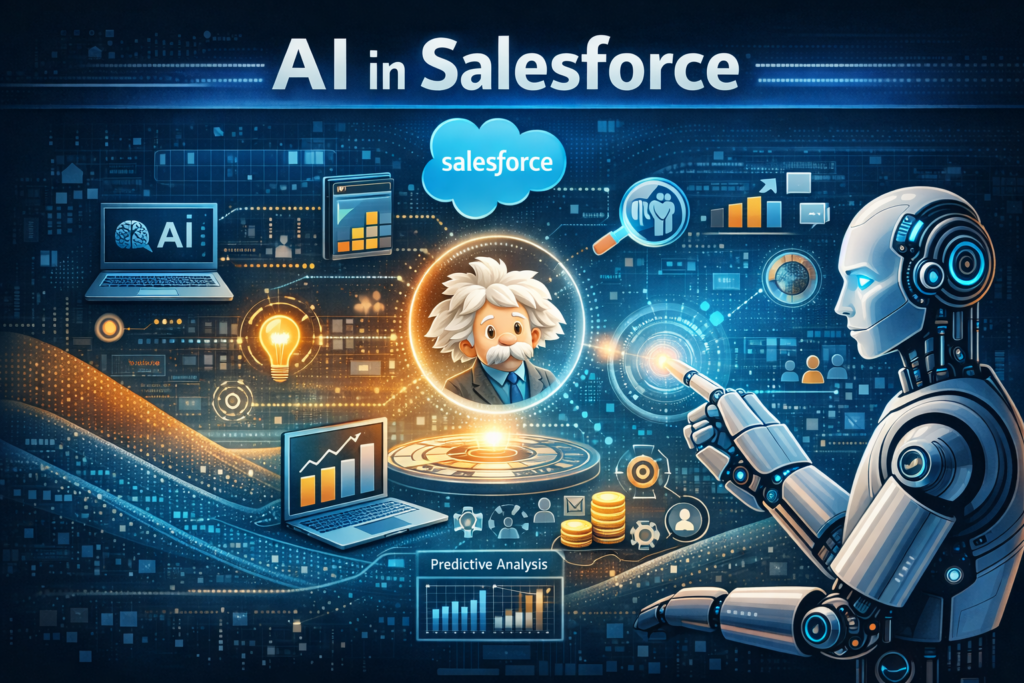
So What’s Actually Changing?
If I had to explain it simply, Salesforce is moving from being a system of record to a system of intelligence.
That’s a big deal.
Before, you logged data, ran reports, and maybe automated a few workflows. Now? The system itself starts suggesting actions, predicting outcomes, and sometimes even acting on your behalf.
And no, it’s not perfect. (Let’s not pretend it is.) But it’s getting sharper fast.
1. AI Becoming Invisible (But More Powerful)
Here’s something interesting: the more advanced AI in Salesforce becomes, the less you actually notice it.
Sounds weird, right?
But think about it. Nobody logs in thinking, “Let me use AI today.” You just want to close deals faster, respond to customers quicker, or clean up messy data.
That’s exactly where AI in Salesforce is heading it’s blending into workflows.
For example:
- Lead scoring that updates automatically based on behavior
- Email suggestions that don’t feel robotic (most of the time)
- Case routing that actually makes sense (finally)
It’s not about adding more dashboards. It’s about removing friction.
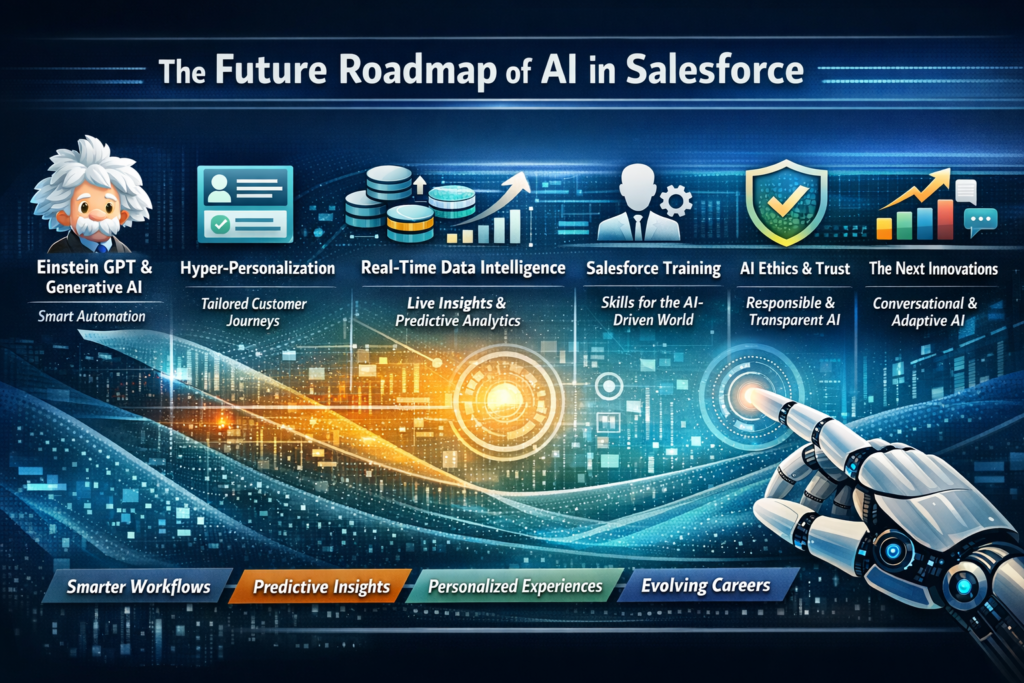
2. Generative AI Is Changing the Game
This is where things get a little more exciting.
With tools like Einstein GPT (and whatever they rename or expand next), Salesforce is pushing hard into generative AI.
And yes, this is where most people perk up.
Imagine:
- Writing sales emails in seconds
- Auto-generating case responses
- Creating reports just by typing a question
I tried this myself recently, and honestly, the first time felt a bit uncanny. Not perfect, but surprisingly usable.
Still, here’s the catch AI in Salesforce works best when you guide it properly. Garbage input still leads to… well, slightly smarter garbage.
3. Hyper-Personalization at Scale
This is one area where AI in Salesforce really shines.
Companies aren’t just segmenting customers anymore they’re predicting what each individual might need next.
Think:
- Product recommendations that actually make sense
- Customer journeys that adapt in real time
- Marketing messages that don’t feel like spam
But here’s my honest take it only works well if your data is clean. And let’s be real most orgs struggle with that.
Which is why, during Salesforce admin training, one of the biggest lessons isn’t about AI it’s about data hygiene.
Because AI without clean data? That’s just chaos, dressed up nicely.
4. Automation That Goes Beyond Workflows
Traditional automation in Salesforce like Process Builder or Flow was already powerful.
Now, add AI into the mix.
Instead of:
- “If X happens, do Y.”
We’re moving toward:
- “If X happens, predict the best possible Y and maybe Z too.”
It’s a subtle but powerful shift.
For example:
- Artificial intelligence to recommend the next best actions for sales representatives
- Automatically prioritizing high-value leads
- Predicting churn before it happens
Honestly, this is where AI in Salesforce starts to sound less like a tool you provide moving forward and more like an assistant who doesn’t speak.
5. Data + AI Cloud: Real-Time Intelligence
If you’ve been following recent updates, Salesforce’s Data Cloud (formerly CDP) is becoming central to everything.
And when you combine it with AI?
Things get interesting.
Instead of pulling reports from static data, you’re working with:
- Real-time customer insights
- Unified data from multiple sources
- Predictive analytics that update continuously
I’ve seen companies go from guessing customer intent to actually anticipating it.
Not perfectly but close enough to matter.
6. The Role of Salesforce Training (And Why It Matters More Now)
Here’s something people don’t talk about enough.
AI tools are only as good as the people using them.
You can have the best AI in Salesforce setup in the world but if your team doesn’t understand it, it just sits there.
That’s where Salesforce training comes in.
And I don’t mean just watching a few videos and calling it a day.
Proper Salesforce training classes or even a solid Salesforce certification course can change how you:
- Interpret AI-generated insights
- Configure automation properly
- Avoid common (and costly) mistakes
I’ve seen admins struggle not because the tools were complex, but because they skipped foundational learning.
7. AI Ethics and Trust (Yes, This Matters)
Let’s slow down for a second.
AI in Salesforce isn’t just about speed and efficiency. There’s a trust factor here.
Salesforce is pushing heavily on:
- Responsible AI usage
- Data privacy
- Transparency in predictions
And honestly, they kind of have to.
Because if users don’t trust the system, they won’t use it.
And if customers feel like they’re being “too predicted” that can backfire.
So the roadmap isn’t just technical it’s also ethical.
8. Real-World Example (Not The Perfect One)
Let me share something practical.
A mid-sized company I came across implemented AI in Salesforce for lead scoring and email automation.
At first, they expected magic.
Instead, they got:
- Slightly better conversions
- Some weird recommendations
- A lot of confusion among the sales team
Why?
Because:
- Their data wasn’t clean
- Their team wasn’t trained properly
- They expected AI to “fix everything.”
Fast forward six months (after proper Salesforce admin training and system cleanup), and things improved significantly.
Lesson? AI amplifies what you already have it doesn’t fix broken systems.
9. Career Impact: Why This Matters for You
If you’re thinking about getting into Salesforce or already working in it this shift matters.
A lot.
Because the demand is changing.
It’s no longer just about:
- Knowing how to create objects
- Building reports
- Managing users
Now, companies are looking for people who understand:
- How AI in Salesforce works
- How to interpret predictions
- How to design smarter workflows
That’s where a good Salesforce course can actually make a difference.
Not just for certification but for real-world understanding.
10. What’s Coming Next? (A Slightly Honest Prediction)
Alright, let’s look ahead.
Based on current trends, here’s where we expect AI in Salesforce to go:
Increase in conversational interfaces (i.e., “talking” to your CRM)
More deeply integrated with third-party AI tools
Better context-aware automation
More AI-driven and less manual configuration
But also?
Probably:
- More complexity under the hood
- A higher introductory learning curve
- And yes a couple of infuriating bugs on the way
- Because no system evolves perfectly.
Final Thoughts
If I had to sum it up in a more human way
AI in Salesforce isn’t about replacing people it’s about reducing the annoying parts of work.
The repetitive stuff. The guesswork. The “what should I do next?” moments.
But it still needs:
- Good data
- Smart configuration
- And people who actually understand what’s going on
That’s why investing time in proper Salesforce training classes or a structured Salesforce certification course isn’t optional anymore it’s becoming essential.
And honestly, once you start working with it properly, you’ll notice something subtle:
You stop reacting to data and start anticipating it.
And that’s where things get interesting.