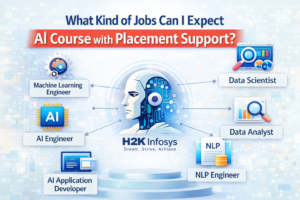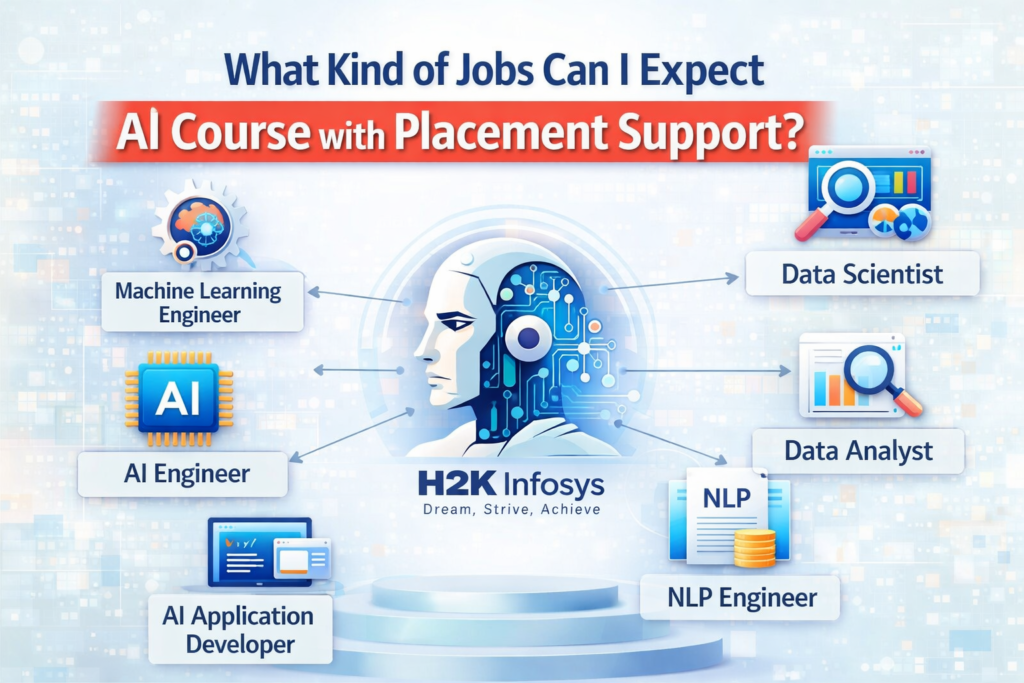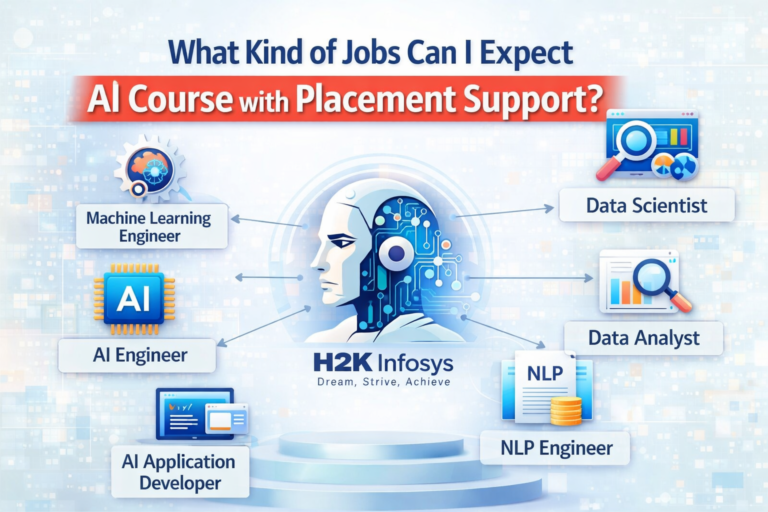
Completing an AI course with placement support at H2K Infosys typically prepares learners for entry-level to mid-level roles such as Machine Learning Engineer, Data Scientist, AI Engineer, Data Analyst, and AI Application Developer. What The exact role depends on prior experience, technical depth, and the tools covered in the program. Most Ai Training Online including those offered by H2K Infosys, focus on practical skills aligned with enterprise use cases, enabling professionals to transition into AI-related roles across industries.
What is an AI Course with Placement Support?
An AI course with placement support is a structured training program that combines technical instruction in Artificial Intelligence with career services such as resume preparation, mock interviews, and job referrals.
Key Components
- Core AI and machine learning concepts
- Hands-on projects using industry tools
- Exposure to real-world datasets
- Career assistance (interview prep, job matching)
Typical Curriculum Areas
- Python programming for AI
- Machine Learning algorithms
- Deep Learning (Neural Networks, CNNs, NLP)
- Data preprocessing and feature engineering
- Model deployment basics (APIs, cloud)
Why is AI Important for Working Professionals?
AI is increasingly integrated into enterprise systems for automation, prediction, and decision-making.
Practical Enterprise Use Cases
- Fraud detection in banking systems
- Recommendation engines in e-commerce
- Predictive maintenance in manufacturing
- Customer sentiment analysis in CRM platforms
Benefits for Professionals
- Expands career opportunities into high-demand domains
- Enables transition from non-technical to technical roles
- Enhances decision-making capabilities using data
How Does AI Work in Real-World IT Projects?
AI systems in production environments follow a structured lifecycle rather than isolated model development.
Typical AI Workflow
- Problem Definition
- Define business objective (e.g., reduce churn)
- Data Collection
- Extract data from databases, APIs, logs
- Data Preprocessing
- Cleaning, normalization, feature selection
- Model Development
- Train models using frameworks like:
- Scikit-learn
- TensorFlow
- PyTorch
- Train models using frameworks like:
- Model Evaluation
- Metrics: accuracy, precision, recall, F1-score
- Deployment
- REST APIs using Flask/FastAPI
- Integration with enterprise systems
- Monitoring
- Model drift detection
- Performance tracking
Common Challenges
- Data quality issues
- Model interpretability
- Scalability in production
- Integration with legacy systems
What Skills Are Required to Learn AI?
AI requires a combination of programming, mathematics, and domain understanding.
Core Technical Skills
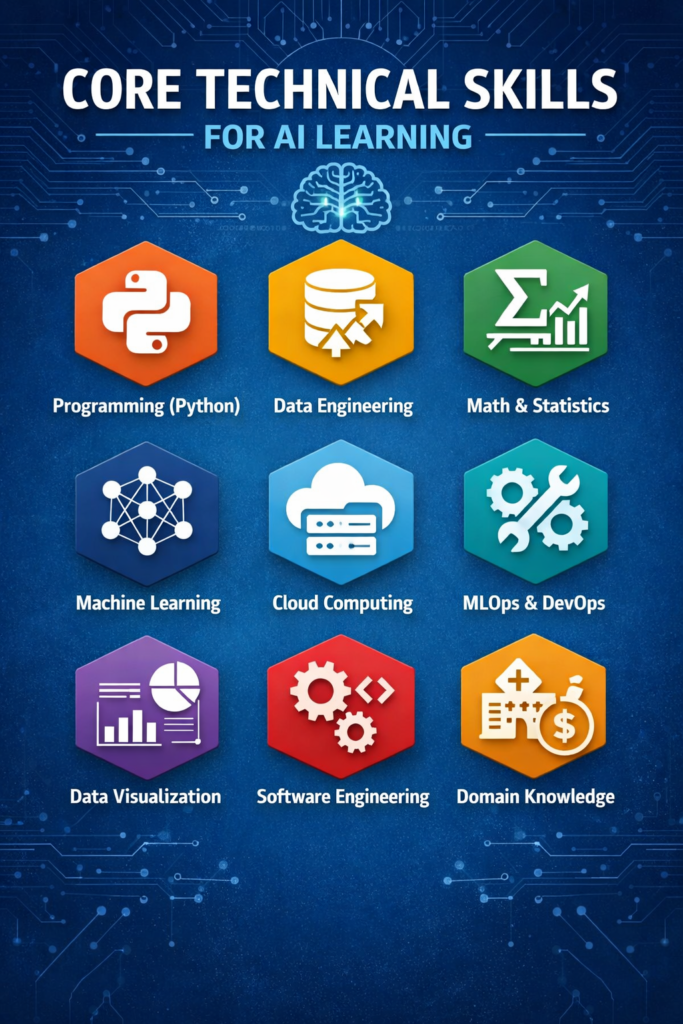
| Skill Area | Description |
|---|---|
| Programming | Python, libraries like NumPy, Pandas |
| Mathematics | Linear algebra, probability, statistics |
| Machine Learning | Supervised & unsupervised learning |
| Deep Learning | Neural networks, NLP, computer vision |
| Data Handling | SQL, data pipelines |
| Tools | Jupyter Notebook, Git |
Supporting Skills
- Problem-solving
- Analytical thinking
- Basic understanding of cloud platforms (AWS, Azure)
How is AI Used in Enterprise Environments?
AI in enterprises is not isolated it is integrated into business workflows and applications.
Common Enterprise AI Implementations
- Customer Analytics Platforms
- Predict customer churn using ML models
- Automation Systems
- Use AI for document processing (OCR + NLP)
- Fraud Detection Engines
- Real-time anomaly detection systems
- Supply Chain Optimization
- Forecast demand using time-series models
Tools Used in Production
| Category | Tools |
|---|---|
| Data Processing | Apache Spark, Pandas |
| ML Frameworks | TensorFlow, PyTorch |
| Deployment | Docker, Kubernetes |
| Cloud Platforms | AWS SageMaker, Azure ML |
What Job Roles Use AI Daily?
After completing Online Ai Certification Courses, learners can pursue various roles depending on their specialization.
1. Machine Learning Engineer
Responsibilities
- Build and deploy ML models
- Optimize algorithms for performance
- Work with large datasets
Tools
- Python, Scikit-learn, TensorFlow
2. Data Scientist
Responsibilities
- Analyze structured/unstructured data
- Build predictive models
- Communicate insights
Tools
- Python, R, SQL, visualization tools
3. AI Engineer
Responsibilities
- Develop AI-powered applications
- Integrate ML models into software systems
Tools
- Deep learning frameworks, APIs
4. Data Analyst (AI-enabled)
Responsibilities
- Data visualization
- Basic predictive analytics
Tools
- Excel, Power BI, Python
5. NLP Engineer
Responsibilities
- Build chatbots, text classifiers
- Work on sentiment analysis
Tools
- NLP libraries (NLTK, SpaCy, Transformers)
6. Computer Vision Engineer
Responsibilities
- Image recognition systems
- Object detection models
Tools
- OpenCV, TensorFlow, PyTorch
What Careers Are Possible After Learning AI?
Career paths depend on your starting point (IT background vs non-IT) and depth of training.
Entry-Level Roles
- Junior Data Analyst
- AI Intern
- Associate ML Engineer
Mid-Level Roles (with experience)
- Data Scientist
- AI Engineer
- ML Engineer
Advanced Roles
- AI Architect
- Research Scientist
- AI Product Manager
Role vs Skill Mapping
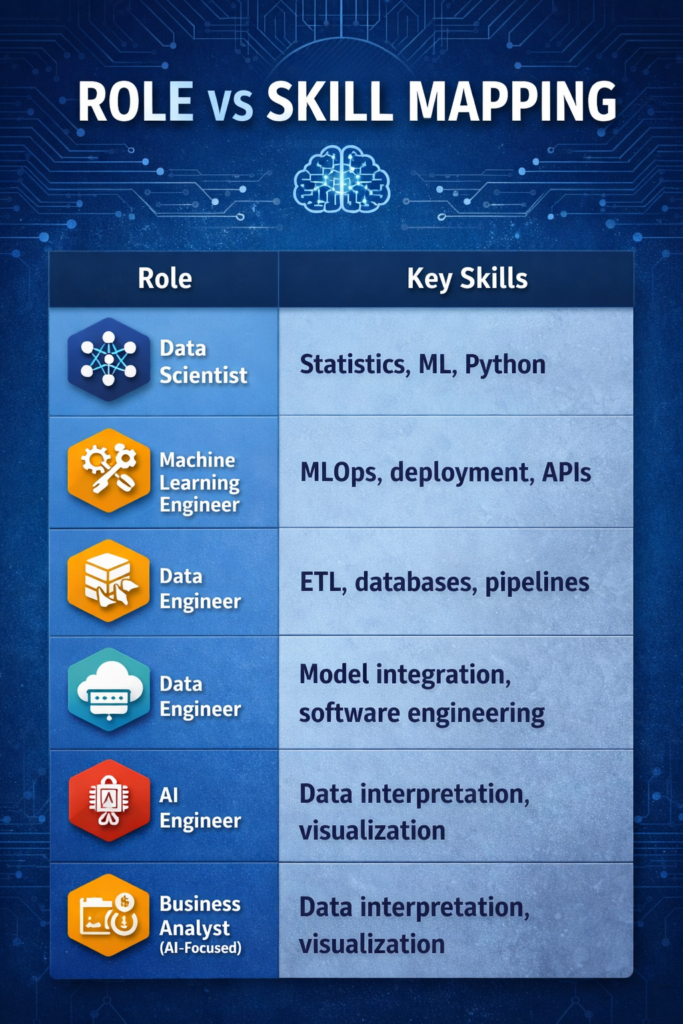
| Role | Key Skills | Experience Level |
|---|---|---|
| Data Analyst | SQL, Excel, Python | Entry |
| ML Engineer | ML algorithms, deployment | Mid |
| Data Scientist | Statistics, modeling | Mid |
| AI Engineer | Deep learning, APIs | Mid-Advanced |
| NLP Engineer | Text processing, transformers | Specialized |
How Placement Support Helps in Securing AI Jobs
Placement support bridges the gap between learning and employment.
Key Services Provided
- Resume building aligned with AI roles
- Mock technical interviews
- Portfolio/project guidance
- Job referrals and networking support
Realistic Expectations
- Placement support improves chances but does not guarantee a job
- Success depends on:
- Skill mastery
- Project experience
- Interview performance
Practical Learning Path for AI Careers
Step-by-Step Approach
- Learn Python fundamentals
- Study statistics and probability
- Implement basic ML algorithms
- Work on real datasets (Kaggle, UCI)
- Build end-to-end projects
- Learn deployment basics
- Prepare for interviews
Example Real-World AI Project Workflow
Use Case: Customer Churn Prediction
Step 1: Data Collection
- Extract customer data from CRM database
Step 2: Data Cleaning
- Handle missing values
- Normalize features
Step 3: Feature Engineering
- Create features like usage frequency
Step 4: Model Training
from sklearn.ensemble import RandomForestClassifier
model = RandomForestClassifier()
model.fit(X_train, y_train)
Step 5: Evaluation
- Accuracy, confusion matrix
Step 6: Deployment
- REST API using Flask
FAQ: AI Jobs After Certification
What is the minimum qualification required for AI jobs?
A background in mathematics, statistics, or programming is helpful, but many professionals transition through structured ai training online programs.
Can non-IT professionals get AI jobs?
Yes, especially in roles like data analysis or entry-level ML roles, provided they build strong foundational skills and projects.
How long does it take to get a job after an AI course?
Typically 3–6 months after course completion, depending on practice, projects, and interview readiness.
Are AI jobs only for experienced professionals?
No. Entry-level roles exist, but competition is high, so practical experience is essential.
Which industries hire AI professionals?
- Banking and finance
- Healthcare
- Retail and e-commerce
- Manufacturing
- IT services
Do online AI certification courses provide real job value?
Yes, if they include:
- Hands-on projects
- Industry-relevant tools
- Practical workflows
Key Takeaways
- AI courses prepare learners for roles like ML Engineer, Data Scientist, and AI Developer
- Hands-on experience and projects are critical for job readiness
- Enterprise AI involves full lifecycle workflows, not just model building
- Placement support improves job search outcomes but requires active effort
- Skills in Python, ML, and data handling are essential for most AI roles