H2K Infosys stands out as a trusted name for Salesforce Training in the USA because it blends real-world experience, hands-on projects, and career-focused mentoring into one practical learning path. If you’re looking for Salesforce Training that actually prepares you for the job market not just an exam this is where the difference shows.
The Real Reason People Look for Salesforce Training Today
Let’s be honest. Most professionals don’t wake up thinking, “I want to study CRM systems.” They’re thinking about career growth, better pay, remote flexibility, or switching into tech without going back to college.
And Salesforce sits right at that sweet spot.
With businesses across healthcare, retail, fintech, and even government agencies moving operations to cloud platforms, Salesforce isn’t just popular it’s foundational. According to recent industry updates, Salesforce continues to dominate the CRM market globally, and demand for administrators and consultants in the U.S. remains strong heading into 2026.
That’s where structured Salesforce Training becomes crucial. Watching random YouTube tutorials won’t cut it anymore. Companies want certified professionals who understand business processes, automation, dashboards, and security not just someone who can navigate a menu.
What Actually Makes a Training Provider “Trusted”?
Trust doesn’t come from flashy ads. It comes from results.
Over the years, I’ve seen professionals enroll in various Salesforce training classes only to realize halfway through that they’re learning theory without context. They know definitions but don’t know how to handle a real client requirement.
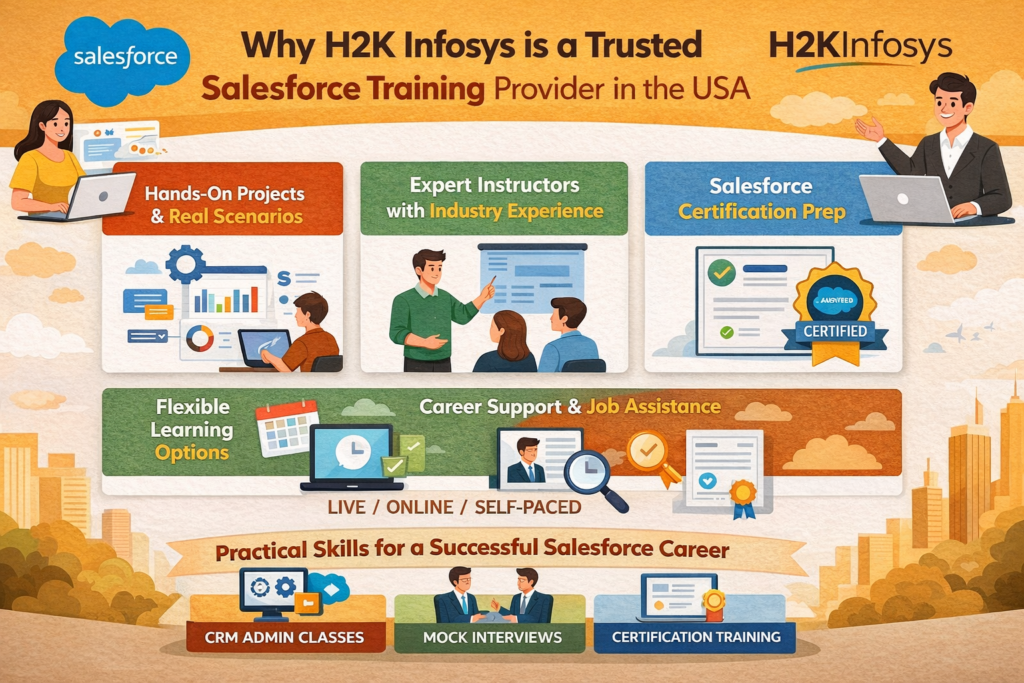
The difference with a trusted provider comes down to five things:
- Real project exposure
- Instructors with live industry experience
- Certification-focused structure
- Career mentoring and interview prep
- Post-training support
This is exactly where Salesforce Training at H2K Infosys gets interesting.
Practical, Job-Oriented Salesforce Training (Not Just Slides)
One of the biggest gaps in the market is between certification and employability. Passing an exam is one thing. Handling a real-time sales automation request from a client? Totally different.
Good Salesforce Training should simulate real business use cases:
- Creating custom objects for a healthcare workflow
- Designing dashboards for sales forecasting
- Building approval processes
- Managing user roles and permissions
- Automating workflows using Flow Builder
When Salesforce CRM Administrator training includes live project work, you begin to think like an administrator not just a student.
I’ve spoken with learners who mentioned that mock projects during Salesforce administrator classes helped them understand how departments actually collaborate. Sales, marketing, and operations all rely on CRM data differently. That perspective changes how you configure the system.
The Certification Angle: Why It Still Matters
There’s always debate around certifications. Are they necessary? Strictly speaking, maybe not. But in the U.S. job market, Salesforce certification training gives you credibility.
Recruiters filter resumes using keywords. Hiring managers want proof that you understand platform fundamentals. And Salesforce’s own certification ecosystem is well respected.
Quality Salesforce Training aligns directly with:
- Salesforce Certified Administrator
- Advanced Administrator
- Platform App Builder
And not just exam dumps actual scenario-based preparation.
The right Salesforce certification training helps you understand why an answer is correct, not just memorize it. That difference shows in interviews.
Learning From Instructors Who’ve Actually Worked in Salesforce
This might sound obvious, but it’s surprisingly rare.
Some training centers hire instructors who only teach. They’ve never implemented Salesforce in a real organization. So when a student asks, “What happens if two automation rules conflict?” they hesitate.
Experienced mentors bring stories. They’ve handled messy data migrations. They’ve worked on compliance-heavy healthcare orgs. They’ve optimized underperforming dashboards before quarterly reviews.
Salesforce Training feels completely different when the instructor says, “Here’s what happened when we tried that in a live project.”
That kind of lived experience builds trust.
Structured Salesforce Training That Matches Market Demand
The Salesforce ecosystem has evolved quickly. In 2024–2026, there’s been a major emphasis on:
- Flow replacing older workflow rules
- AI-driven CRM features
- Data Cloud integration
- Industry-specific clouds (Health Cloud, Financial Services Cloud)
A modern Salesforce CRM Administrator training program has to reflect these updates. Outdated material is a red flag.
Salesforce Training should now include:
- Flow Builder deep dives
- Lightning Experience configuration
- AI-assisted CRM features
- Data security and compliance best practices
When the Salesforce administrator course adapts to these changes, learners stay competitive.
Flexibility for Working Professionals
Most people enrolling in Salesforce Training are already working full-time or managing family responsibilities.
Evening batches, weekend sessions, recorded classes, and lifetime access to materials matter more than we admit.
Flexible Salesforce training classes allow students to learn without quitting their jobs. That alone increases completion rates.
And let’s face it when training feels manageable, you’re more likely to stick with it.
Hands-On Practice: The Sandbox Advantage
You can’t learn Salesforce passively.
Real Salesforce Training gives you access to practice environments where you:
- Configure profiles
- Set up validation rules
- Build reports
- Test automation
When Training for Salesforce includes guided sandbox exercises, confidence grows naturally.
I’ve seen beginners go from “What is an object?” to building mini CRM apps within weeks just because they were encouraged to practice consistently.
Career Support That Goes Beyond the Course
Here’s something most blogs don’t mention.
Completing Salesforce Training is step one. Landing a job is step two and it’s often harder.
Trusted providers understand that. They include:
- Resume building workshops
- LinkedIn profile optimization
- Mock interviews
- Real-time scenario discussions
- Networking guidance
Salesforce certification training combined with career coaching makes a huge difference.
Especially in 2026, where hiring managers care about communication skills just as much as technical ability.
Real-World Example: Career Transition Story
I remember speaking to a professional from a non-technical background in customer support, actually. She enrolled in Salesforce Training after her company adopted Salesforce internally.
Instead of staying in support, she completed Salesforce administrator classes, passed her certification, and transitioned into an internal CRM admin role within eight months.
Her secret? Consistency and project-based learning.
That’s the kind of outcome structured Salesforce training classes aim for.
Alignment With U.S. Job Market Trends
The U.S. tech market has shifted toward cloud specialization. While software development remains competitive, CRM administration offers a practical entry point.
Many mid-sized businesses are actively seeking certified admins who can:
- Customize Sales Cloud
- Automate lead assignments
- Improve reporting visibility
- Maintain data quality
Salesforce Training tailored to these needs makes graduates job-ready not just certificate holders.
Community and Ongoing Support
Learning doesn’t stop after certification.
Strong Salesforce Training programs offer alumni groups, discussion forums, and continued mentorship. When learners can ask post-course questions, they grow faster.
That ongoing engagement builds long-term trust.
Why H2K Infosys Continues to Stand Out
It really comes down to a combination of factors:
- Practical Salesforce Training
- Updated curriculum aligned with platform changes
- Real-time projects
- Certification-focused structure
- Career mentoring
- Flexible schedules
When Salesforce CRM Administrator training is built around employability not just theory students notice.
Salesforce certification training that includes mock interviews and resume refinement prepares learners for real conversations with hiring managers.
Salesforce training classes that prioritize hands-on labs create confidence.
And Training for Salesforce that evolves with the platform keeps professionals relevant.
Conclusion
Salesforce Training is an investment. Not just financially but in time, energy, and focus.
Choosing the right provider determines whether you end up confused or career-ready.
When Salesforce Training combines real-world scenarios, experienced instructors, certification preparation, and job support, it builds trust naturally.
That’s why many professionals consider Salesforce administrator classes from H2K Infosys a reliable path into the Salesforce ecosystem.
If your goal is to become a confident administrator, not just someone who passed an exam structured Salesforce Training makes all the difference.
And honestly? In today’s competitive U.S. tech market, the right Salesforce certification training could be the pivot your career needs.