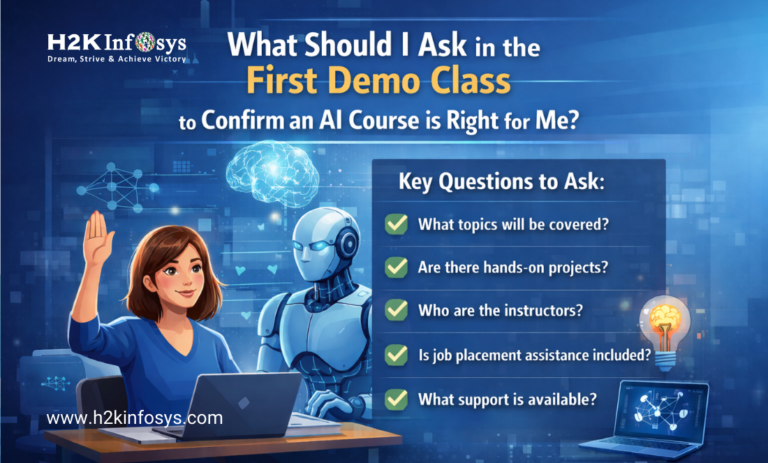
The first demo class of an AI course is the most reliable opportunity to evaluate whether the curriculum, tools, teaching approach, and practical exposure align with your career goals. At H2K Infosys, the AI course demo session is designed to introduce learners to the real structure of the AI training program, including enterprise tools, project workflows, and the practical learning approach used throughout the course.
You should ask specific questions about course structure, real world project exposure, tools used in enterprise environments, instructor expertise, and job-oriented skill development. These questions help confirm whether the AI Course Certification will prepare you for practical IT roles rather than just theoretical knowledge.
What Is an AI Course Certification?
An AI course certification is a structured training program that teaches artificial intelligence concepts, tools, and real-world implementation methods, followed by an assessment or certification validating your skills.
These certifications typically cover:
- Machine learning fundamentals
- Neural networks and deep learning
- Natural language processing (NLP)
- AI model development and deployment
- Real-world AI tools such as Python, TensorFlow, and cloud AI services
The purpose of an Artificial Intelligence Online Training program is to prepare learners for enterprise AI workflows, including model building, testing, deployment, and monitoring.
AI certification programs vary significantly in quality. The demo class allows you to verify whether the course provides practical job-ready skills or only theoretical exposure.
Why Is the First Demo Class Important?
The demo class provides direct insight into how the course is taught and whether it matches enterprise IT requirements.
Key areas you can evaluate during the demo:
- Instructor expertise and teaching clarity
- Depth of curriculum coverage
- Real-world project integration
- Hands-on learning opportunities
- Tool exposure and technical depth
In enterprise environments, AI professionals work with complex workflows, production systems, and cloud platforms. A quality course should reflect these realities.
What Questions Should You Ask in the First Demo Class?
Below are critical questions categorized by technical, practical, and career relevance.
1. What Topics Are Covered in This AI Course Certification?
This question helps confirm whether the curriculum covers foundational and advanced AI concepts.
Expected core topics:
| Category | Topics |
|---|---|
| Fundamentals | AI basics, machine learning, supervised learning |
| Programming | Python, data structures, NumPy, Pandas |
| Machine Learning | Regression, classification, clustering |
| Deep Learning | Neural networks, TensorFlow, PyTorch |
| NLP | Text processing, transformers |
| Deployment | Model deployment, APIs |
| Cloud AI | AWS AI, Azure AI, Google AI |
A complete Artificial Intelligence Online Training course should include both theory and implementation.
2. Does the Course Include Real-World Projects?
Enterprise AI roles require practical experience.
Ask about projects such as:
- Fraud detection system
- Customer churn prediction
- Recommendation systems
- AI chatbots
- Image classification systems
Example enterprise project workflow:
Step 1: Data collection
Step 2: Data cleaning
Step 3: Model training
Step 4: Model testing
Step 5: Deployment using cloud platform
Step 6: Monitoring model performance
Without project exposure, learners may struggle to apply AI skills in professional environments.
3. What Tools and Technologies Will I Learn?
Enterprise AI workflows use specific tools.
Essential tools include:
| Category | Tools |
|---|---|
| Programming | Python |
| ML libraries | Scikit-learn |
| Deep learning | TensorFlow, PyTorch |
| Data processing | Pandas, NumPy |
| Visualization | Matplotlib, Seaborn |
| Development | Jupyter Notebook |
| Deployment | Docker, Flask |
| Cloud AI | AWS SageMaker, Azure ML |
Artificial Intelligence Online Training should include hands-on practice with these tools.
4. Will the Course Teach Model Deployment?
Model deployment is critical in enterprise AI.
Deployment includes:
- Creating APIs for models
- Integrating models into applications
- Using cloud deployment tools
- Monitoring model performance
Example deployment workflow:
Train model → Save model → Create API → Deploy API → Integrate into application
This is essential for real-world AI engineering roles.
5. How Is Hands-On Practice Integrated?
Hands-on learning is necessary to build confidence.
Ask about:
- Coding exercises
- Lab assignments
- Project work
- Real datasets
Enterprise AI teams use datasets from:
- Business databases
- Customer analytics platforms
- Transaction systems
Courses should simulate these environments.
6. Who Is the Instructor and What Is Their Industry Experience?
Instructor expertise is one of the most important factors.
Ask about:
- Industry experience
- AI project experience
- Enterprise AI system exposure
Instructors with real-world experience can explain:
- Production challenges
- Performance optimization
- Deployment issues
These insights are essential for career readiness.
How Does Artificial Intelligence Work in Real-World IT Projects?
Artificial intelligence is used to automate decision-making, analyze data, and improve system efficiency.
Enterprise AI workflow includes:
| Step | Description |
|---|---|
| Data Collection | Gather business data |
| Data Cleaning | Remove errors |
| Model Training | Train machine learning models |
| Testing | Evaluate accuracy |
| Deployment | Deploy model to production |
| Monitoring | Track performance |
Example: Fraud Detection
AI analyzes transaction data and identifies suspicious patterns automatically.
Why Is AI Course Certification Important for Working Professionals?
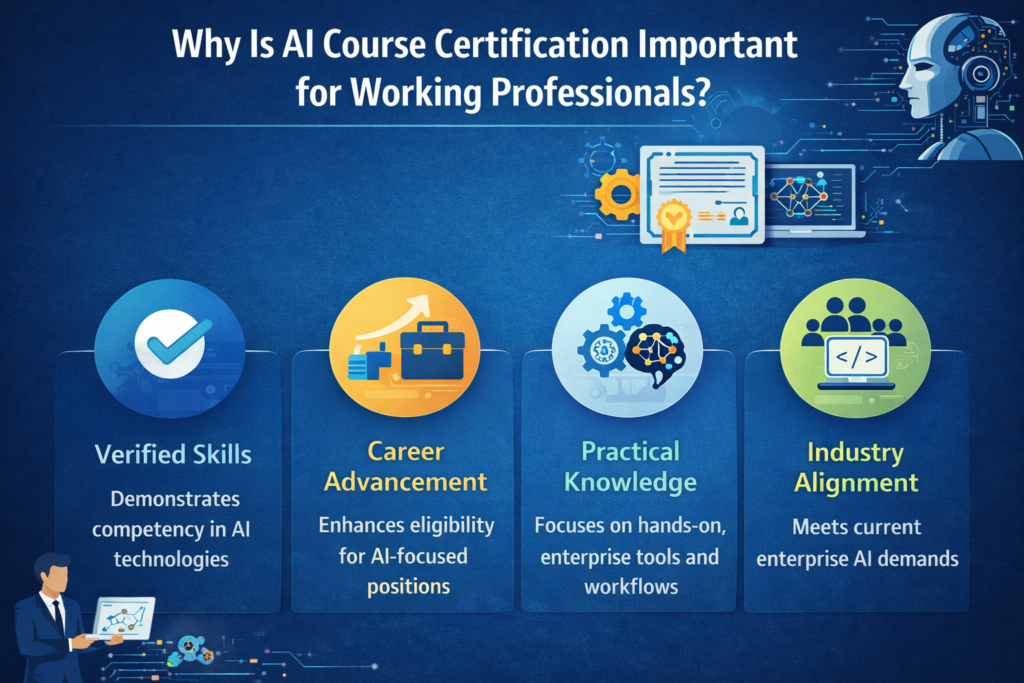
AI skills are increasingly required across IT roles.
Benefits include:
- Automation capability
- Data-driven decision making
- Career transition opportunities
- Increased technical expertise
Common IT roles using AI:
- Software engineers
- QA engineers
- Data analysts
- Cloud engineers
- DevOps engineers
Artificial Intelligence Online Training helps professionals transition into these roles.
What Skills Are Required to Learn AI?
AI learning requires both technical and conceptual skills.
Technical Skills
- Python programming
- Data analysis
- Statistics fundamentals
- Machine learning concepts
Practical Skills
- Problem solving
- Data interpretation
- Model evaluation
Tool Skills
- TensorFlow
- Jupyter Notebook
- Cloud AI platforms
These skills are developed gradually during training.
How Is AI Used in Enterprise Environments?
AI is widely used across industries.
Common use cases:
| Industry | Use Case |
|---|---|
| Finance | Fraud detection |
| Healthcare | Disease prediction |
| Retail | Recommendation systems |
| Banking | Risk analysis |
| IT | Automated testing |
| Customer service | AI chatbots |
Enterprise AI systems integrate with existing software infrastructure.
What Job Roles Use AI Daily?
AI is used in many IT roles.
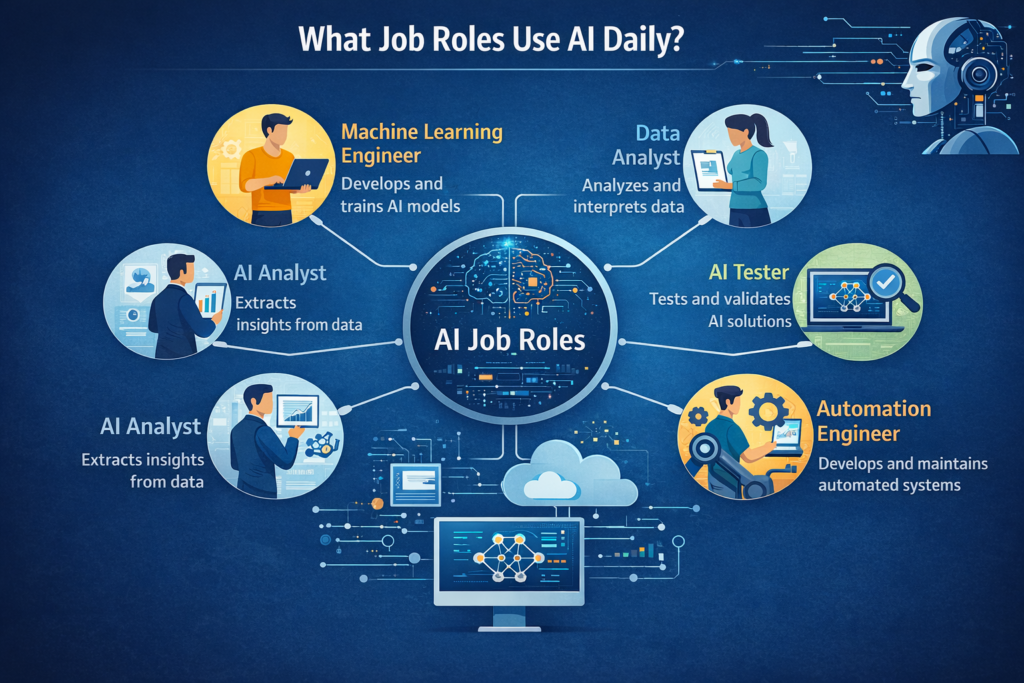
Common roles include:
| Role | Responsibilities |
|---|---|
| AI Engineer | Build AI systems |
| Machine Learning Engineer | Train ML models |
| Data Scientist | Analyze data |
| AI Developer | Develop AI applications |
| Automation Engineer | Implement AI automation |
Artificial Intelligence Online Training prepares learners for these roles.
What Careers Are Possible After Completing an AI Course Certification?
Career opportunities include:
- AI Engineer
- Machine Learning Engineer
- Data Scientist
- AI Analyst
- Automation Engineer
Entry-level roles often focus on model implementation and data analysis.
Advanced roles focus on:
- Model optimization
- Deployment
- Architecture design
What Should You Observe During the Demo Class?
Beyond asking questions, observe key indicators.
Teaching Quality
- Clear explanations
- Structured teaching
- Practical examples
Technical Depth
- Code demonstrations
- Real-world scenarios
- Tool usage
Practical Orientation
- Project discussion
- Hands-on exercises
These indicators help evaluate course effectiveness.
What Red Flags Should You Watch For?
Warning signs include:
- Only theory, no projects
- No tool exposure
- No coding demonstrations
- No deployment training
AI courses must include practical implementation.
Example Enterprise AI Project Workflow
Below is a typical AI development workflow.
| Step | Tool Used |
|---|---|
| Data collection | SQL, Python |
| Data cleaning | Pandas |
| Model training | Scikit-learn |
| Model testing | Python |
| Deployment | Flask, Docker |
| Monitoring | Cloud tools |
A quality course should teach this workflow.
FAQ Section
What is the most important question to ask in the AI demo class?
Ask whether the course includes real-world projects and deployment training.
Does AI certification require coding?
Yes. Python is commonly used for AI development.
Can beginners learn AI?
Yes. Beginners can learn AI with structured training and practice.
How long does AI training take?
Most Artificial Intelligence Online Training programs range from 3 to 6 months.
Do AI courses include job-oriented training?
Many courses include projects, tool training, and interview preparation.
Key Takeaways
- Demo classes help evaluate course quality, instructor expertise, and practical exposure
- Ask about real-world projects, deployment, and enterprise tools
- Artificial Intelligence Online Training should include hands-on coding and implementation
- AI course certification prepares learners for enterprise IT roles
- Project-based learning is essential for career readiness