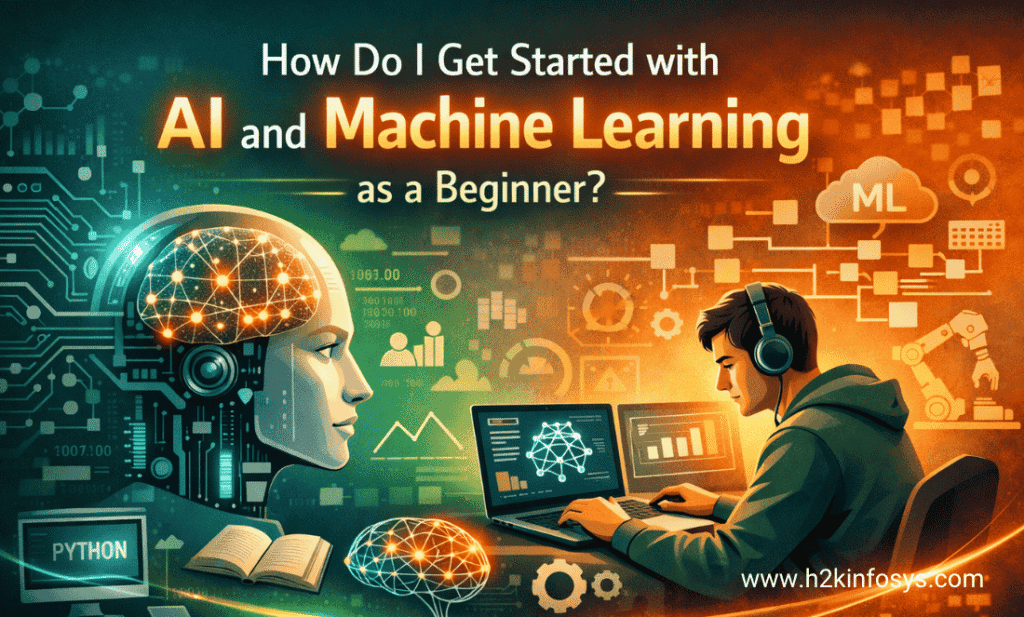
H2K Infosys Artificial intelligence certification online programs in the USA teach a structured set of technical and practical skills required to design, implement, and maintain AI-driven systems in enterprise environments. These programs typically cover machine learning, data preprocessing, neural networks, natural language processing, model deployment, and AI system integration. A comprehensive Artificial intelligence certified course also includes programming, statistical analysis, and real-world project workflows using industry standard tools such as Python, TensorFlow, and cloud-based AI platforms.
What is Artificial Intelligence?
Artificial Intelligence (AI) is a field of computer science focused on creating systems capable of performing tasks that typically require human intelligence. These tasks include recognizing patterns, understanding language, making predictions, and automating decision-making processes.
AI systems rely on mathematical models, algorithms, and large datasets to learn patterns and improve performance over time. Unlike traditional rule-based software, AI systems can adapt and refine their outputs based on data inputs.
Core Components of Artificial Intelligence
Artificial intelligence certification programs typically teach the following foundational areas:
| Component | Description | Enterprise Example |
|---|---|---|
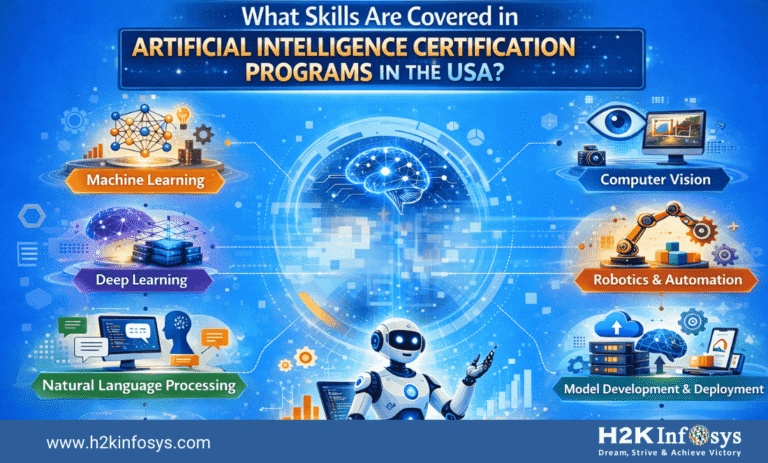
| Machine Learning | Algorithms that learn patterns from data | Fraud detection in banking |
| Deep Learning | Neural networks for complex pattern recognition | Image recognition in healthcare |
| Natural Language Processing | Understanding and generating human language | Chatbots and virtual assistants |
| Computer Vision | Interpreting visual data | Automated quality inspection |
| Predictive Analytics | Forecasting future outcomes | Sales forecasting |
Why is Artificial Intelligence Important for Working Professionals?
AI is increasingly integrated into enterprise IT systems across industries such as finance, healthcare, retail, manufacturing, and cybersecurity. Professionals with AI skills contribute to data-driven decision-making, automation, and system optimization.
Key Reasons AI Skills Are in Demand
1. Automation of Manual Processes
AI systems automate repetitive tasks such as:
- Data classification
- Email filtering
- Customer service chat handling
- Log monitoring
2. Improved Decision-Making
Organizations use AI to analyze large datasets and support:
- Risk assessment
- Demand forecasting
- Customer segmentation
3. Integration with Existing IT Systems
AI is integrated with:
- Cloud infrastructure (AWS, Azure, Google Cloud)
- Databases and data warehouses
- Enterprise software applications
4. Cross-Functional IT Relevance
AI skills complement roles in:
- Software development
- Data engineering
- DevOps
- Cybersecurity
What Skills Are Covered in Artificial Intelligence Certification Programs in the USA?
A structured Artificial Intelligence Certification Online covers multiple skill categories required for real-world AI system development and deployment.
1. Programming Skills for AI Development
Programming is essential for implementing AI algorithms and handling data processing tasks.
Common Programming Languages Taught
| Language | Purpose | Example Use |
|---|---|---|
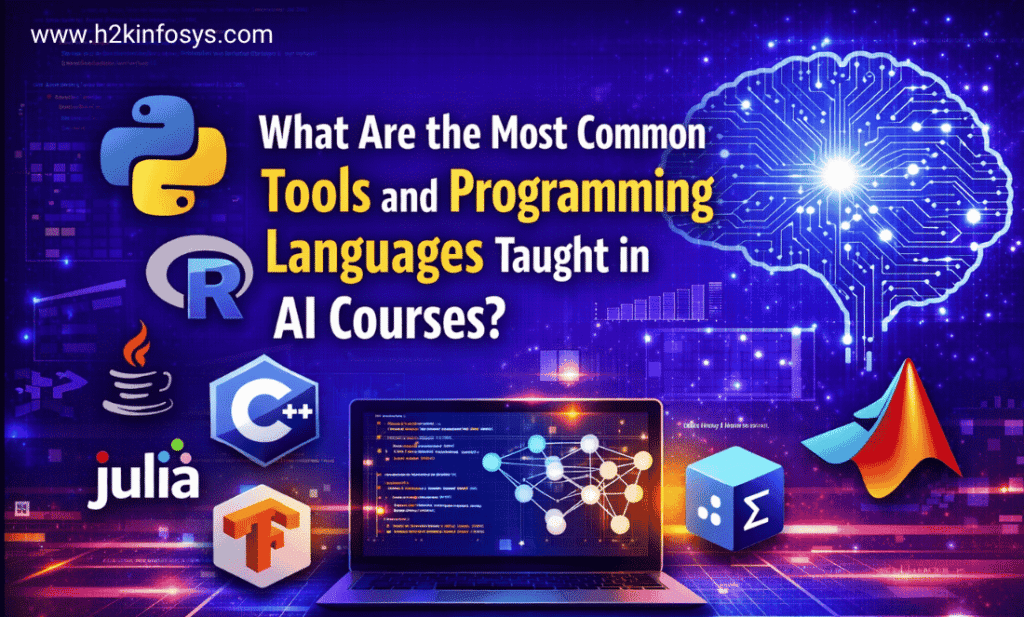
| Python | Primary AI development language | Model training and evaluation |
| SQL | Data extraction | Querying training datasets |
| R | Statistical analysis | Data modeling |
| Java | Enterprise integration | Production AI systems |
Practical Example
from sklearn.linear_model import LinearRegressionmodel = LinearRegression()
model.fit(training_data, target_values)
prediction = model.predict(new_data)
This workflow demonstrates basic machine learning model training and prediction.
2. Mathematics and Statistics for AI
AI models rely heavily on mathematical principles.
Core Mathematical Concepts Covered
- Linear algebra
- Probability theory
- Statistics
- Calculus basics
- Optimization techniques
Why These Skills Matter
Mathematics helps professionals:
- Understand how models learn
- Diagnose performance issues
- Improve accuracy
Example: Understanding gradient descent helps optimize neural networks.
3. Machine Learning Fundamentals
Machine learning is the core skill taught in most AI training courses.
Key Machine Learning Techniques
| Technique | Purpose | Enterprise Example |
|---|---|---|
| Regression | Predict numeric values | Price prediction |
| Classification | Assign categories | Spam detection |
| Clustering | Group similar data | Customer segmentation |
| Recommendation Systems | Suggest items | Product recommendations |
Machine Learning Workflow Taught in Certification Programs
- Data collection
- Data preprocessing
- Model selection
- Model training
- Model evaluation
- Deployment
4. Data Preprocessing and Feature Engineering
Raw data must be cleaned and transformed before training AI models.
Skills Covered
- Handling missing values
- Normalizing data
- Encoding categorical variables
- Feature selection
- Data transformation
Enterprise Example
Before training a fraud detection model:
- Remove invalid transactions
- Normalize transaction amounts
- Encode payment methods
5. Deep Learning and Neural Networks
Deep learning enables AI systems to solve complex tasks such as image recognition and speech processing.
Topics Covered
- Artificial neural networks (ANN)
- Convolutional neural networks (CNN)
- Recurrent neural networks (RNN)
- Transformer models basics
Industry Tools Taught
| Tool | Purpose |
|---|---|
| TensorFlow | Neural network development |
| PyTorch | Deep learning research and production |
| Keras | Simplified neural network building |
6. Natural Language Processing (NLP)
NLP enables machines to understand human language.
Skills Covered in NLP Training
- Text preprocessing
- Tokenization
- Sentiment analysis
- Chatbot development
- Language modeling
Enterprise Applications
- Customer support chatbots
- Email classification
- Document analysis
7. AI Model Evaluation and Validation
AI certification programs teach how to measure model performance.
Common Evaluation Metrics
| Metric | Purpose |
|---|---|
| Accuracy | Overall correctness |
| Precision | Correct positive predictions |
| Recall | Detecting all relevant cases |
| F1 Score | Balanced performance measure |
8. AI Model Deployment and Production Integration
Developing a model is only part of the process. Deployment ensures models function in real systems.
Deployment Skills Covered
- Model serialization
- REST API integration
- Cloud deployment
- Model monitoring
Deployment Workflow Example
- Train model
- Save model
- Deploy using API
- Integrate into application
- Monitor performance
9. Working with AI Frameworks and Libraries
AI training courses provide hands-on experience with industry-standard tools.
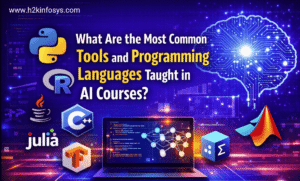
Common AI Tools Covered
| Tool | Purpose |
|---|---|
| Scikit-learn | Machine learning algorithms |
| TensorFlow | Deep learning |
| PyTorch | Neural network development |
| Pandas | Data manipulation |
| NumPy | Numerical computing |
10. Cloud-Based AI Platforms
Enterprise AI systems often run on cloud platforms.
Cloud AI Services Covered
| Platform | AI Services |
|---|---|
| AWS | SageMaker |
| Azure | Azure Machine Learning |
| Google Cloud | Vertex AI |
Why Cloud AI Skills Are Important
Cloud platforms provide:
- Scalability
- Model hosting
- Automated deployment
How Does Artificial Intelligence Work in Real-World IT Projects?
AI follows a structured lifecycle in enterprise systems.
Enterprise AI Workflow
| Step | Description |
|---|---|
| Data Collection | Gather raw business data |
| Data Cleaning | Remove errors and inconsistencies |
| Model Training | Train AI model |
| Evaluation | Validate performance |
| Deployment | Integrate into system |
| Monitoring | Track performance |
How is Artificial Intelligence Used in Enterprise Environments?
AI is commonly used across enterprise departments.
Enterprise Use Cases
IT Operations
- Predict system failures
- Detect anomalies in logs
Cybersecurity
- Detect suspicious activity
- Identify malware patterns
Finance
- Fraud detection
- Credit risk assessment
Healthcare
- Medical image analysis
- Patient outcome prediction
What Skills Are Required to Learn Artificial Intelligence?
Artificial intelligence certification programs help learners build these prerequisite skills.
Basic Skills
- Programming fundamentals
- Basic mathematics
- Logical thinking
- Data handling
Intermediate Skills
- Python programming
- Statistics knowledge
- Database querying
What Job Roles Use Artificial Intelligence Daily?
AI skills apply to multiple IT roles.
Job Role vs Skill Mapping
| Job Role | AI Skills Used |
|---|---|
| Machine Learning Engineer | Model development |
| Data Scientist | Data analysis and modeling |
| AI Engineer | AI system deployment |
| Software Engineer | AI integration |
| Data Analyst | Predictive analytics |
What Careers Are Possible After Learning Artificial Intelligence?
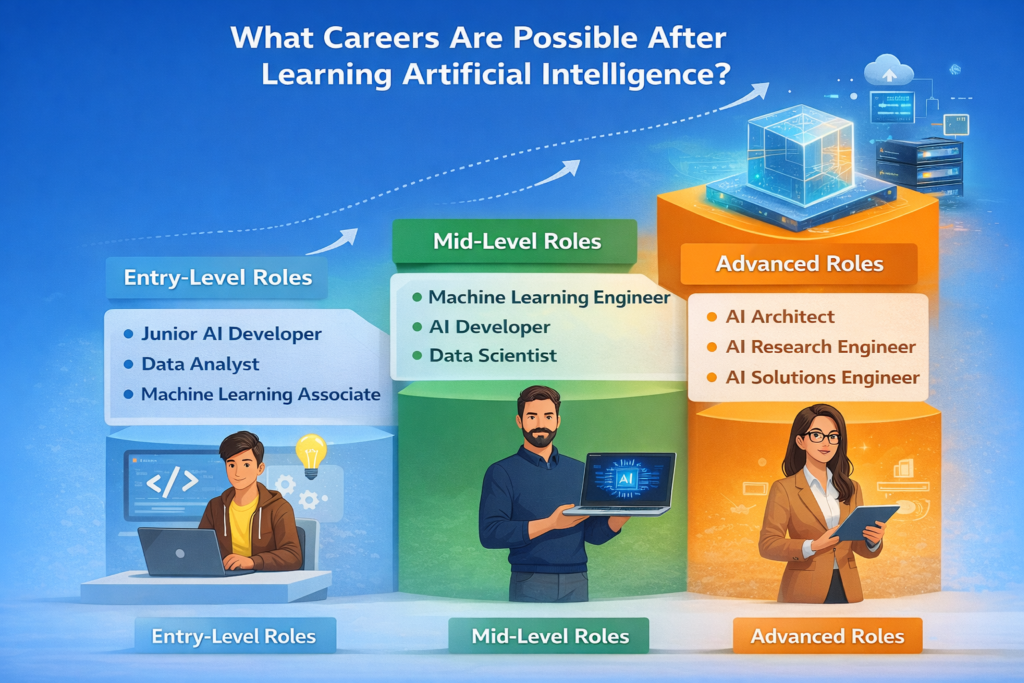
Completing AI Training Courses prepares professionals for several career paths.
Common Career Paths
Entry-Level Roles
- Junior AI Developer
- Data Analyst
- Machine Learning Associate
Mid-Level Roles
- Machine Learning Engineer
- AI Developer
- Data Scientist
Advanced Roles
- AI Architect
- AI Research Engineer
- AI Solutions Engineer
What Tools Are Commonly Taught in Artificial Intelligence Certified Course Programs?
Core Tools Overview
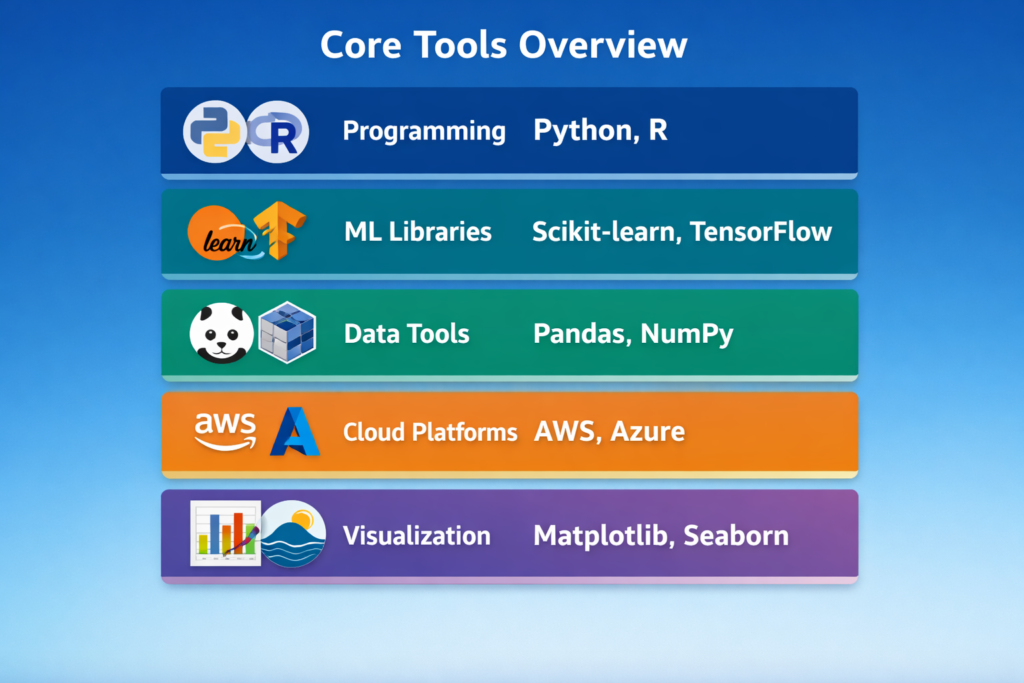
| Category | Tools |
|---|---|
| Programming | Python, R |
| ML Libraries | Scikit-learn, TensorFlow |
| Data Tools | Pandas, NumPy |
| Cloud Platforms | AWS, Azure |
| Visualization | Matplotlib, Seaborn |
How Are AI Skills Applied in Real Enterprise Projects?
Example: Fraud Detection System Workflow
Step 1: Collect transaction data
Step 2: Clean and preprocess data
Step 3: Train classification model
Step 4: Deploy model
Step 5: Detect fraud in real-time
Common Challenges Professionals Learn to Handle
AI training programs prepare learners to solve practical problems such as:
- Data quality issues
- Model performance tuning
- Deployment integration
- Scalability challenges
FAQ: Artificial Intelligence Certification Programs in the USA
What is included in an Artificial intelligence certified course?
It includes programming, machine learning, deep learning, NLP, model deployment, and cloud integration skills.
Do AI training courses include hands-on projects?
Yes, most programs include real-world projects such as predictive modeling and chatbot development.
Is programming required for AI certification?
Yes, Python is commonly required for AI model development and implementation.
How long does it take to learn AI?
Most certification programs range from 3 to 12 months depending on depth and schedule.
Are cloud platforms included in AI training courses?
Yes, many programs include AWS, Azure, or Google Cloud AI tools.
Best Practices Taught in Artificial Intelligence Certification Programs
Model Development Best Practices
- Use clean, validated datasets
- Split training and testing data
- Avoid overfitting
Deployment Best Practices
- Monitor model performance
- Maintain version control
- Secure AI systems
Learning Path in Artificial Intelligence Certification Programs
| Stage | Skills Learned |
|---|---|
| Beginner | Programming and statistics |
| Intermediate | Machine learning |
| Advanced | Deep learning and deployment |
Key Takeaways
- Artificial intelligence certification programs teach programming, machine learning, and deployment skills.
- AI training courses include hands-on experience with tools like Python, TensorFlow, and cloud platforms.
- Professionals learn data preprocessing, model training, evaluation, and deployment workflows.
- AI skills are used in enterprise IT systems for automation, analytics, and decision-making.
- Career paths include AI Engineer, Data Scientist, and Machine Learning Engineer roles.
Explore H2K Infosys Artificial Intelligence certified course programs to build hands-on AI skills aligned with real enterprise environments.
Enroll in structured AI training courses designed to help working professionals apply AI concepts in real-world IT projects.