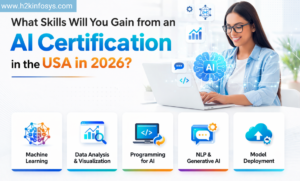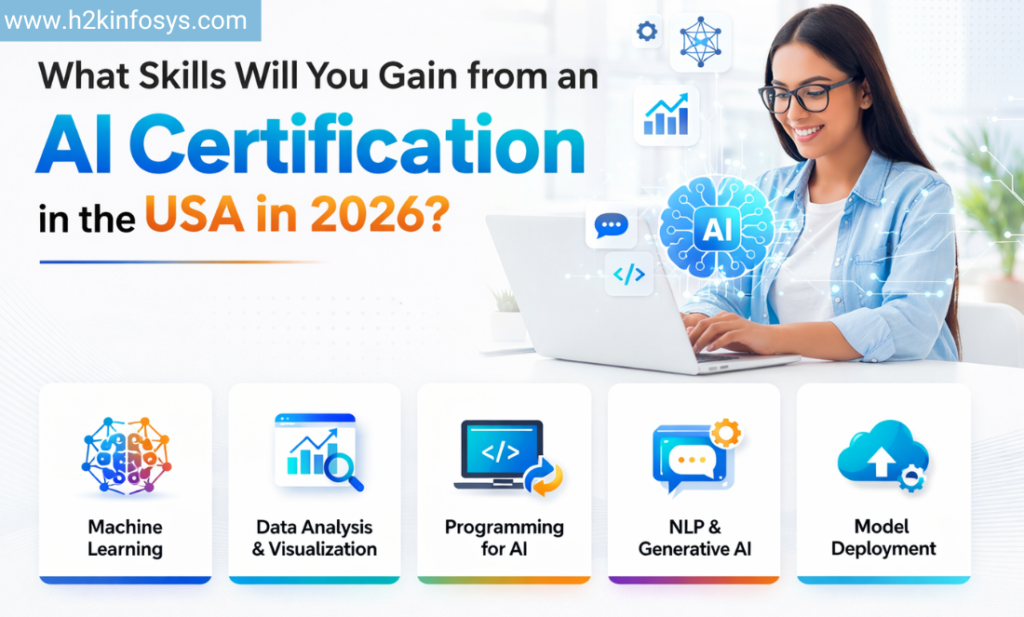
An AI certification in the USA equips learners with a combination of technical, analytical, and applied skills required to design, develop, and deploy artificial intelligence solutions in real-world environments. At H2K Infosys, AI training programs are designed to provide hands-on experience in key areas such as machine learning model development, data preprocessing, programming, model evaluation, and deployment practices used in enterprise IT systems. These AI Training Courses also emphasize practical problem-solving, industry relevant tools, and workflow integration across various business domains, helping learners become job-ready professionals.
What is an AI Certification in the USA?
An AI certification in the USA is a structured training program designed to validate an individual’s ability to work with artificial intelligence technologies. These programs are typically offered by training institutions, universities, and professional platforms.
They focus on:
- Core AI concepts (machine learning, deep learning, NLP)
- Practical implementation using tools and frameworks
- Real-world project exposure
- Industry-relevant workflows
Unlike purely academic degrees, AI training courses are often aligned with job roles and emphasize hands-on learning.
Why is AI Certification Important for Working Professionals?
AI is increasingly integrated into enterprise systems across industries such as finance, healthcare, retail, and logistics. For working professionals, AI Course Certification helps bridge the gap between theoretical knowledge and practical application.
Key reasons include:
- Skill relevance: Many IT roles now require familiarity with AI and data-driven decision-making
- Career transition: Enables movement from traditional IT roles (QA, support, manual testing) to AI-focused roles
- Project readiness: Provides exposure to tools and workflows used in production environments
- Standardization: Certifications offer structured learning aligned with industry expectations
What Skills Do You Gain from AI Training Courses?
AI course certification programs typically focus on a layered skill development approach.
1. Programming Skills for AI Development
Most AI systems are built using programming languages such as:
- Python (primary language for AI/ML)
- R (used in statistical modeling)
- SQL (for data extraction and manipulation)
Practical Skills:
- Writing scripts for data processing
- Implementing algorithms using libraries like NumPy and Pandas
- Automating workflows
2. Data Handling and Preprocessing Skills
AI models depend heavily on high-quality data. Learners develop skills to handle raw datasets.
Core tasks include:
- Data cleaning (handling missing values, duplicates)
- Data transformation and normalization
- Feature engineering
- Data visualization using tools like Matplotlib or Seaborn
Example Workflow:
- Import dataset
- Identify null values
- Apply transformations
- Create new features
- Prepare dataset for modeling
3. Machine Learning Model Development
A key component of AI certification is understanding how to build predictive models.
Skills gained:
- Supervised learning (regression, classification)
- Unsupervised learning (clustering)
- Model selection and training
- Hyperparameter tuning
Common algorithms:
- Linear Regression
- Decision Trees
- Random Forest
- Support Vector Machines
4. Deep Learning and Neural Networks
Advanced AI training includes deep learning concepts.
Skills include:
- Understanding neural network architecture
- Working with frameworks like TensorFlow and PyTorch
- Training models for image recognition, speech processing
Enterprise Use Case:
- Fraud detection systems
- Medical image analysis
- Recommendation engines
5. Natural Language Processing (NLP)
NLP enables machines to understand human language.
Skills covered:
- Text preprocessing
- Tokenization and stemming
- Sentiment analysis
- Chatbot development
Tools:
- NLTK
- spaCy
- Transformers (Hugging Face)
6. Model Evaluation and Optimization
Building a model is only part of the process; evaluating its performance is critical.
Skills gained:
- Accuracy, precision, recall metrics
- Confusion matrix interpretation
- Cross-validation techniques
- Overfitting vs underfitting analysis
7. AI Model Deployment Skills
In enterprise environments, deploying models is essential.
Skills include:
- Creating APIs using Flask or FastAPI
- Integrating models into applications
- Monitoring model performance in production
- Version control using Git
How Does AI Work in Real-World IT Projects?
AI in enterprise projects follows a structured lifecycle.
Typical AI Workflow:
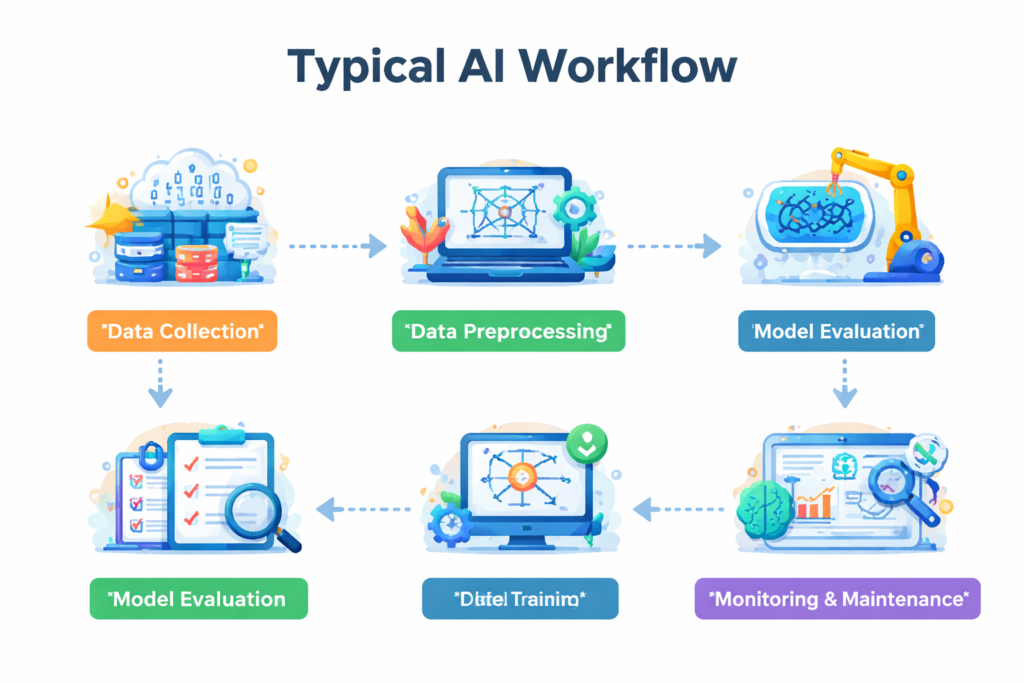
| Step | Description |
|---|---|
| Problem Definition | Identify business use case |
| Data Collection | Gather structured/unstructured data |
| Data Processing | Clean and prepare data |
| Model Building | Train AI/ML models |
| Evaluation | Validate performance |
| Deployment | Integrate into system |
| Monitoring | Track performance and retrain |
Example Scenario: Customer Churn Prediction
- Extract customer data from database
- Clean and preprocess data
- Build classification model
- Evaluate using accuracy metrics
- Deploy model into CRM system
- Predict churn risk in real-time
How is AI Used in Enterprise Environments?
AI is commonly integrated into business processes to improve efficiency and decision-making.
Common Enterprise Applications:
- Finance: Fraud detection, credit scoring
- Healthcare: Diagnosis support systems
- Retail: Recommendation engines
- Logistics: Demand forecasting
- Customer Support: Chatbots and automation
Key Challenges:
- Data privacy and compliance
- Model interpretability
- Scalability of AI systems
- Integration with legacy systems
What Skills Are Required to Learn AI Course Certification?
Before enrolling in AI training courses, learners benefit from foundational knowledge.
Recommended Prerequisites:
- Basic programming (Python preferred)
- Understanding of statistics (mean, variance, probability)
- Familiarity with data structures
- Logical problem-solving skills
What Tools and Technologies Are Covered in AI Training Courses?
AI certification programs expose learners to industry-standard tools.
Tool Comparison Table:
| Category | Tools | Purpose |
|---|---|---|
| Programming | Python, R | Core development |
| Data Handling | Pandas, NumPy | Data manipulation |
| Visualization | Matplotlib, Seaborn | Graphical insights |
| ML Frameworks | Scikit-learn | Model building |
| Deep Learning | TensorFlow, PyTorch | Neural networks |
| NLP | NLTK, spaCy | Text processing |
| Deployment | Flask, Docker | Model deployment |
What Job Roles Use AI Skills Daily?
AI certification prepares learners for multiple roles across IT and data domains.
Role vs Skill Mapping:
| Job Role | Key Skills Used |
|---|---|
| Machine Learning Engineer | Model building, deployment |
| Data Scientist | Data analysis, ML algorithms |
| AI Engineer | Deep learning, NLP |
| Data Analyst | Data visualization, statistics |
| Business Analyst | AI-driven insights |
| Automation Engineer | AI integration in workflows |
What Careers Are Possible After Learning AI?
AI certification opens opportunities across multiple industries.
Career Paths:
- Entry-level: Junior Data Analyst, AI Associate
- Mid-level: Machine Learning Engineer, Data Scientist
- Advanced: AI Architect, Research Scientist
Industries Hiring AI Professionals:
- Banking and Finance
- Healthcare
- E-commerce
- Telecommunications
- Manufacturing
How Do AI Training Courses Support Hands-On Learning?
Practical exposure is a key component of AI course certification.
Common Learning Activities:
- Real-world datasets (e.g., customer data, sales data)
- Capstone projects
- Model deployment exercises
- Case studies based on enterprise problems
Example Project:
Predicting Loan Approval
- Input: Applicant data
- Process: Feature engineering + model training
- Output: Approval prediction
What Are the Best Practices Followed in AI Projects?
Professionals working with AI follow structured best practices.
Development Best Practices:
- Use version control (Git)
- Maintain clean datasets
- Document models and assumptions
- Use reproducible workflows
Deployment Best Practices:
- Monitor model drift
- Implement logging systems
- Ensure data security compliance
- Use scalable infrastructure (cloud platforms)
FAQ: AI Certification and Skills
1. Do AI training courses require coding experience?
Basic programming knowledge is recommended, especially in Python. However, many beginner-friendly AI course certification programs include foundational coding modules.
2. How long does it take to gain AI skills?
Depending on the program, learners can acquire foundational skills in 3–6 months, with continued learning required for advanced expertise.
3. Are AI certifications useful for non-technical professionals?
Yes, roles like business analysts and project managers benefit from understanding AI workflows and data-driven decision-making.
4. What is the difference between AI and machine learning skills?
AI is a broader domain that includes machine learning, NLP, and robotics. Machine learning is a subset focused on algorithms that learn from data.
5. Do AI certifications include real-world projects?
Most structured AI training courses include hands-on projects that simulate enterprise scenarios such as prediction models and automation systems.
6. Can AI skills be applied across industries?
Yes, AI is domain-agnostic and is used in finance, healthcare, retail, logistics, and more.
Key Takeaways
- AI certification in the USA builds practical, job-ready skills in machine learning, data handling, and model deployment
- AI training courses emphasize real-world workflows, tools, and enterprise applications
- Learners gain experience with industry-standard technologies like Python, TensorFlow, and Scikit-learn
- AI skills are applicable across multiple roles including data science, machine learning engineering, and analytics
- Hands-on projects and deployment practices prepare professionals for real IT environments