Salesforce AI in 2026 is becoming increasingly autonomous, where it’s no longer a helper but a decision-maker, a predictor, and a workflow optimizer with minimal human intervention, and right from the start, H2K Infosys is making sure its Salesforce certification training programs are keeping up with this new trend.
The Quiet Shift: From “Smart Tools” to “Decision Makers”
If you’re a Salesforce user with a bit of experience, you might have noticed something interesting: AI wasn’t always a part of the equation. At least, it wasn’t a necessary part. Now, however, it seems like it is.
Salesforce AI in 2026 is becoming increasingly integral to how a business will function on its platform. It’s no longer a nice-to-have but a need-to-have. And it’s getting into areas where it feels a bit well, a bit too close to decision-making for comfort.
It’s exciting, but it’s a bit daunting at the same time.
I recall a project I handled a couple of years ago where we had to adjust our lead scoring criteria every quarter. Now, AI is handling it for us in real-time, without our knowledge of it even happening.
Einstein AI Is Evolving And It’s Getting Personal
So let’s talk a bit about Einstein AI.
Einstein AI used to be a prediction tool for forecasts and opportunity scores. Now, however, Salesforce AI’s Einstein is becoming a bit more conversational. Think about it:
- AI copilots on our dashboards
- Natural language processing for our reports
- Recommendations in real-time during customer engagement
You’re no longer just using Salesforce. You’re kind of talking to it.
A sales rep, for example, can now ask:
“What deals are most likely to close this week, and why?”
Instead of a report, they get an explanation, including risk factors, recent customer sentiment, and what to do next.
That’s a big leap forward.
The Rise of Autonomous Workflows
One of the largest changes in Salesforce AI this year is automation, but not the automation we’re used to thinking about. No, this is way more advanced.
We’re talking about AI-powered workflows that can:
- Find patterns in lots of different data sources
- Take action on their own, without anyone touching a button
- Get better on their own, automatically optimizing their processes
For example, a customer service system can automatically detect a frustrated tone in a customer’s voice, escalate the case to a top agent, offer a discount or compensation, and even record the case to improve itself on future interactions.
This is what’s starting to feel like a digital teammate, not just software.
Why Training is More Important, Not Less
You might think, “With all this automation, don’t we need to worry less about training?” Well, think again.
With Salesforce AI getting so much more powerful, training is now more, not less, important. Why? Because the more powerful Salesforce AI is, the more we need to understand:
- How is this AI trained?
- What data is this AI using?
- How might this AI get biased, and what are the risks?
- How do we understand what this AI is telling us?
That’s why Salesforce training classes, Salesforce certification training, etc., are changing so fast. They’re not just about teaching people to use Salesforce anymore. They’re about teaching people to understand Salesforce AI.
I’ve seen professionals struggle not because they don’t know how to use Salesforce, but because they don’t trust, or don’t understand, what the AI is giving them.
And in a system this advanced, that hesitation could bring everything to a grinding halt.
Real World Scenario: Sales Teams in 2026
Okay, let me give you a brief example of what this could look like in the real world.
Let’s say you’re a mid-sized SaaS company using Salesforce AI to power your sales pipeline. Let’s walk through what a typical day could look like:
- AI systems automatically prioritize leads
- AI systems write emails to those leads with a surprisingly human tone
- Sales reps receive recommendations on the best time to follow up
- AI systems alert them when a deal is at risk of falling apart
The result is a much more efficient sales process with better conversion rates and less guessing.
But the problem is that those who don’t know how to effectively interpret the AI recommendations often choose to ignore them or worse – misuse them.
That’s where the Salesforce admin training comes in – they’re the new middleman between the AI systems and the business decisions.
Data Cloud + AI: The Real Game Changer
But what is the real game changer behind this rapid evolution in AI systems? Well, it’s actually pretty simple – it’s the data.
I think the integration of the Salesforce AI with the Salesforce Data Cloud is probably one of the biggest reasons we’re seeing this rapid evolution in AI systems.
Because of this integration, we’re able to see a more holistic approach to how we’re using the data. We’re able to see:
- Unified customer profiles
- Real-time data
- Cross-channel insights
And when the AI systems have this much context, their recommendations become almost eerily accurate.
I’ve seen cases where the AI systems were able to predict a churn event weeks before anyone else knew anything was wrong.
That’s not magic – that’s just good data usage.
The Role of Generative AI in Salesforce
Well, the buzzwords of the future – Generative AI – are no longer just a buzzword – it’s actually a reality on the platform.
Salesforce AI can now assist with:
- Writing emails and proposals
- Summarizing customer interactions
- Generating reports in plain language
- Creating knowledge base articles
And it does so in a more natural-sounding way.
But it’s not perfect. There’s still a need for human intervention to refine the tone and context. Still, it’s saving us hours of work every week.
This is why the latest Salesforce training courses now include prompt engineering as part of the syllabus.
After all, the right question for the AI is the right answer.
Ethical AI: A Bigger Conversation Than Ever
With great power comes great responsibility. Yeah, yeah, we know the rest.
As Salesforce AI continues to evolve and become more autonomous, so does the debate around ethics and transparency.
Businesses are now asking:
- Why did the AI make this decision?
- Can we audit the AI?
- Are we inadvertently perpetuating biases?
Salesforce has introduced more features to increase explainability, but it’s not just their responsibility.
Businesses also need trained professionals who can:
- Interpret AI outputs
- Identify biases
- Ensure compliance
This is why the latest Salesforce training courses are not just technical but also strategic and ethical.
Industries Feeling the Impact Most
While Salesforce AI is impacting many businesses, some industries are feeling the effects more than others.
Healthcare
AI can now predict patient needs, schedule appointments, and improve communication.
Finance
Fraud detection and risk analysis are now faster and more accurate.
Retail
Hyper-personalized customer experiences are no longer the exception but the norm.
Education
Student engagement and retention strategies can now be powered by AI.
And in all these, one thing is consistent the need for professionals who have the skills and the knowledge, both in the platform and the AI.
The Skills You’ll Actually Need in 2026
Let’s face it, we need more than the ability to click around the Salesforce platform.
What’s Becoming Important
- AI literacy the ability to understand the AI itself
- Data interpretation skills
- Prompt engineering skills
- Workflow automation design skills
- Ethical decision-making skills
Yes, admin skills still exist, but these have now become the foundation.
This is the reason people are opting to take more time in Salesforce administrator classes and advanced Salesforce training.
A Small Personal Observation
I have a small observation, and I think it’s quite interesting.
People who use Salesforce AI successfully aren’t necessarily the ones who have the technical skills. They’re the ones who have the curiosity to ask:
“Why did the AI suggest this?” Instead of accepting it, using it, and so on.
Where H2K Infosys Fits Into All This
Salesforce AI is constantly evolving, and so must the training industry. Not everyone is doing a good job in this.
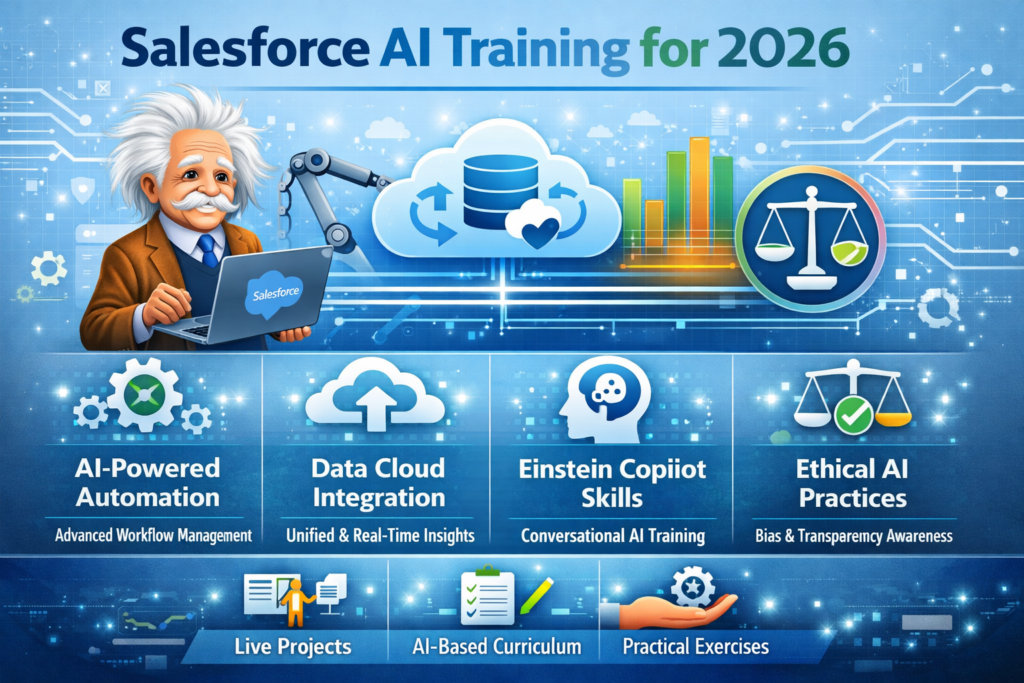
What’s interesting about H2K Infosys is that their approach is forward-thinking. Their programs are changing to include:
- Real-time project scenarios
- AI-based use cases
- Hands-on experience with Einstein AI Salesforce tools
That’s important, as learning from outdated information in a field that’s advancing at a rate like this well, let’s just say it’s not going to be all that useful.
The Future: Fully Autonomous CRM?
So, where is all this going?
If we look at where we are versus where we were, it’s pretty clear that Salesforce AI is on a path to create a fully autonomous CRM system.
Think about it:
- AI handling customer relationship management from start to finish
- AI predicting customer needs before they ever have to ask
- AI automatically adjusts business strategies
Okay, so we’re not quite there yet. But we are closer than most people think.
Final Thoughts
Salesforce AI in 2026 is no longer an evolution. It’s a revolution in how we think about work.
It’s no longer about tools. It’s no longer about technology. It’s about how we work with each other as humans, and with AI.
And if you want to remain relevant in a field like this, spending time in a Salesforce AI training class or a Salesforce AI certification class is no longer optional. It’s kind of a baseline.
Because it’s going to be people who understand how to work with AI, not against it, who are going to be standing out.