Artificial Intelligence (AI) certifications in the USA can significantly boost career prospects, providing professionals with essential skills needed to excel in AI-driven industries. These certifications are often recognized by leading companies and provide a practical understanding of AI tools, techniques, and applications in real-world IT environments. Among the various AI certifications available, some offer higher job placement rates, as they are aligned with the needs of employers and industry trends. In this article, we will explore the most valuable AI certifications, how they work in real-world IT projects, the skills they teach, and the career opportunities they create.
At H2K Infosys, we offer comprehensive AI and machine learning courses tailored to equip professionals with the skills and certifications needed to succeed in this rapidly evolving field. With a focus on hands-on learning and industry-standard tools, our courses provide the necessary foundation to gain recognition in the AI space and open doors to career advancement.
What is AI Certification?
An AI certification is a formal recognition that a professional has acquired a certain level of expertise in the field of Artificial Intelligence. AI certifications typically validate an individual’s ability to work with AI tools, technologies, and frameworks. They are offered by educational platforms, universities, and tech companies, and can vary in terms of depth, specialization, and cost. Obtaining an AI certification is a way for IT professionals to demonstrate their knowledge and proficiency in AI, enhancing their employability and career prospects.
How Do AI Certifications Work in Real-World IT Projects?
AI certifications provide knowledge and skills that can be directly applied in real-world IT projects, particularly in industries such as healthcare, finance, manufacturing, and retail. These certifications focus on the practical use of AI tools and techniques, enabling professionals to solve problems related to automation, machine learning (ML), data analysis, natural language processing (NLP), and robotics.
Common Use Cases of AI in IT Projects
- Machine Learning (ML) and Predictive Analytics: AI certifications often teach professionals to develop models that predict future trends based on historical data, such as customer behavior, market trends, and operational efficiency.
- Natural Language Processing (NLP): This involves AI applications like chatbots, voice recognition, and sentiment analysis, which are widely used in customer service and marketing.
- Automation of Business Processes: Many AI certifications focus on developing automation solutions, including robotic process automation (RPA), for streamlining business workflows.
- AI in Cybersecurity: AI certifications teach how AI is used to detect threats, predict vulnerabilities, and automate response strategies in enterprise security environments.
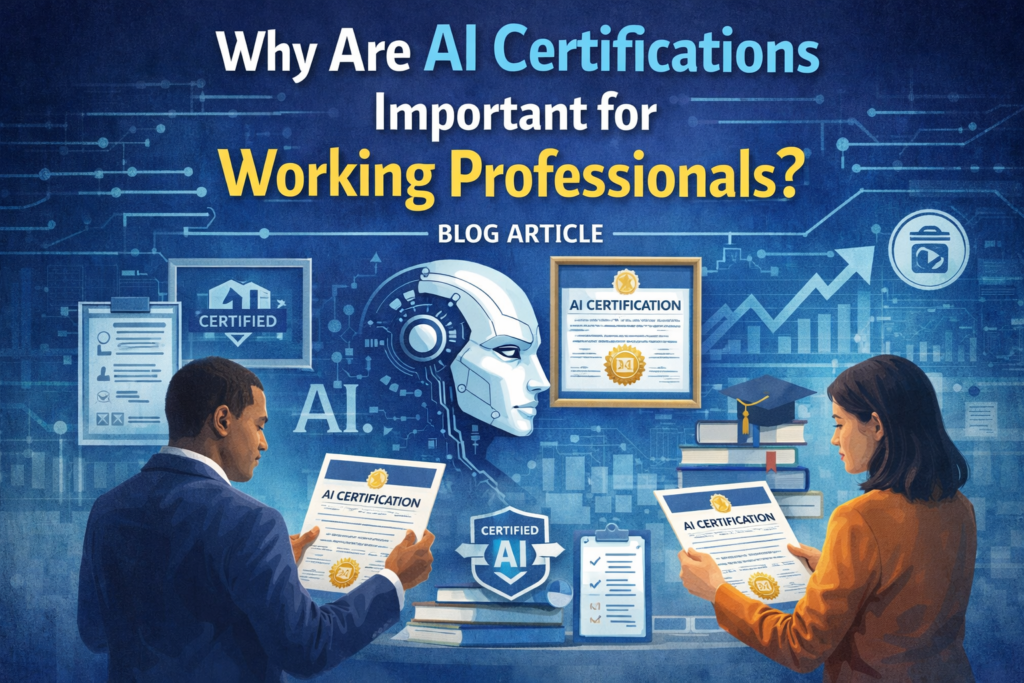
Why Are AI Certifications Important for Working Professionals?
AI certifications are crucial for working professionals for several reasons:
- Increased Demand for AI Professionals: As AI continues to transform industries, there is a growing demand for skilled professionals who can implement AI solutions effectively.
- Career Advancement: Professionals with AI certifications are often considered for higher-level roles such as data scientists, AI engineers, and machine learning experts.
- Competitive Edge: In a crowded job market, AI certifications can give candidates a competitive edge by demonstrating their specialized knowledge and commitment to continuous learning.
- Improved Salary Prospects: AI skills are in high demand, and professionals with relevant certifications often command higher salaries and job benefits.
What Skills Are Required to Learn AI?
AI certifications generally require a basic understanding of computer science, programming, and data analysis. However, more advanced certifications may require a deeper knowledge of statistics, machine learning algorithms, and mathematical modeling. The skills required to succeed in AI certifications typically include:
- Programming Languages: Proficiency in Python, R, Java, and other languages commonly used in AI development.
- Mathematics and Statistics: Strong foundations in linear algebra, calculus, probability, and statistics are essential for understanding machine learning and data science concepts.
- Data Management: The ability to work with large datasets, clean data, and use databases effectively is critical for AI development.
- Machine Learning Algorithms: Understanding algorithms such as decision trees, regression analysis, and neural networks.
- Software Tools: Familiarity with AI frameworks and libraries such as TensorFlow, Keras, PyTorch, and Scikit-learn.
Which AI Certifications Lead to the Highest Job Placement Rates?
Several AI certifications are recognized by employers and can lead to high job placement rates. These certifications are offered by top educational institutions, tech companies, and professional organizations. Below are some of the most prominent AI certifications in the USA.
1. Google Professional Machine Learning Engineer
Overview: The Google Professional Machine Learning Engineer certification is designed for professionals looking to demonstrate their expertise in machine learning and AI applications. It covers machine learning theory, data preparation, model development, and the deployment of AI models in production environments.
Job Placement Potential: Given Google’s influence in the AI field, this certification is highly respected in the tech industry. Many companies seek professionals who are proficient in Google Cloud AI tools and machine learning practices, leading to high job placement rates.
Skills Acquired:
- Building machine learning models using TensorFlow and Keras
- Working with large datasets and cloud infrastructure
- Developing AI solutions for scalable applications
2. IBM AI Engineering Professional Certificate
Overview: Offered by IBM this certification provides professionals with hands-on experience in AI engineering. It covers the core aspects of AI, such as machine learning, deep learning, neural networks, and natural language processing (NLP).
Job Placement Potential: IBM’s strong presence in the enterprise technology space makes this certification valuable for professionals seeking roles in AI development, particularly within large organizations. The certificate also includes industry-standard tools such as Watson, further increasing its employability appeal.
Skills Acquired:
- Building machine learning models
- Natural language processing and deep learning
- Working with cloud-based AI tools
3. Microsoft Certified: Azure AI Engineer Associate
Overview: This certification focuses on AI development using Microsoft Azure. Professionals will learn how to implement AI solutions using Azure’s machine learning, cognitive services, and bot services. The certification is ideal for those interested in cloud-based AI solutions.
Job Placement Potential: Microsoft is a leading provider of enterprise software and cloud services. As businesses increasingly adopt Microsoft Azure, demand for Azure-certified AI engineers is high, which boosts job placement rates.
Skills Acquired:
- Designing and implementing AI solutions using Azure
- Integrating AI with cloud services and APIs
- Developing intelligent apps with Azure Cognitive Services
4. Stanford University’s Machine Learning Certification
Overview: Stanford University offers one of the most highly regarded machine learning courses, taught by Professor Andrew Ng. This certification provides a deep understanding of machine learning algorithms, supervised and unsupervised learning, and reinforcement learning.
Job Placement Potential: Due to its academic prestige, Stanford’s certification is highly respected in the tech industry. The course provides a strong foundation in machine learning, which can lead to roles in AI engineering, data science, and machine learning research.
Skills Acquired:
- Supervised and unsupervised learning algorithms
- Neural networks and deep learning techniques
- Practical applications of machine learning models
5. Certified AI & Machine Learning Expert (CEAI)
Overview: The Certified AI & Machine Learning Expert certification, offered by the Global Tech Council, provides in-depth knowledge and hands-on experience in machine learning, deep learning, and artificial intelligence. It is designed for professionals looking to specialize in AI systems and applications.
Job Placement Potential: This certification is ideal for professionals seeking roles in AI development and research. The certification is recognized in the industry, and its hands-on approach helps professionals demonstrate practical AI skills that are in high demand.
Skills Acquired:
- Advanced machine learning techniques
- Deep learning algorithms and neural networks
- Practical AI applications in various industries
What Careers Are Possible After Learning AI?
AI professionals can pursue a variety of roles in tech companies, startups, and enterprises. Some of the most common job roles after completing AI certifications include:
- Machine Learning Engineer: Responsible for designing and developing machine learning models and systems to automate tasks and improve decision-making processes.
- Data Scientist: Specializes in extracting insights from data using AI tools and techniques, often applying machine learning models to analyze trends and predict outcomes.
- AI Research Scientist: Conducts research to develop new AI algorithms, models, and techniques, often working in academic or corporate research labs.
- AI Software Engineer: Develops AI-powered software solutions, integrating machine learning, computer vision, and natural language processing into applications.
- AI Product Manager: Oversees the development and implementation of AI products, ensuring they meet customer needs and align with business objectives.
FAQ: AI Certifications
Q1: What is the best AI certification for beginners?
The Stanford University Machine Learning Certification and IBM AI Engineering Professional Certificate are excellent for beginners, offering a foundational understanding of machine learning and AI principles.
Q2: How long does it take to get an AI certification?
The duration of AI certifications varies. For example, the Google Professional Machine Learning Engineer certification typically takes 3-6 months to prepare for, while Stanford’s Machine Learning Certification can be completed in around 2-3 months, depending on the learner’s pace.
Q3: Are AI certifications recognized by employers?
Yes, many AI certifications from organizations like Google, IBM, Microsoft, and Stanford are highly recognized by employers, particularly in tech and AI-driven industries.
Q4: Can I pursue an AI certification without a strong programming background?
While a basic understanding of programming is helpful, many AI certifications, such as the IBM AI Engineering Professional Certificate, are designed to teach essential skills from scratch, making them accessible to beginners in programming.
Conclusion & Key Takeaways
AI certifications can greatly enhance a professional’s career in the rapidly growing AI field. Key certifications from Google, IBM, Microsoft, and Stanford provide opportunities for high job placement rates due to their industry recognition and focus on practical, real-world skills. Professionals who pursue Artificial intelligence certification online gain valuable knowledge in machine learning, natural language processing, and AI integration in various industries.
- Google Professional Machine Learning Engineer is highly respected.
- IBM’s AI Engineering certificate offers hands-on experience with industry-standard tools.
- Microsoft’s Azure AI Engineer Associate is essential for cloud-based AI roles.
- Stanford’s certification offers foundational knowledge in machine learning.
- AI & Machine Learning Expert certification offers in-depth expertise.
To accelerate your AI career, explore hands-on learning opportunities and industry-recognized certifications from H2K Infosys today.