If you take a step back and look at AI courses in 2026, there’s definitely a pattern kind of hard to miss once you notice it. The ones people actually bring up in conversations, or casually recommend, aren’t the ones packed with dense theory and slide decks that go on forever. It’s usually the courses that show what things look like in practice… like how models get built, break, and then (hopefully) work again.
They still cover the fundamentals, yeah that part hasn’t gone anywhere. You’ll run into the usual machine learning concepts. But that’s not really what sticks with people. What does is the hands on stuff: writing Python code, experimenting with TensorFlow or PyTorch, sometimes pushing things to the cloud just to see how they behave outside your laptop.
And honestly, it kind of tracks. Learning AI and Machine learning Courses this way doesn’t feel like traditional studying. It’s messier, a bit trial-and-error at times but closer to how things actually happen on the job. You’re not just memorizing ideas, you’re… figuring them out as you go, which is probably the whole point.
So… what exactly is an online AI course?
At a basic level, it’s just a structured way to learn Courses of Artificial Intelligence. But that definition doesn’t really say much.
The better courses go beyond just watching videos. They usually include:
- Core concepts machine learning, deep learning, NLP, computer vision
- Programming (mostly Python, no surprise there)
- Data cleaning and preprocessing (which takes more time than people expect)
- Building and evaluating models
- Deploying those models using cloud tools or containers
It’s less about “knowing AI” and more about being able to do something useful with it.
What you’ll usually learn (if the course is solid)
Most modern AI courses revolve around a few key areas:
- Programming: Python, plus libraries like NumPy and Pandas
- Machine Learning: Supervised and unsupervised methods
- Deep Learning: Neural networks, CNNs, RNNs
- Frameworks: TensorFlow, PyTorch, Scikit-learn
- Deployment: Docker, Kubernetes, APIs
- MLOps: CI/CD pipelines for models
If deployment or MLOps is completely missing… that’s usually a warning sign. Not always, but often.
Different types of AI courses you’ll come across
Not all courses are built for the same purpose. Broadly, they fall into three buckets.
1. Foundation + Practical Programs
Good if you’re starting out.
They cover:
- Core algorithms
- Data science basics
- Hands-on coding
You’ll work through things like regression, classification, feature engineering, and how to evaluate models properly.
2. Advanced AI & Deep Learning
This is where things get deeper (and sometimes a bit overwhelming):
- Neural networks
- Transformers
- Generative AI
These usually assume you already know the basics so jumping in too early can feel rough.
3. Enterprise AI & MLOps Courses
These are especially useful if you’re already in a job and want to level up.
They focus on:
- Deployment pipelines
- Monitoring and retraining models
- Integrating AI into real systems
This is where AI stops being a “project” and becomes part of a product.
How AI actually works in real projects
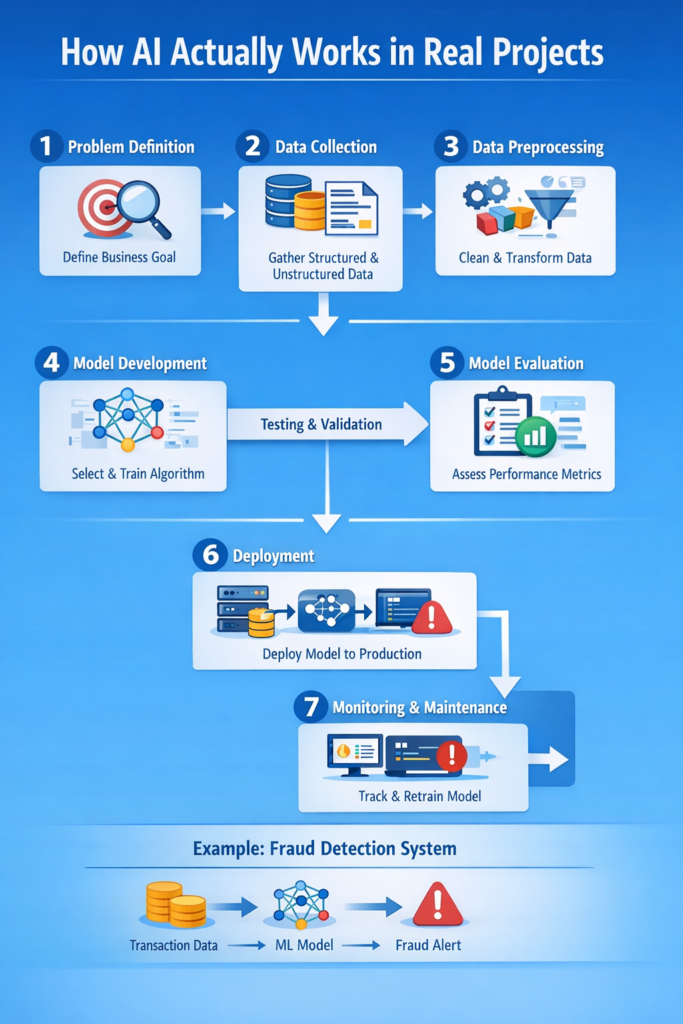
In real companies, AI isn’t just experimentation or Kaggle-style modeling. There’s a process pretty structured, actually.
A typical workflow looks like:
- Define the problem (e.g., predicting customer churn)
- Collect data (databases, logs, text, whatever’s available)
- Clean and preprocess it (this part can get messy)
- Build a model (Random Forest, neural networks, etc.)
- Evaluate it (accuracy, precision, recall, F1 score)
- Deploy it (API or batch pipeline)
- Monitor and maintain it
Take fraud detection as a simple example:
- Input: transaction data
- Process: classification model
- Output: fraud probability
- Deployment: real-time API connected to payment systems
That’s the kind of end-to-end thinking good courses try to teach.
Why so many professionals are learning AI now
AI isn’t really optional anymore in a lot of industries. It’s quietly become part of everyday systems finance, healthcare, retail, even IT operations.
People usually get into AI for a few reasons:
- Automating decisions
- Getting better insights from data
- Working with cloud platforms (AWS, Azure, etc.)
- Moving into higher-paying roles
In real terms, that means things like:
- Fraud detection in banking
- Patient risk prediction in healthcare
- Recommendation systems in retail
- Predictive maintenance in IT
Skills you’ll need (and pick up along the way)
You don’t need to be amazing at math but some basics definitely help.
Core skills:
- Python
- Basic data structures
- Statistics and probability
- Linear algebra (just the essentials)
AI-specific skills:
- Data preprocessing
- Feature engineering
- Model selection and tuning
- Model evaluation
Tools you’ll keep seeing:
- Python
- Pandas
- Scikit-learn
- TensorFlow / PyTorch
- Jupyter Notebook
- Docker
How AI fits into real systems
In companies, AI isn’t sitting alone it’s part of a larger pipeline.
A simplified flow looks like:
Data → Pipeline → Model → Deployment → Monitoring
A few realities here:
- Models need to scale
- Security and compliance matter
- Everything connects through APIs
A typical setup might include:
- Data from multiple sources
- ETL pipelines
- Cloud-based training
- Containerized deployment
- Monitoring with logs and alerts
Roles where AI is used daily
Once you’ve got AI skills, there are a few common paths:
- Machine Learning Engineer: builds and deploys models
- Data Scientist: analyzes data and creates predictions
- AI Engineer: integrates AI into applications
- MLOps Engineer: handles deployment and lifecycle
- Advanced Data Analyst: uses ML tools for insights
Daily work often includes:
- Writing data pipelines
- Training and tuning models
- Debugging performance issues
- Collaborating with dev teams
- Monitoring systems in production
Career paths after learning AI
Depending on what you enjoy:
- ML algorithms → Machine Learning Engineer
- Data analysis → Data Scientist
- Deep learning → AI Researcher
- Deployment → MLOps Engineer
- Business side → AI Product Analyst
Rough progression:
- Entry-level: Data Analyst, Junior ML Engineer
- Mid-level: ML Engineer, Data Scientist
- Advanced: AI Architect, Lead Data Scientist
What actually makes a course worth it?
Not all courses deliver. A few things that usually matter:
- Hands-on projects (with real datasets, not toy ones)
- Coverage of tools (Python + ML + cloud)
- Real-world use cases
- Some exposure to MLOps
- Instructors with actual industry experience
If it’s all theory and no real application… it’s probably not enough.
A simple learning path
If you’re starting from scratch, it usually goes like this:
- Beginner: Python, statistics, data basics
- Intermediate: ML algorithms, evaluation
- Advanced: Deep learning, NLP, computer vision
- Professional: Deployment, MLOps, cloud AI
Example workflow (real-world style)
Let’s say you’re building a churn prediction system:
- Collect CRM data
- Clean and preprocess it
- Train a classification model
- Evaluate using ROC-AUC
- Deploy via API
- Monitor performance over time
That’s the kind of end-to-end flow you’ll need to get comfortable with.
Challenges (because there will be some)
Learning AI isn’t always smooth.
Technical side:
- Understanding math concepts
- Debugging models
- Handling large datasets
Practical side:
- Not enough real-world exposure
- Deployment feels confusing at first
- Integration with existing systems
What usually helps:
- Work on real datasets
- Build complete projects (not just notebooks)
- Start learning deployment earlier than you think
A few quick questions people usually ask
Best AI course for beginners?
One that starts simple—Python, stats—and gradually adds projects.
Is it good for working professionals?
Yes, especially courses focused on real workflows and deployment.
How long does it take?
- 3–6 months for basics
- 6–12 months to feel job-ready
Do you need coding experience?
Helpful, but many courses teach Python from scratch.
Does certification matter?
It helps a bit but real projects matter more.
Final thoughts
If there’s one thing worth remembering it’s this: the best AI courses today are practical.
They don’t stop at building models. They show how those models actually get used starting from messy data and ending in real systems that people rely on.
That’s what really makes the difference.
If you’re choosing a course, look for one that feels close to real work. Not just concepts, but actual workflows. That’s where things start to click and where your career really starts moving.