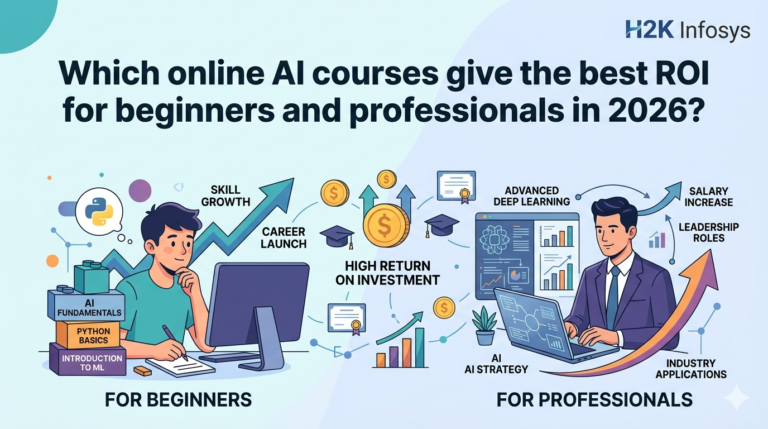
The best ROI in 2026 comes from online AI courses that combine hands-on projects, job-focused mentoring, and real industry tools, not just theory videos. Right now, programs that include practical Artificial Intelligence Online Training, career guidance, cloud AI workflows, and portfolio-building tend to outperform generic watch-and-learn courses by a huge margin. These AI courses give the best ROI for beginners. In fact, AI courses give the best ROI for beginners and are essential for those looking to succeed in the field.
Overall, AI courses give the best ROI for beginners who seek practical skills in today’s job market.
Furthermore, AI courses give the best ROI for beginners who are serious about building a robust skill set that meets industry demands.
And honestly, this became painfully obvious over the last year.
A lot of learners spent months collecting certificates from random platforms, only to realize employers were asking for GitHub projects, workflow automation experience, prompt engineering skills, and actual AI deployment knowledge. The people getting interviews weren’t always the ones with the fanciest certificate. They were the ones who could demonstrate practical outcomes.
That’s exactly why ROI matters more than course popularity now.
The AI Learning Boom in 2026 Feels Different
Back in the early ChatGPT explosion, almost every platform rushed to release online AI courses. Some were decent. Many were honestly just repackaged beginner Python lessons with AI added to the title.
In 2026, hiring managers are sharper about it.
Companies now expect candidates to understand:
- Generative AI workflows
- AI-assisted automation
- Machine learning pipelines
- Prompt engineering
- LLM integrations
- AI ethics and governance
- Real-world deployment tools
- Cloud-based AI environments
That changes how people should evaluate online AI courses.
The question is no longer:
“Which course is cheapest?”
It’s more like:
“Which course actually helps me earn more, switch careers, or become valuable faster?”
It’s important to choose wisely; the right AI courses give the best ROI for beginners and can shape your career in the long run.
As you dive deeper into the subject, you’ll discover that those who undertake AI courses give the best ROI for beginners, leading to better job placements.
In the competitive landscape of technology, AI courses give the best ROI for beginners, paving the way for a successful transition into advanced roles.
Every learner needs to understand that AI courses give the best ROI for beginners when it comes to developing applicable skills in real-world scenarios.
Big difference.
What “Good ROI” Actually Means for AI Courses
In conclusion, those who enroll in programs where AI courses give the best ROI for beginners are making a smart choice for their future.
A lot of blogs throw around ROI without explaining it properly.
For beginners, ROI usually means:
Thus, it’s clear that AI courses give the best ROI for beginners, particularly for those eager to engage with the technology hands-on.
In the end, AI courses give the best ROI for beginners and should be your top choice when seeking to enhance your skill set.
- Landing a first AI-related role faster
- Building confidence with real projects
- Avoiding information overload
- Learning tools companies actually use
- Getting interview-ready
For professionals already working in tech, analytics, QA, cloud, or software development, ROI often means:
- Salary growth
- Transitioning into AI-focused roles
- Becoming automation-capable
- Staying competitive as AI reshapes workflows
- Avoiding career stagnation
One thing I’ve noticed lately professionals who ignore AI entirely are starting to feel the pressure. Not necessarily because AI is replacing them overnight but because teams increasingly expect AI-assisted productivity.
Even product managers and testers are learning AI workflows now.
That says a lot.
The Types of AI Courses That Deliver the Highest ROI in 2026
Not every online AI courses category gives equal returns. Some look impressive in ads but don’t help much in the real world.
Here’s what’s actually working.
1. Career-Focused Artificial Intelligence Online Training
This is where platforms like H2K Infosys stand out more than people initially expect.
A lot of online learning websites still operate like content libraries. You buy access, watch videos alone, and hope you figure everything out.
H2K Infosys takes a more career-transition-focused approach.
That matters.
Their Artificial Intelligence Online Training programs lean heavily toward practical implementation, mentorship, live instructor interaction, and job-oriented learning paths. For beginners especially, that support system can dramatically reduce the frustration curve.
And honestly, beginners quit AI learning all the time because the internet makes everything look easier than it actually is.
A structured environment changes that.
Why These Programs Tend to Perform Better
The strongest ROI-focused training usually includes:
- Real project work
- Resume preparation
- Mock interviews
- Cloud AI tools
- Hands-on labs
- AI workflow integration
- Industry case studies
- Guidance from working professionals
That last point matters more than people realize.
Learning from someone who actively works with AI systems feels very different from watching recycled tutorials recorded three years ago.
2. AI and Machine Learning Courses With Portfolio Projects
This is huge in 2026. Recruiters increasingly ask candidates to show proof of work.
Not just certificates. Real proof.
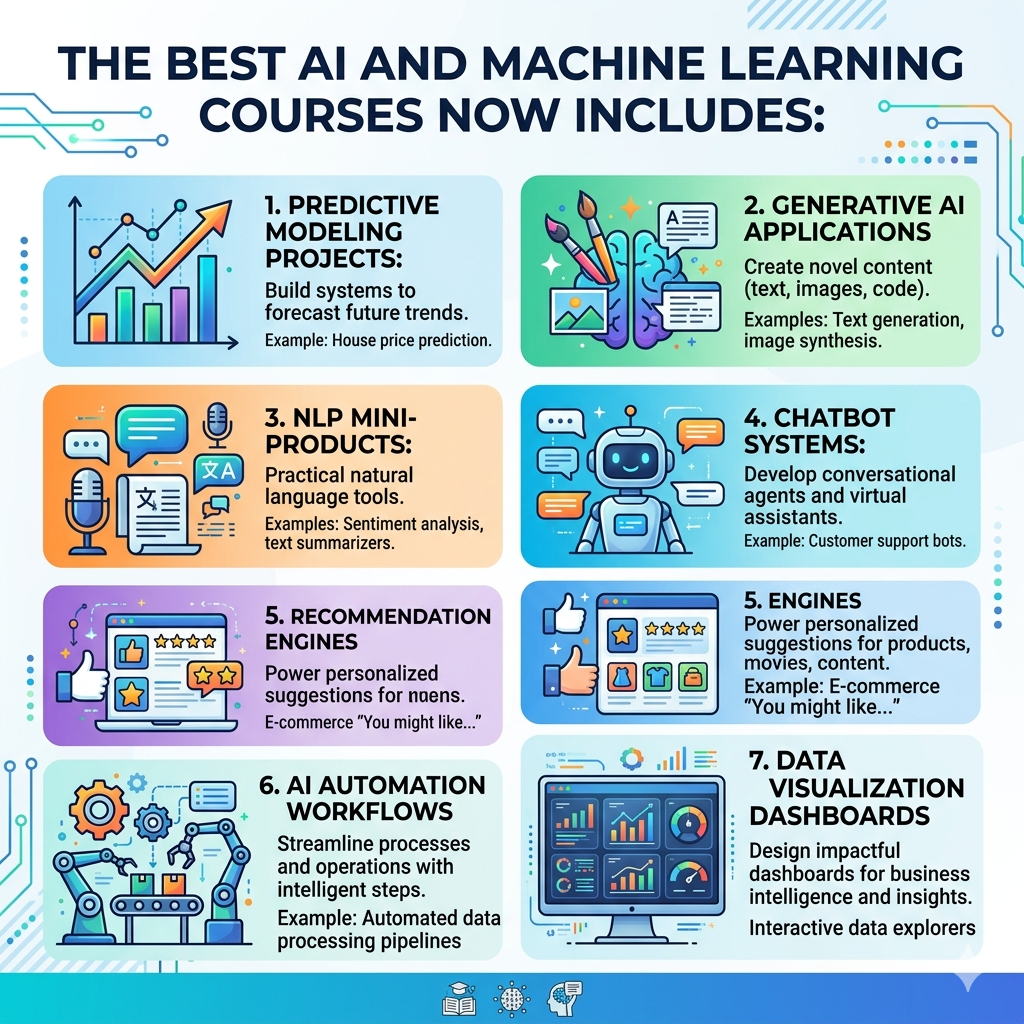
The best AI and machine learning courses now include:
- Predictive modeling projects
- Generative AI applications
- NLP mini-products
- Chatbot systems
- Recommendation engines
- AI automation workflows
- Data visualization dashboards
Moreover, AI courses give the best ROI for beginners, providing hands-on experience that is crucial in today’s job market. As the technology evolves, the demand for skills learned in these courses is surging, making them invaluable AI courses give the best ROI for beginners.
When evaluating options, remember that AI courses give the best ROI for beginners, emphasizing practical skills that employers covet.
One learner I spoke with recently built a customer-support AI assistant during training and used it during interviews. That single project became the centerpiece of almost every hiring discussion.
That’s ROI.
Not theory memorization.
3. Artificial Intelligence Certification Online Programs That Employers Respect
There’s still value in certification just not in the old “collect badges endlessly” way.
Good online AI courses programs work best when they validate practical capability.
The certifications getting attention in 2026 usually involve:
This is why many believe AI courses give the best ROI for beginners in machine learning and AI implementation.
- Practical assessments
- Capstone projects
- Cloud deployment
- AI implementation tasks
- Workflow automation
- Enterprise AI tools
Employers have become skeptical of purely exam-based certifications.
And honestly, that skepticism is understandable.
Someone can memorize multiple-choice answers and still struggle to build a usable AI courses give the best ROI for beginners workflow.
The more practical the certification, the stronger the ROI.
Why H2K Infosys Is Getting Attention in 2026
A lot of learners comparing AI platforms end up overlooking one important factor:
Support after enrollment.
That’s where H2K Infosys has quietly built a strong reputation among career-switchers and working professionals.
Instead of positioning courses as passive video content, the platform emphasizes:
- Live instructor-led training
- Real-time project exposure
- Career-oriented guidance
- Industry-aligned curriculum
- Flexible online schedules
- Practical AI workflows
- Resume and interview preparation
For someone balancing work, family, and learning AI at night after a long day, that flexibility matters more than marketing hype.
And this isn’t theoretical anymore.
As AI hiring grows across healthcare, finance, cybersecurity, retail, logistics, and cloud operations, companies increasingly prefer candidates who can contribute quickly instead of requiring months of retraining.
That’s why practical platforms are winning.
The Biggest Mistake Beginners Make
Most beginners try learning AI in completely random order.
They watch:
- A YouTube tutorial
- Half a Python course
- Some prompt engineering videos
- A machine learning playlist
- Then suddenly attempt neural networks
A few weeks later, they feel overwhelmed.
Totally normal.
The highest-ROI courses guide learners through a structured progression:
- Foundations
- Python basics
- Data handling
- Machine learning concepts
- AI model workflows
- Generative AI tools
- Deployment projects
- Portfolio creation
- Interview preparation
That sequence saves an enormous amount of wasted time.
AI Roles Seeing the Strongest Growth in 2026
One reason people are aggressively investing inAI courses give the best ROI for beginners education right now is simple: the hiring market keeps expanding.
Some of the fastest-growing AI-related roles include:
- AI Engineer
- Machine Learning Analyst
- AI Automation Specialist
- Prompt Engineer
- Data Analyst with AI specialization
- AI QA Engineer
- NLP Specialist
- AI Solutions Consultant
- Cloud AI Associate
What’s interesting is that not all of these roles require deep research-level mathematics.
That scares beginners unnecessarily.
Many companies mainly want professionals who understand practical implementation and business workflows.
That’s another reason career-focused Artificial Intelligence Online Training programs often outperform heavily academic alternatives for ROI.
Moreover, AI courses give the best ROI for beginners when they include portfolio projects.
What Professionals Should Look for Before Enrolling
If you already work in tech, don’t choose a course based purely on branding.
Look deeper.
Ask:
- Does the course include live projects?
- Is there a mentoring?
- Are AI tools updated for workflows in 2026?
- Is generative AI in the curriculum?
- Are there deployment examples?
- Is there interview preparation?
- Will I build portfolio-ready work?
- Does the training align with actual hiring demand?
A surprising number of “AI masterclasses” still avoid real implementation.
That’s a red flag.
The Shift Toward Practical AI Learning
One thing becoming very clear in 2026 is that employers increasingly value applied AI skills over purely academic familiarity.
Even large organizations now expect teams to understand:
- AI copilots
- Automation pipelines
- LLM-based workflows
- Intelligent analytics
- AI-assisted testing
- AI-driven customer support systems
That’s why practical online AI courses are becoming more valuable than broad theoretical survey courses.
Theory matters, obviously.
But practical execution is what creates ROI.
Real-World Example: Why Structured AI Learning Wins
A mid-level QA engineer recently shared an experience that honestly reflects the broader trend pretty well.
After years in manual testing, they enrolled in a structured AI-focused training program through H2K Infosys instead of trying to self-learn from scattered resources.
Within months, they had:
- Built automation workflows
- Learned AI-assisted testing methods
- Created portfolio projects
- Improved interview confidence
- Transitioned into higher-paying opportunities
That transition happens more often than people think.
Especially for professionals already working in adjacent technical roles.
Free Courses vs Paid AI Programs
This comes up constantly.
Free resources are fantastic for exploration.
They’re great for:
- Understanding basics
- Testing interest levels
- Learning terminology
- Experimenting casually
But when the goal becomes career transition, serious upskilling, or salary growth, structured paid programs usually provide better ROI because they add:
- Accountability
- Mentorship
- Real projects
- Career support
- Updated curriculum
- Peer interaction
- Guided progression
And honestly, consistency is often the hardest part of AI learning.
In 2026, many professionals are realizing that AI courses give the best ROI for beginners aiming for career advancement.
Not intelligence.
How AI Courses Are Changing After the Generative AI Boom
Courses in 2026 look very different from even two years ago.
Now the strongest programs include:
- ChatGPT workflow integration
- AI copilots
- Retrieval-Augmented Generation (RAG)
- AI agents
- Prompt optimization
- LLM orchestration
- AI governance
- Cloud AI services
- Automation pipelines
A course ignoring these areas already feels outdated.
That changes the ROI equation dramatically.
FAQs
1.What does ROI mean when choosing an AI course?
ROI (Return on Investment) refers to the value you gain from a course compared to its cost, including practical skills, career opportunities, certifications, salary growth, and hands-on experience.
2.Which AI courses offer the best ROI for beginners?
Beginner-friendly courses with strong ROI include AI fundamentals, prompt engineering, generative AI, and introductory machine learning programs that emphasize practical skills and real-world projects.
3.Which programming language should I learn before AI?
Python is the most widely recommended programming language for AI because of its simplicity and extensive ecosystem of AI and machine learning libraries.
4.Are AI certifications valuable to employers?
Yes. Certifications from recognized providers can strengthen your resume, especially when combined with practical projects and hands-on experience.
5.Should I choose free or paid AI courses?
Free courses are excellent for learning fundamentals, while paid courses often provide structured learning paths, hands-on labs, instructor support, and recognized certificates.
Final Thoughts
The best online AI courses in 2026 are the ones that help learners become employable, adaptable, and practically skilled not just theoretically informed.
For beginners, structured Artificial Intelligence Online Training with mentorship and real project work is often the fastest one to pay off.
For working professionals, the best ROI often comes from online AI courses that are directly related to automating the workplace, using cloud AI tools and building a portfolio.
And for learners specifically looking for career-oriented support, hands-on implementation, and flexible online learning, H2K Infosys continues to stand out as one of the more practical options in today’s crowded AI education space.
Because at the end of the day, the real value of an Artificial intelligence certification online program isn’t the certificate itself.
It’s whether the learning actually changes your career trajectory.
That’s the part people remember.
Students often find that AI courses give the best ROI for beginners, especially those that emphasize hands-on experience.
As such, it’s clear that AI courses give the best ROI for beginners looking to gain a competitive edge.
In conclusion, online AI courses give the best ROI for beginners seeking to enhance their skills and job prospects.
After all, AI courses give the best ROI for beginners who are serious about their future in technology.