Artificial intelligence (AI) training online has, almost quietly, become a genuinely practical path for people considering a career switch. It’s not some huge, disruptive leap you don’t have to quit your job or go back to college full-time. That’s part of the appeal. Programs like H2K Infosys, for example, are designed to fit into your routine, not take it over. And that flexibility is really what’s making this approach stick for so many people.
You can keep your job, manage your responsibilities, and still learn something meaningful on the side. And not just “learn” in a passive way more like gradually build skills that actually connect to real roles. That part matters. A lot of people don’t want another certificate that just sits there; they want something usable.
What stands out with most Online Ai Programs is the way they lean into application rather than pure theory. You’re not just reading about machine learning concepts and moving on. You try things. Sometimes it works, sometimes it doesn’t and honestly, that’s where most of the learning happens. That slightly messy, trial-and-error phase? It’s more valuable than it sounds.
What Is AI Training Online?
At a basic level, AI training online is just structured learning delivered through digital platforms. Simple definition but the experience can vary quite a bit depending on the program.
The better ones don’t stop at recorded lectures. They try to simulate how AI is actually used in real environments. So instead of just explaining concepts, they guide you through applying them.
You’ll usually come across topics like:
- Machine learning fundamentals
- Data cleaning and preparation (which tends to take longer than people expect… sometimes frustratingly so)
- Building and evaluating models
- Deploying those models into something functional
And instead of hypothetical tools, you work with what professionals actually use:
- Python, along with libraries like NumPy, Pandas, and Scikit-learn
- Frameworks such as TensorFlow or PyTorch
- Jupyter Notebooks for experimentation
- Cloud platforms like AWS or Azure
One thing people often underestimate is how convenient this setup is. You can access everything from your laptop, whether it’s late at night or early morning. No commute, no fixed classroom. That flexibility makes a bigger difference than it sounds on paper.
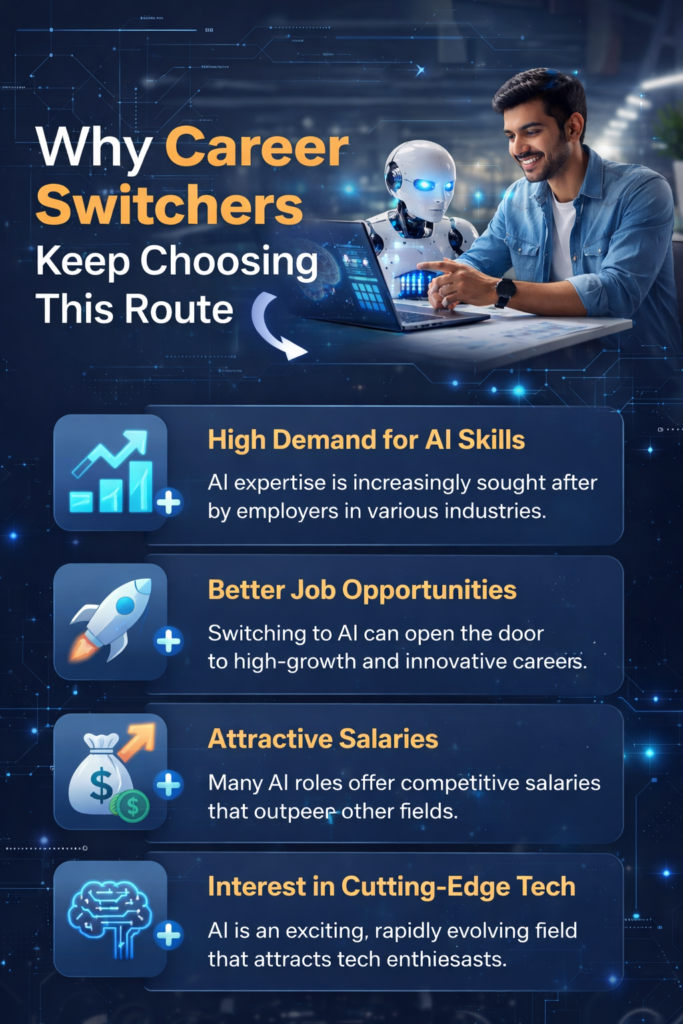
Why Career Switchers Keep Choosing This Route
1. It works with real schedules
Most people switching careers aren’t starting fresh they’re juggling work, family, and everything else life throws at them. Online learning gives you room to breathe. You can study when it suits you. Not perfectly structured, but realistic.
2. It connects directly to job demand
AI isn’t limited to tech companies anymore. It shows up everywhere:
- Finance uses it for fraud detection and risk analysis
- Healthcare applies it in diagnostics and predictions
- Retail uses it for recommendations and forecasting
- IT teams rely on it for automation and monitoring
So when courses are built around these kinds of use cases, they feel grounded. You can actually see where the skills fit.
3. You build things, not just notes
This is where online AI training really separates itself. Instead of memorizing concepts, you might:
- Build a recommendation engine
- Train a model on real-world data
- Put together a simple chatbot
These aren’t just academic exercises. They start to resemble the kind of work you’d be expected to do on the job. And that shift from theory to doing is usually where confidence starts to grow.
4. It’s more focused (and usually more affordable)
Traditional degrees still have value, no doubt. But they can be long and expensive. Online AI programs tend to cut straight to what’s needed. You don’t spend years on it you build relevant skills in months.
5. You’re not limited by location
One interesting side effect of online learning is exposure. You might learn from instructors in different countries, work on datasets from global sources, or interact with people who have completely different backgrounds. It adds perspective, even if you don’t notice it immediately.
How AI Actually Works in Real Projects
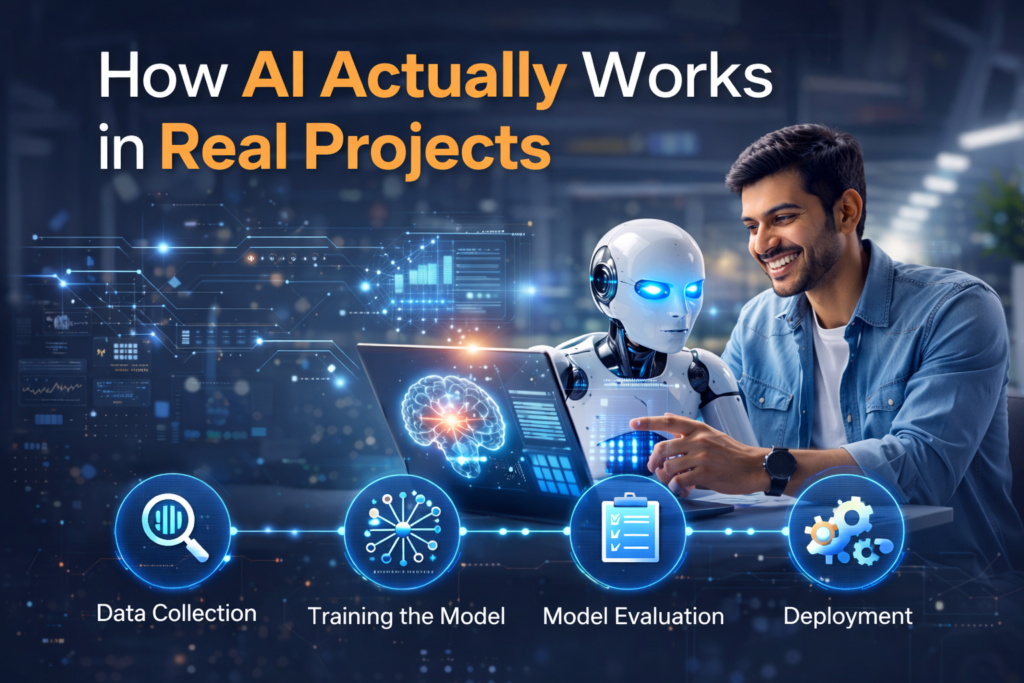
There’s sometimes this idea that AI is complicated or mysterious. In reality, most projects follow a fairly structured process. Not always clean, but structured.
It usually looks something like this:
- Start with a clear problem (for example, predicting customer churn)
- Gather data from various sources databases, APIs, logs
- Clean and prepare that data (this step can get messy, honestly)
- Choose an approach regression, classification, clustering
- Train the model and evaluate its performance
- Deploy it, often using APIs or cloud platforms
- Monitor and update it over time
And that last part monitoring is easy to overlook. Models don’t stay accurate forever. Data changes, patterns shift. So there’s always some level of maintenance involved.
It’s not a one-and-done process. More like a loop.
Why AI Skills Are Becoming Useful Across Roles
AI training isn’t just for people aiming to become data scientists or machine learning engineers. It’s broader than that.
Once you start working with data and models, your way of thinking changes a bit. You begin to look for patterns, question assumptions, and rely more on data rather than guesswork.
For example:
- Someone in QA might automate testing processes
- A business analyst might use data to support decisions more effectively
- IT support professionals might use AI tools for monitoring and troubleshooting
It becomes less about the title and more about how you apply the skills.
Skills You’ll Pick Up Along the Way
You don’t need to have everything figured out before starting. Most people don’t.
That said, there are a few core areas you’ll gradually build:
- Python programming (this becomes your main tool)
- Basic math statistics and probability mostly
- Data handling cleaning, transforming, visualizing
- Machine learning concepts
Then there are the less obvious skills, which are just as important:
- Problem-solving (figuring things out when nothing works the first time)
- Curiosity (this one carries you through tough spots)
- Understanding how businesses actually use data
That last one is often overlooked. Knowing why you’re building something matters as much as knowing how.
Where AI Shows Up in Real Work
AI is already part of many systems people use daily, even if it’s not always visible.
Some common examples:
- IT operations use it for predictive maintenance and log analysis
- Finance teams apply it to fraud detection and credit scoring
- Retail companies use it for demand forecasting and personalization
- Healthcare uses it for image analysis and risk prediction
Of course, working with AI in real environments isn’t just about building models. There are constraints—scalability, security, compliance. Things need to work reliably, not just in a demo notebook.
Career Options After Learning AI
Once you’ve built some hands-on experience, a few paths typically open up:
- Data Analyst
- Junior Data Scientist
- Entry-level Machine Learning Engineer
- AI or Automation Specialist
Each role mixes technical knowledge with practical understanding. Employers usually look for that balance not just theory, not just tools, but the ability to connect the two.
Online Learning vs Traditional Education
If you compare the two honestly, online AI training offers:
- More flexibility
- Faster timelines
- Greater focus on practical work
Traditional education still has depth, but it often moves slower and leans more toward theory. It really depends on what you’re looking for and how quickly you want to get there.
Common Challenges (and how people get past them)
Most beginners hit similar roadblocks at some point:
- Programming can feel overwhelming at first
- Math concepts take time to click
- Real datasets can be messy and confusing
It’s normal. Almost expected.
What tends to help is keeping things simple in the beginning:
- Start with small projects
- Practice regularly, even if it’s just a little each day
- Follow guided examples before trying to build everything from scratch
Over time, things start to connect. Not all at once but gradually.
A Few Practical Questions People Usually Have
Can beginners start AI training online?
Yes. Many programs are designed to start from basics and build upward.
How long does it take?
Typically anywhere from 3 to 9 months. It depends on how much time you can commit.
Do you need coding experience?
Not always. Some courses include introductory Python, so you can learn as you go.
Is it useful for non-technical roles?
Yes, actually. Even a basic understanding of AI can improve how decisions are made in business roles.
Final Thoughts
What makes Online Ai Certification Courses work is its practicality. It doesn’t expect you to step away from your life it fits into it. You learn in small steps, build gradually, and apply what you learn along the way.
And maybe that’s the key point it’s not about mastering everything in AI. That’s unrealistic for most people anyway. It’s about learning enough to start solving real problems, gaining confidence, and then building from there.
If a program includes hands-on projects, real-world scenarios, and some kind of guidance (mentorship does help more than people expect), the transition into AI roles starts to feel less like a leap and more like a steady shift.