Artificial intelligence no longer feels like one of those distant ideas that only show up in research labs or conference keynotes. It’s already built into a lot of the systems people learn every day, and most of the time it’s working quietly enough that hardly anyone stops to think about it. With training providers like H2K Infosys helping learners understand these real-world applications, the technology feels even more accessible. That shift took time, of course. Better cloud infrastructure helped a lot. Wider access to usable data helped too. And machine learning tools have become far more practical than they were a few years ago, which made a real difference.
A lot of companies have moved past the stage of trying AI just because it sounded interesting. The conversation has changed. It’s more practical now, maybe a little less flashy. The real questions are simpler and harder at the same time: where does AI actually help, and what can it improve without creating extra complexity somewhere else? In some teams, it’s used to automate repetitive work. In others, it supports analytics, decision-making, or customer-facing features. Either way, AI is starting to feel less like a side project and more like part of ordinary operations.
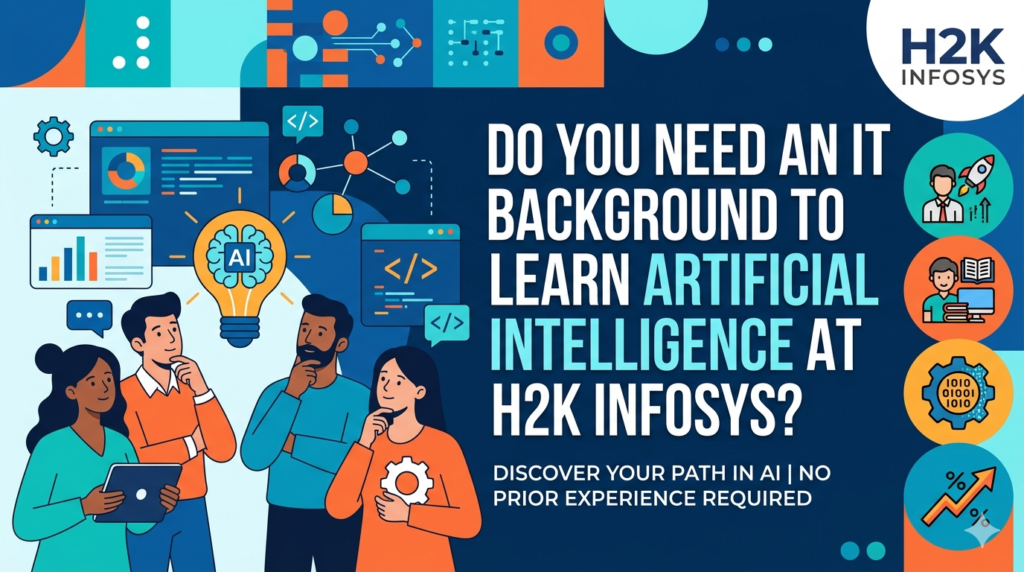
That shift has also made the skills gap easier to see. Plenty of people understand AI in general terms. Applying it in a real engineering or business environment is a different thing entirely. That’s a big reason structured Artificial intelligence Engineer Course programs have become more valuable. They help close the gap between understanding the concepts and actually using them, which, honestly, is where most people get stuck.
Learning AI online has become much more realistic too. You can work with cloud platforms, run experiments, use real datasets, and build projects in environments that feel surprisingly close to what production teams use. Not exactly the same, obviously. But close enough that the experience carries over in a useful way.
What Is Artificial Intelligence?
At a basic level, artificial intelligence is about building systems that can handle tasks we usually associate with human judgment, pattern recognition, or decision-making. Not in some dramatic sci-fi sense. More in a practical, everyday sense.
That can include things like:
- recognizing patterns in large or messy datasets
- understanding written or spoken language
- making decisions based on inputs and rules
- predicting likely outcomes from historical data
AI is not one narrow field. It’s really a group of related areas that overlap quite a bit:
- Machine Learning (ML): systems that learn from data instead of relying only on fixed rules
- Deep Learning: neural-network-based approaches used for more complex tasks
- Natural Language Processing (NLP): methods for understanding and working with language
- Computer Vision: systems that interpret images, video, and other visual input
So when people talk about AI, they’re usually talking about a mix of statistics, programming, experimentation, and domain knowledge working together to solve real problems. That combination matters more than any one tool by itself.
Why This Is a Good Time to Learn AI
A few years ago, learning AI could feel harder than it probably needed to be. Infrastructure was expensive, tools were less accessible, and the learning path often felt scattered. That’s changed quite a bit.
The tools are easier to access now
Platforms like AWS SageMaker, Google Vertex AI, and Azure Machine Learning make it possible to experiment without building everything from scratch. That removes a major barrier, especially for beginners and working professionals who don’t have endless time to piece together an environment on their own.
Open-source frameworks have matured
TensorFlow, PyTorch, and Scikit-learn are no longer just research tools or beginner playgrounds. They’re used in real production settings, which means the time spent learning them tends to pay off in practical ways.
Businesses are already using AI in useful ways
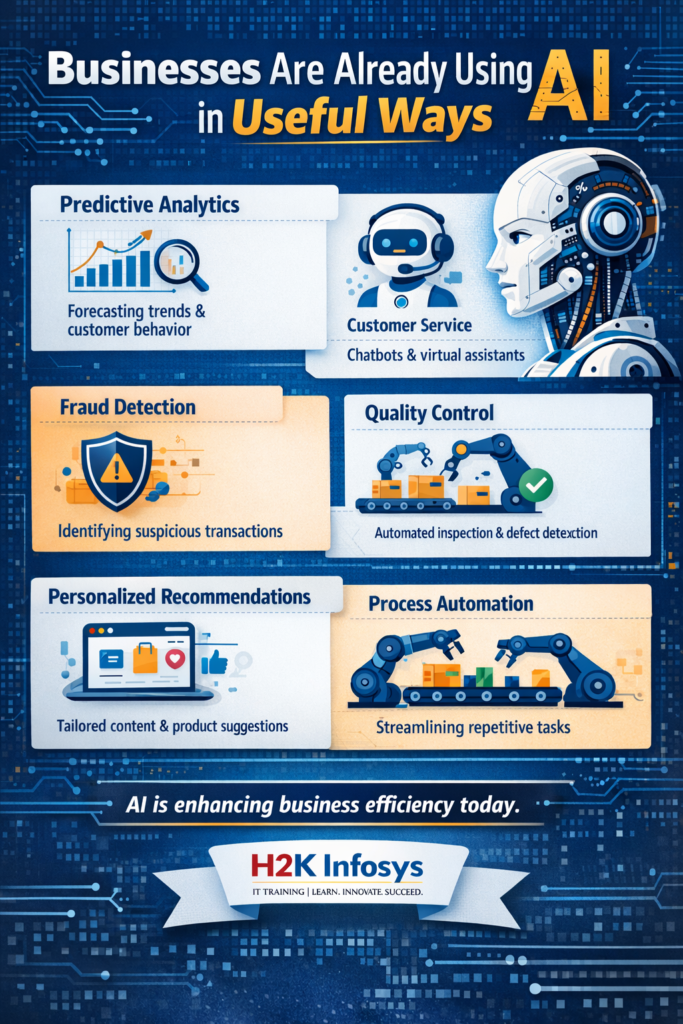
You can see that in areas like:
- fraud detection
- recommendation systems
- predictive maintenance
- customer support automation
This isn’t really a “maybe someday” technology anymore. In many organizations, it’s already part of the workflow.
Online learning is more hands-on now
A lot of modern Ai learning Courses include guided labs, real projects, and practical datasets. That matters because AI usually starts making sense once you stop only reading about it and actually build something. That’s when it clicks for most people.
AI connects naturally with existing roles
You don’t always need to make a dramatic career switch to learn AI. For many professionals, it builds on work they already do in software development, analytics, DevOps, or data operations. In that sense, it often feels more like an upgrade than a reset.
How AI Works in Real Projects
In real project environments, AI usually follows a structured workflow. From the outside it can look complicated, and sometimes it is, but the overall pattern stays fairly consistent.
A typical workflow includes:
Collecting data
Pulling information from databases, APIs, logs, sensors, or other sources.
Preparing the data
Cleaning missing values, fixing inconsistencies, and creating useful features.
Developing the model
Choosing an algorithm or architecture and training it.
Evaluating performance
Measuring how well it works using the right metrics for the task.
Deploying the model
Making it available through an API or integrating it into a larger system.
Monitoring and updating
Tracking drift, watching performance, and deciding when retraining is needed.
Fraud detection is a simple example people often use, even though it gets messy pretty fast in real life. Transaction data goes in, a classification model processes it, and the output is a fraud probability score. On paper, that sounds neat enough. Then the real-world issues show up: imbalanced classes, latency limits, compliance requirements, incomplete data. That’s usually where the real work begins.
Why AI Matters for Working Professionals
AI isn’t useful only for data scientists, even though that assumption still hangs around. Its relevance is much broader now.
It can help professionals:
- automate repetitive tasks
- improve decisions with predictive insights
- add intelligent features to products and services
Different roles use AI in different ways:
- Software engineers may integrate machine learning APIs or services
- Data analysts may build forecasting or prediction models
- DevOps engineers may support deployment, scaling, and monitoring
- Business analysts may use AI-supported insights to guide decisions
So the goal is not always to become a full-time AI specialist. In a lot of cases, it’s simply about expanding what you can do in the role you already have. For many people, that’s the more realistic way to think about it.
Skills You’ll Probably Need
Most structured AI learning paths start with the basics and build toward more advanced topics over time.
Core foundations
- Python programming
- data structures and basic algorithms
- statistics and probability
AI-related concepts
- machine learning algorithms
- neural networks
- model evaluation methods
Common tools
- Python and sometimes R
- TensorFlow and PyTorch
- Pandas and NumPy
- visualization libraries
- Docker and Flask
Then there are the less obvious skills that matter just as much: problem-solving, comfort with imperfect data, and the ability to understand what the business is actually trying to solve. Those are easy to underestimate at first, but they usually make a bigger difference than people expect.
Where AI Shows Up in Real Systems
AI already appears in plenty of systems people interact with regularly.
Predictive maintenance
Used in manufacturing and IoT environments to estimate when equipment might fail.
Recommendation systems
Common in e-commerce and content platforms, where systems suggest products, shows, or articles based on user behavior.
NLP applications
Chatbots, sentiment analysis, document classification, search improvement, virtual assistants.
Computer vision
Used in quality inspection, surveillance, medical imaging, and image-based analysis.
From a systems perspective, enterprise AI often spans several layers: data ingestion, processing, model training or inference, deployment, and monitoring. It may not sound glamorous written out like that, but that’s how many real implementations actually work.
Roles That Use AI
AI-related skills show up across a range of job titles, including:
- AI Engineer
- Machine Learning Engineer
- Data Scientist
- NLP Engineer
- Computer Vision Engineer
These roles overlap more than they might seem at first. Usually, the difference comes down to where the main focus sits—model building, optimization, deployment, research, or a specific domain area.
Career Options After Learning AI
Once you build real AI skills, several career paths can open up.
- AI Engineer: designs and deploys AI systems
- Machine Learning Engineer: focuses on model performance, reliability, and scale
- Data Scientist: analyzes data and builds models for insight and prediction
- AI Researcher: explores new methods and algorithms
- Business Intelligence Analyst: uses data and AI-supported tools to guide decisions
These roles exist across industries like fintech, healthcare, logistics, retail, and IT services. Anywhere data plays a meaningful role, AI becomes more relevant. That’s the short version, really.
How AI Courses Connect to Real Work
Strong AI courses usually follow a progression that mirrors how people actually learn.
- Beginner: Python, statistics, and data fundamentals
- Intermediate: machine learning concepts and model building
- Advanced: deep learning, deployment, and production workflows
The better programs don’t stop at theory. They include hands-on projects, real datasets, model testing, and API-based deployment. That practical side is often what turns a vague understanding into something you can actually use.
Challenges You’ll Likely Run Into
Learning AI is rewarding, but it’s not especially neat.
Common challenges include:
- math that feels heavier than expected
- large or messy datasets that slow everything down
- models that are difficult to interpret clearly
- deployment work that feels like a separate skill altogether
A few things help:
- start with small projects
- focus on practical work early
- use cloud tools when local hardware is limited
- learn version control, especially Git
That last one sounds minor until a project gets messy, and at some point it probably will.
Applying AI in a Real Scenario
Let’s say the goal is to build a customer churn prediction system.
A simplified workflow could look like this:
- gather customer data
- clean and preprocess the data
- train a classification model
- evaluate performance
- deploy the model through an API
Basic pseudo-code might look like this:
data = load_dataset()
cleaned_data = preprocess(data)
model = train_model(cleaned_data)
predictions = model.predict(new_data)
Written out like that, it looks neat and orderly. Real projects are rarely that clean. There are usually edge cases, revisions, unexpected failures, and a lot more iteration than the tidy version suggests. That’s normal, by the way.
Common Questions
Where should I start?
Start with Python, basic statistics, and introductory machine learning. A solid foundation usually helps more than jumping into advanced topics too early.
Do I need a programming background?
It helps, definitely. But many learning paths include the basics, so you don’t need to have everything figured out before you begin.
How long does it take to learn AI?
For many working professionals, 6 to 12 months is a realistic range, depending on consistency and how deep they want to go.
Is AI only useful for specialists?
No. It’s useful across software, analytics, operations, and data-related roles.
Can AI really be learned online?
Yes. With hands-on practice, guided learning, and real projects, online learning can be very effective.
Key Takeaways
- AI is already part of many business workflows
- modern tools and platforms have made learning more accessible
- structured courses are better aligned with real-world practice than they used to be
- AI skills can support several career paths
- practical project experience matters a great deal
If you’re thinking about moving into AI, structured learning can make the whole process feel much more manageable. You can absolutely try to piece everything together on your own, sure, but for most people that route ends up being slower and more frustrating than it first appears.
Usually, the turning point comes when you stop only studying the concepts and start building something—even if it’s small and a little rough around the edges. That’s when the pieces really start to connect.