Before you hit the resume refresh button for 2026, here’s the deal. H2K Infosys thinks that real Business Analyst Skills don’t just collect requirements; they need <= 3 years of experience with data manipulation, AI, business stakeholder sensibility, and a little empathy, for good measure, to make a business difference. AI tools are changing the way work is done, and I’ve watched hiring managers look for candidates with a mix of great technical skills and strong initiative, or a ‘notebook and pen’ type of leader.
They are moving ‘real’ analysts that way, and are not as enthusiastic about the tools that analysts claim to wanna use. They are interested in ‘real numbers’. They are interested in moving from listing functions to having an impact. If you are thinking about BA Training, BA certification, or business analyst courses, this guide will show you what companies want and what they will want in 2026.
Why Business Analyst Skills Matter More Than Ever in 2026
Companies are automating fast. Tools powered by AI now generate reports, dashboards, and even draft requirements. But here’s what they can’t do well: understand messy human problems, navigate politics in meetings, and connect business goals with technology decisions. That’s where strong Business Analyst Skills shine.
In my experience working with fintech and SaaS teams, the analysts who get promoted aren’t just good with spreadsheets. They’re the ones who:
- Ask better questions than the client.
- Translate vague business ideas into measurable KPIs.
- Challenge assumptions (politely, of course).
- Use AI tools intelligently instead of fearing them.
And if you’re going through business analyst training or planning for business analyst certification online, these are exactly the areas you should focus on.
Core Analytical Business Analyst Skills
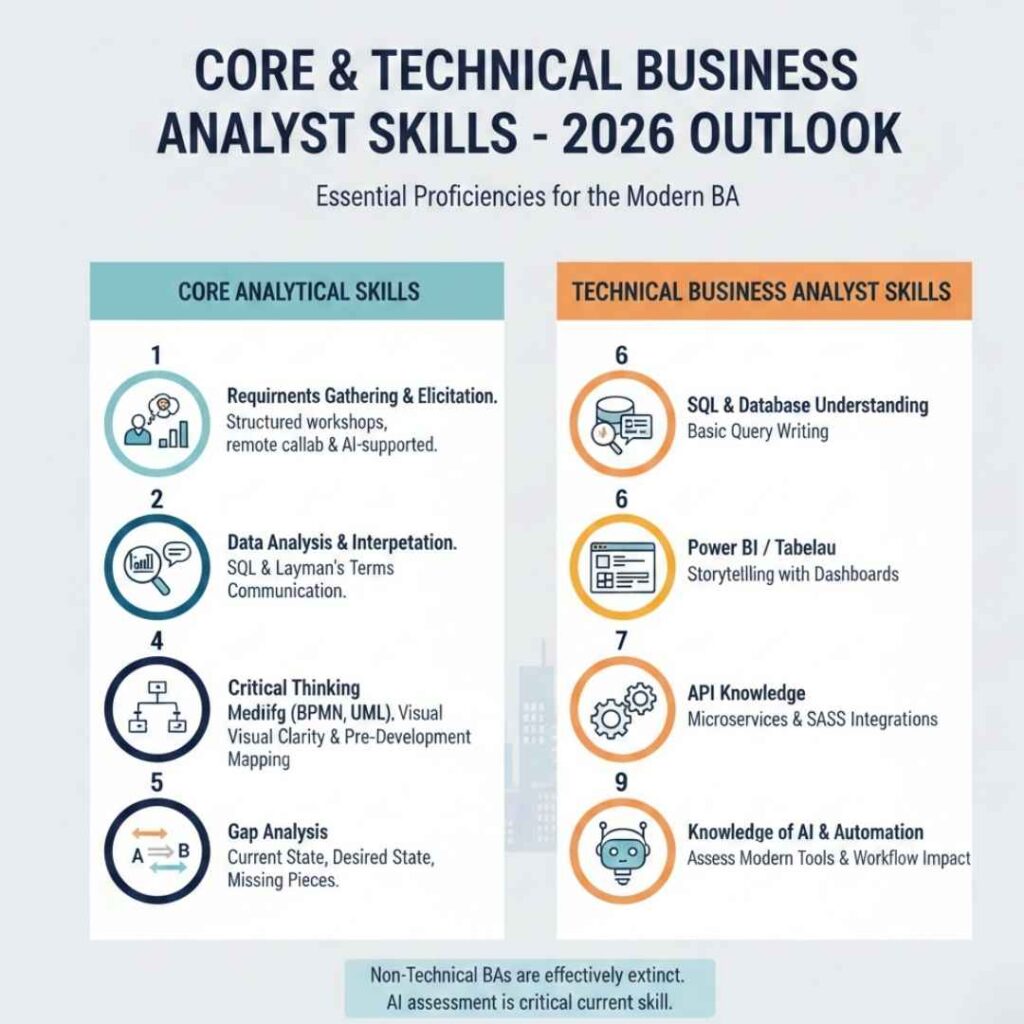
1. Requirements Gathering & Elicitation
While still foundational, in 2026, this will be based on structured discovery workshops, remote collaboration, and AI-supported workshops.
2. Data Analysis & Interpretation
Interpreting patterns necessitates both SQL knowledge and the ability to communicate the meaning in layman’s terms. This is currently one of the most in-demand Business Analyst Skills on job portals.
3. Critical Thinking
Stakeholders, on certain occasions, request the wrong solution. A good analyst identifies the real problem behind.
4. Business Process Modeling (BPMN, UML)
The advantage of visual clarity is great. Before any development is done, process mapping will reduce confusion.
5. Gap Analysis
Where are we at the moment? Where do we want to arrive? What is missing? This is still a high visibility area of impact for Business Analyst Skills.
Technical Business Analyst Skills
Let’s face it fully non-technical BAs are effectively extinct.
6. SQL & Database Understanding
Basic query writing knowledge separates you from the rest.
7. Power BI / Tableau
Storytelling with dashboards is more than just adding some charts it’s constructing a narrative of the business.
8. API Knowledge
Bolstering microservices and SaaS integrations makes this a requirement.
9. Knowledge of AI & Automation
At this point, it is more critical to know what modern BA Skills are than to construct ML models. An understanding of modern tools and their impact on workflows is vital. Current BA Skills include assessing AI.
10. Agile & Scrum Methodologies
For most BAs, this includes sprint planning, backlog grooming, and scrum ceremonies.
If you are considering taking business analysis courses or are doing business analyst training, make sure to include these technical skills in your assessment of the curriculum.
Communication & Stakeholder Business Analyst Skills
This is where careers are made or stalled.
11. Stakeholder Management
Different personalities. Different agendas. Navigating this requires emotional intelligence.
12. Clear Documentation
BRDs are evolving into learner artifacts, but clarity still wins.
13. Presentation Skills
You’ll often present to leadership. Your slide deck must tell a story.
14. Conflict Resolution
Projects get tense. Strong Business Analyst Skills include staying neutral and solution-focused.
15. Active Listening
Not just hearing, understanding context, hesitation, and unspoken risks.
Skills of Business Analysts that are Strategic and Business-Focused
By 2026, Business Analysts will be expected to act as consultants.
16. Calculating ROI & Cost-Benefit Analysis
If you can suggest an alternative that would lead to an increase in revenue or a reduction in expenses, you will be in an advantageous position since the executives are interested in such figures.
17. Risk Assessment
Identifying the risks that a project may encounter in the future will save money, and more importantly, preserve the reputation of the business.
18. Domain Knowledge
The more industry knowledge you possess (SaaS, retail, fintech, healthcare), the more you are in demand.
19. Change Management
Without user acceptance, new systems are doomed to fail. Business Analysts should master the art of communicating change, as this is perhaps the most neglected of their skills.
20. Strategic Thinking
The ability to comprehend the potential future effects of a decision or action on the business is what distinguishes an advanced Business Analyst from a beginner.
Modern & Future-Ready Business Analyst Skills
What I continue to observe in my analysis of job postings is the mention of AI, digital transformation, and data governance.
21. Data Governance
Given the increasing number of global privacy regulations, an understanding of compliance is important.
22. Basic Knowledge of Cybersecurity
This is especially true for projects in fintech and healthcare.
23. Basic Knowledge of Cloud Tools (AWS/Azure/GCP)
You don’t need to be an architect, but you should be able to navigate the different environments.
24. UX & Customer Journey Mapping
User-first thinking is the best strategy to improve the success of a product.
25. Business Analysts Betrayal
Tech changes. Tools change. This might be the most critical of all Business Analyst Skills.
Bonus Skills That Boost Your Resume
26. Negotiation
Balancing scope vs budget is daily reality.
27. Workshop Facilitation
Running productive meetings is harder than it looks.
28. Documentation Automation Tools
AI-powered requirement tools are becoming common in enterprise environments.
How to Develop These Business Analyst Skills in 2026

If you want to cultivate your Business Analyst Skills, this is what you can do:
- Enroll in a course to guide you through the steps of becoming a business analyst that includes real-world assignments.
- Research business analyst certifications that can be obtained online and are internationally recognized.
- If your career is shifting to business analysis, look for business analyst training and placement programs.
- Seek ba/systems training that offers a capstone case study.
- Obtain an Agile and AI-integrated business analyst certification.
- Participate in hands-on business analysis workshops and training instead of theory courses.
- Select a business analysis course that includes live engagement with ‘stakeholders’ during the training.
For me, the training that gives candidates real-life project artifacts (not a stack of certificates) is the one that opens the doors to the most interviews the fastest.
What Recruiters Are Looking for in 2026
Here’s a small inside insight:
Many recruiters now use AI resume screeners. They scan for measurable outcomes.
Instead of writing:
“Gathered requirements for CRM implementation.”
Try:
“Led cross-functional requirement workshops that reduced CRM implementation rework by 22%.”
That shows applied Business Analyst Skills not just participation.
Conclusions
The best Business Analysts in 2026 will have a broad range of skills including analytics, communication, understanding of business, and being ready for AI. It may be a tough market, but it also offers many opportunities for those who are flexible.
If you are putting money into business analyst training, obtaining a ba certification, or looking into business analyst certification online, spend less time on credential collection, and more time on developing practical skills.
At the end of the day, companies do not hire resumes.
They are looking for problem-solvers.
And that is exactly the expectation of today’s Business Analysts.