In today’s fast-paced digital economy, organizations rely heavily on Business Analysts (BAs) to translate ideas into successful solutions. One of the most critical and often misunderstood responsibilities of a BA is understanding Business vs Stakeholder Requirements. While both are essential, confusing or blending them can lead to scope creep, failed projects, unhappy stakeholders, and wasted budgets.
For professionals enrolling in business analysis courses or pursuing a business analyst certification online, mastering this distinction is not optional it is foundational. At H2K Infosys, we emphasize real-world requirement analysis through hands-on projects, live instructor-led sessions, and career-oriented business analyst online training designed for working professionals.
This comprehensive guide explores the meaning, differences, challenges, and best practices around Business vs Stakeholder Requirements, equipping you with the mindset and skills demanded in real enterprise environments.
Understanding Requirements in Business Analysis

Before diving deeper into Business vs Stakeholder Requirements, it’s important to understand what “requirements” mean in the context of business analysis.
Requirements define what a solution must do to solve a business problem or achieve a business objective. They guide developers, testers, project managers, and decision-makers throughout the project lifecycle. In business analyst classes, requirements are typically categorized into business, stakeholder, functional, non-functional, and technical requirements.
Among these, business and stakeholder requirements sit at the top of the requirement hierarchy and directly influence everything that follows.
What Are Business Requirements?
Business requirements describe the high-level goals, objectives, and outcomes that an organization wants to achieve. They focus on why a project exists rather than how it will be implemented.
Examples of business requirements include:
- Increase customer retention by 15%
- Reduce operational costs by automating manual workflows
- Ensure regulatory compliance with industry standards
- Improve time-to-market for new digital products
Business requirements are usually defined by executive leadership, senior management, or strategy teams. In business analysis training, learners are taught to document these requirements using vision statements, business cases, and value propositions.
Understanding business requirements is the first step in resolving Business vs Stakeholder Requirements, because business goals provide the anchor point for all stakeholder needs.
What Are Stakeholder Requirements?
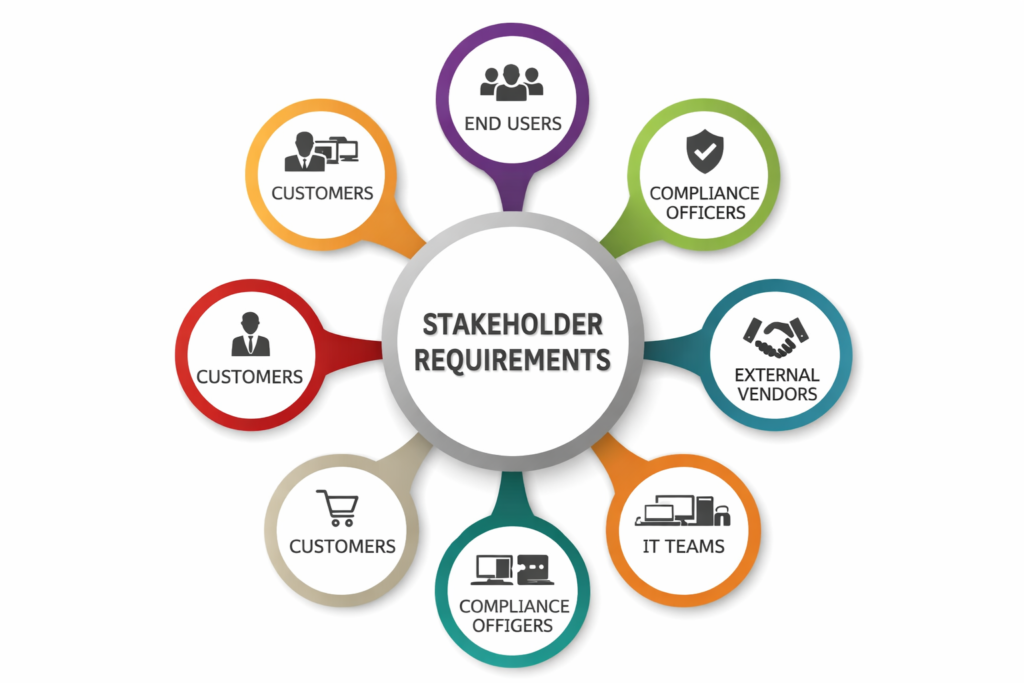
Stakeholder requirements capture the needs, expectations, and constraints of individuals or groups who are affected by the project. Stakeholders can include:
- End users
- Customers
- Department managers
- IT teams
- Compliance officers
- External vendors
These requirements explain what stakeholders need from the solution to perform their roles effectively. For example:
- Customer service agents need a faster ticketing system
- Finance teams need accurate real-time reports
- Compliance teams need audit trails
- End users need an intuitive user interface
In real projects, stakeholder requirements are often detailed, diverse, and sometimes conflicting. This is where Business vs Stakeholder Requirements becomes a practical challenge for Business Analysts.
Business vs Stakeholder Requirements: The Core Difference
The central distinction between Business vs Stakeholder Requirements lies in scope and perspective.
Business requirements:
- Represent organizational goals
- Focus on value and outcomes
- Are strategic and high-level
Stakeholder requirements:
- Represent individual or group needs
- Focus on usability and functionality
- Are tactical and detailed
A skilled Business Analyst understands that stakeholder requirements must support and align with business requirements, not replace them. This alignment is heavily emphasized in H2K Infosys’ business analyst training with placement, where learners practice resolving real-world requirement conflicts.
Why Business Analysts Must Master This Distinction
Failing to manage Business vs Stakeholder Requirements properly can derail even the most well-funded projects. Common consequences include:
- Scope creep due to unchecked stakeholder demands
- Solutions that satisfy users but fail business objectives
- Executive dissatisfaction despite high user adoption
- Increased rework and delivery delays
In professional business analyst online training, learners are trained to act as balancers and negotiators, ensuring stakeholder needs are met without compromising business goals.
Real-World Example: Business vs Stakeholder Requirements in Action
Consider a retail company launching a new e-commerce platform.
Business requirement:
- Increase online sales by 25% within one year
Stakeholder requirements:
- Marketing wants advanced promotional features
- Customers want faster checkout
- IT wants minimal integration complexity
- Finance wants real-time revenue dashboards
The challenge of Business vs Stakeholder Requirements is to prioritize and reconcile these needs while keeping the primary business goal sales growth front and center. This is exactly the type of scenario simulated in H2K Infosys’ business analyst classes, using case studies and capstone projects.
Techniques to Manage Business vs Stakeholder Requirements
Effective Business Analysts use structured techniques to manage Business vs Stakeholder Requirements:
1. Stakeholder Analysis
Identify stakeholders, their influence, interests, and expectations.
2. Requirements Traceability Matrix (RTM)
Map stakeholder requirements back to business requirements to ensure alignment.
3. MoSCoW Prioritization
Classify requirements as Must-have, Should-have, Could-have, or Won’t-have.
4. Workshops and Interviews
Facilitate discussions that reveal hidden assumptions and conflicts.
These techniques are core modules in H2K Infosys’ business analysis courses, ensuring learners gain hands-on experience rather than just theoretical knowledge.
Common Challenges Business Analysts Face
Managing Business vs Stakeholder Requirements is not without challenges:
- Stakeholders may push personal preferences over business value
- Executives may provide vague or shifting business goals
- Conflicting stakeholder priorities can stall decisions
- Poor documentation can lead to misunderstandings
Through structured business analysis training, professionals learn how to navigate these challenges using communication, data analysis, and negotiation skills.
The Role of Documentation
Clear documentation plays a critical role in resolving Business vs Stakeholder Requirements. Business Analysts typically use:
- Business Requirement Documents (BRD)
- Stakeholder Requirement Specifications
- User stories and acceptance criteria
- Use cases and process flows
In business analyst certification online programs at H2K Infosys, learners are trained to produce industry-standard documentation aligned with real enterprise expectations.
Agile Perspective on Business vs Stakeholder Requirements

In Agile environments, Business vs Stakeholder Requirements are managed iteratively rather than upfront. Business goals are expressed as product visions and epics, while stakeholder needs emerge through user stories and backlog refinement.
The Business Analyst (or Product Owner proxy) ensures:
- Each user story aligns with a business objective
- Stakeholder feedback is continuously evaluated
- Business value is delivered incrementally
This Agile alignment is a key focus area in modern business analyst online training programs.
How H2K Infosys Trains You Differently
At H2K Infosys, we go beyond theory to ensure professionals can confidently manage Business vs Stakeholder Requirements in real jobs. Our training model includes:
- Live instructor-led sessions
- Real-time project simulations
- Hands-on tools and templates
- Mock interviews and resume guidance
- Dedicated career support
Our business analyst training with placement is specifically designed to bridge the gap between learning and employment.
Career Impact of Mastering Business vs Stakeholder Requirements
Professionals who excel in Business vs Stakeholder Requirements are highly valued across industries such as banking, healthcare, retail, IT services, and fintech. Employers look for BAs who can:
- Align solutions with strategy
- Manage diverse stakeholder expectations
- Reduce project risk
- Deliver measurable business value
Graduates of H2K Infosys’ business analyst classes often report faster career growth, higher confidence in interviews, and better on-the-job performance.
Certification and Skill Validation
Earning a business analyst certification online validates your ability to handle real-world scenarios like Business vs Stakeholder Requirements. Certifications combined with hands-on experience significantly improve employability, especially for career switchers and working professionals.
H2K Infosys integrates certification preparation directly into its business analysis courses, ensuring learners are job-ready, not just exam-ready.
Conclusion
Understanding Business vs Stakeholder Requirements is one of the most critical competencies for a successful Business Analyst. It defines your ability to think strategically, communicate effectively, and deliver solutions that truly matter.
Whether you are starting your journey or upgrading your skills through business analysis training, choosing the right learning partner makes all the difference. With expert instructors, real-world projects, and career-focused support, H2K Infosys empowers professionals to master Business vs Stakeholder Requirements and build rewarding careers in business analysis.
Ready to take the next step?
Explore H2K Infosys’ business analyst online training programs and gain the skills, confidence, and placement support needed to succeed in today’s competitive job market.