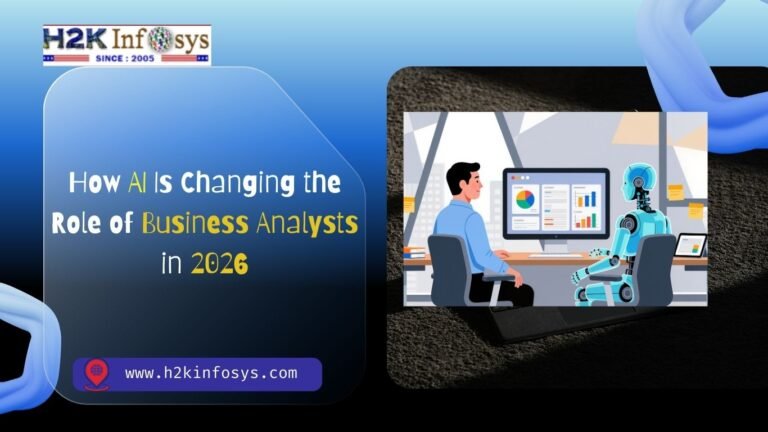
In 2026, AI is reshaping the role of business analysts from task-focused data handling to strategic, AI-enabled decision support. Routine activities such as data cleaning, reporting, and basic modeling are increasingly automated, allowing business analysts to focus on interpreting advanced insights, guiding business strategy, and ensuring the ethical use of AI. With predictive and generative AI, they can perform deeper scenario analysis and forecasting, while AI-powered visualization tools help translate complex findings into clear and actionable business stories. Training providers such as H2K Infosys can support aspiring and experienced business analysts in building practical AI, analytics, critical-thinking, and communication skills. Success in this evolving profession depends on AI fluency, sound judgment, and continuous learning, demonstrating that business analysts are not being replaced by AI but strengthened by it.
What Is How AI Is Changing the Role of Business Analysts in 2026?
How AI is changing the Role of Business Analysts in 2026 refers to the structural shift in responsibilities, skills, and tools as AI becomes embedded across enterprise systems. Business Analysts now spend less time on manual data gathering and more time on validating insights, framing business problems for AI models, and governing how automated decisions align with business goals.
This change affects how requirements are written, how stakeholders collaborate, and how value is measured across projects.
How Does AI Work in Real-World Business Analysis Projects?
In enterprise environments, AI is typically integrated into existing analytics, workflow, and decision-support platforms rather than used as standalone tools. Role of Business Analysts interact with AI through dashboards, recommendation engines, and automation layers embedded in business systems.
Typical AI-Enabled Business Analysis Workflow
- Data ingestion
- Structured data from databases (ERP, CRM)
- Semi-structured data from logs, tickets, and documents
- AI-driven analysis
- Pattern detection using machine learning models
- Forecasting demand, risk, or performance metrics
- Natural language processing for text-heavy inputs
- Business interpretation
- Analysts validate AI outputs
- Translate insights into business requirements
- Identify constraints, risks, and dependencies
- Decision enablement
- Dashboards with predictive indicators
- Automated alerts and recommendations
- Feedback loops for continuous improvement
In this workflow, AI performs computational tasks, while the Role of Business Analysts ensures relevance, accuracy, and alignment with business strategy.
Why Is AI-Driven Business Analysis Important for Working Professionals?
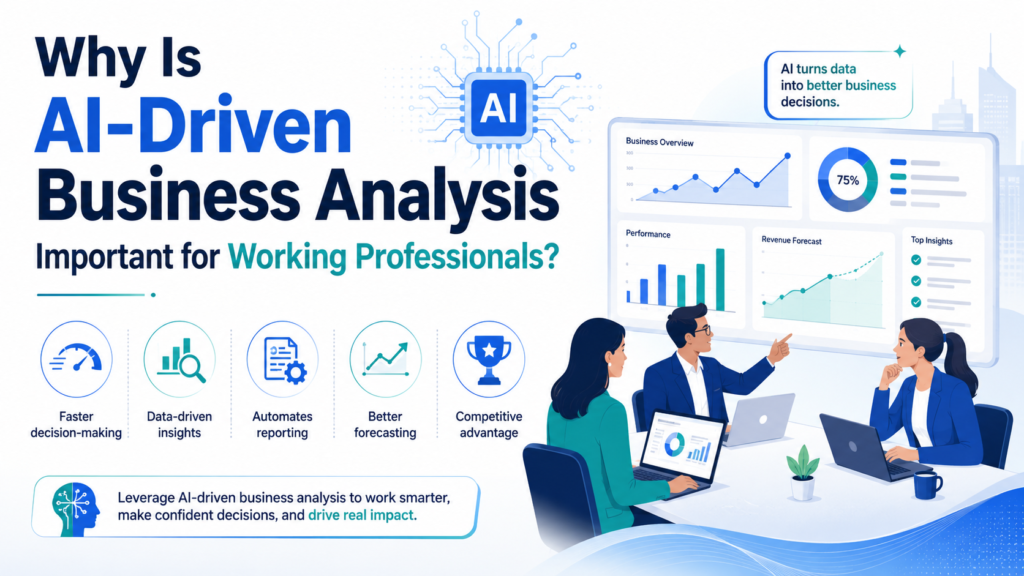
For working professionals, AI-driven business analysis addresses three persistent challenges: scale, speed, and complexity.
Key Drivers
- Increased data volume
Manual analysis does not scale with real-time enterprise data streams. - Faster decision cycles
Businesses expect near-instant insights to remain competitive. - Cross-functional complexity
AI solutions often span IT, operations, compliance, and customer experience.
Professionals with strong business analysis training who understand AI concepts are better positioned to manage these challenges without relying solely on technical teams.
What Skills Are Required to Learn Business Analyst Roles in an AI-Driven Environment?
The modern Role of Business Analysts skill set combines foundational analysis capabilities with AI literacy and governance awareness. This evolution is reflected in updated ba training and business analysis training curricula.
Core Skills That Remain Essential
- Requirements elicitation and documentation
- Stakeholder communication
- Process modeling (BPMN, value streams)
- Data interpretation and validation
New Skills Introduced by AI Adoption
| Skill Area | Description |
|---|---|
| AI literacy | Understanding how models are trained, validated, and deployed |
| Data reasoning | Interpreting probabilities, confidence scores, and biases |
| Prompt framing | Structuring inputs for AI-assisted analysis tools |
| Ethical analysis | Evaluating fairness, explainability, and compliance |
| Change management | Managing adoption of AI-driven workflows |
These skills are increasingly emphasized in business analyst courses and business analyst classes designed for mid-career professionals.
How Is AI Used in Enterprise Business Analysis Environments?
AI usage in Role of Business Analysts is practical and operational, not experimental. Enterprises typically adopt AI where it enhances existing workflows.
Common Enterprise Use Cases
- Requirements prioritization
AI analyzes historical delivery data to suggest priority levels. - Process optimization
Machine learning identifies bottlenecks in operational workflows. - Risk analysis
Predictive models flag potential project or compliance risks. - Customer insights
NLP models summarize feedback, tickets, and surveys.
Tools Commonly Encountered
| Category | Examples |
|---|---|
| BI platforms | Power BI with AI visuals, Tableau with predictive extensions |
| Process mining | Celonis, UiPath Process Mining |
| NLP analysis | Embedded analytics in CRM or ticketing systems |
| Automation | Low-code platforms with AI decision rules |
Role of Business Analysts are not expected to build these systems, but they must understand how outputs are generated and how to validate them.
What Job Roles Use AI-Enabled Business Analysis Daily?
AI has expanded the scope of traditional business analysis into adjacent roles.
Common Roles in 2026
- Business Analyst (AI-enabled)
- Digital Business Analyst
- Product Analyst
- Process Analyst
- Business Systems Analyst
- Analytics Translator
These roles often appear in job descriptions linked to business analyst certification online programs and business analyst training and placement tracks.
How AI Changes Requirements Gathering and Documentation
AI alters how requirements are discovered, validated, and maintained.
Traditional vs AI-Augmented Requirements
| Aspect | Traditional Approach | AI-Augmented Approach |
|---|---|---|
| Discovery | Interviews, workshops | AI-assisted pattern discovery |
| Documentation | Static documents | Living models with feedback |
| Validation | Manual reviews | Automated impact analysis |
| Change handling | Reactive | Predictive recommendations |
Business Analysts now focus on defining decision logic, thresholds, and Role of Business Analysts that guide AI systems rather than documenting every scenario manually.
How Do Business Analysts Work With Data Scientists and Engineers?
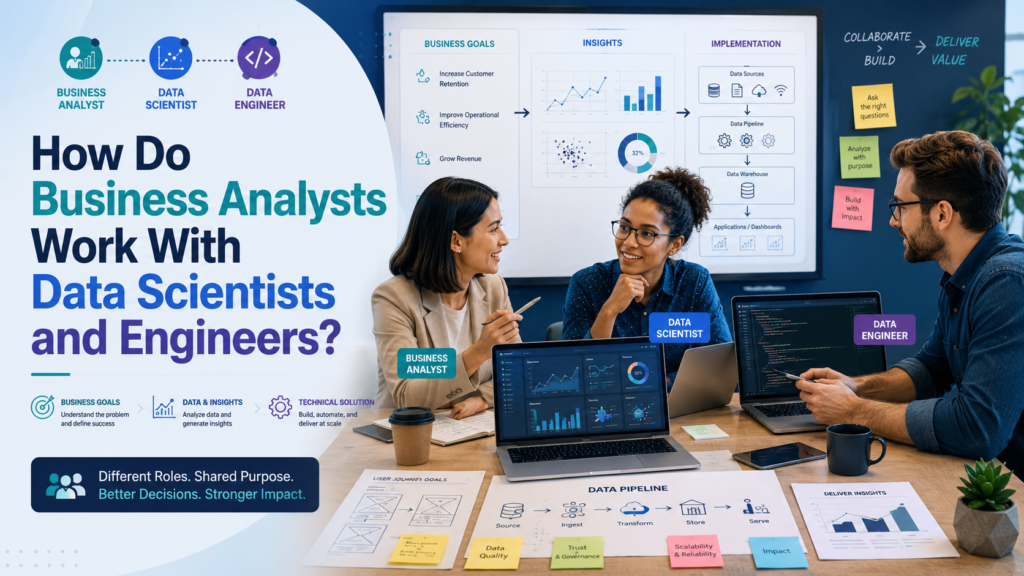
In AI projects, Role of Business Analysts act as intermediaries between business stakeholders and technical teams.
Key Collaboration Responsibilities
- Translating business goals into measurable outcomes
- Defining success metrics for AI models
- Reviewing assumptions and data sources
- Ensuring outputs are explainable to non-technical users
This collaboration model is commonly covered in advanced ba certification and business analysis online training programs.
What Challenges Do Business Analysts Face With AI Adoption?
AI adoption introduces new constraints that analysts must manage carefully.
Common Challenges
- Data quality issues
AI outputs are only as reliable as the input data. - Explainability gaps
Stakeholders often require transparent reasoning behind decisions. - Bias and fairness concerns
Analysts must identify and escalate potential ethical risks. - Over-automation risk
Not all decisions should be automated.
Best practices emphasize governance frameworks and continuous validation rather than blind reliance on AI.
What Frameworks and Standards Guide AI-Driven Business Analysis?
Several frameworks influence how AI is governed in enterprise analysis work.
Relevant Standards and Practices
- Agile and Scrum for iterative delivery
- BPMN for process clarity
- CRISP-DM adapted for business context
- Responsible AI guidelines
- Data governance policies
Understanding these frameworks strengthens the credibility of analysts working on AI initiatives.
How Should Professionals Learn Business Analysis for AI-Driven Roles?
Learning paths increasingly integrate AI concepts into traditional Role of Business Analysts education.
Typical Learning Path
| Stage | Focus |
|---|---|
| Foundation | Core BA skills and documentation |
| Data basics | SQL, data modeling, analytics |
| AI concepts | Machine learning basics, NLP |
| Tool usage | BI platforms with AI features |
| Governance | Ethics, compliance, risk |
This structure Role of Business Analysts is common across modern business analyst courses and ba training programs.
Frequently Asked Questions (FAQ)
Does AI replace Business Analysts?
No. AI automates data-heavy tasks but increases the need for analysts who can interpret, govern, and contextualize insights.
Do Business Analysts need to learn coding?
Basic data literacy is useful, but deep programming is not mandatory for most roles.
Is AI covered in current BA certification programs?
Many ba certification and business analyst certification online programs now include AI and analytics modules.
Can beginners enter this field in 2026?
Yes, with structured business analysis training and guided exposure to AI-enabled tools.
Are AI skills required for all BA roles?
Not all roles require the same depth, but AI awareness is becoming a baseline expectation.
Key Takeaways
- AI is augmenting, not replacing, Business Analysts
- Analysts focus more on interpretation, governance, and strategy
- AI literacy is now a core professional skill
- Enterprise adoption emphasizes practical, explainable use cases
- Structured learning paths help professionals adapt effectively
Explore structured Role of Business Analyst learning paths at H2K Infosys to gain hands-on exposure to modern, AI-enabled analysis practices.
Advance your career with practical training designed for real enterprise environments