Switching into business analysis is absolutely possible even if you’re coming from a non-IT or unrelated background. With the right BA Training, practical exposure, and structured learning, professionals from QA, sales, support, finance, or even non-technical roles are successfully transitioning into business analyst roles in 2026.
I’ve personally seen colleagues make this shift. One was a customer support executive who spent years answering client tickets. She didn’t realize she was already doing half the work of a business analyst, identifying user problems, documenting issues, and suggesting improvements. After formalizing her skills through Business Analyst Training, she moved into a BA role within months. That’s exactly why this BA Career Switch Guide exists to show you the real path forward, not just theory.
What Is Business Analysis and Why So Many People Are Switching
Business analysis is essentially the bridge between business needs and technical solutions. Business analysts identify problems, gather requirements, and help teams build solutions that actually work.
In 2026, business analysis is one of the fastest-growing tech roles, especially with companies adopting AI tools, automation platforms, and data-driven decision-making. Every product, whether it’s a banking app or a healthcare system, needs someone who understands both the business side and the technical side.
That’s why this BA Career Switch Guide is so relevant now. The demand isn’t slowing down it’s accelerating.
Typical responsibilities include:
- Gathering and documenting requirements
- Communicating with stakeholders
- Creating process flows and diagrams
- Supporting product teams
- Ensuring business goals align with technical solutions
Most of these skills can be learned through business analysis online training and real-world projects.
Who Can Switch into Business Analysis
This is probably the biggest misconception that only technical professionals can become business analysts. That’s simply not true.
This BA Career Switch Guide applies to people from backgrounds like:
- Software testing and QA
- Customer support
- Banking and finance
- Sales and marketing
- Operations and logistics
- Fresh graduates
- Career break professionals returning to work
I’ve worked with QA testers who transitioned smoothly because they already understood software workflows. But I’ve also seen teachers and HR professionals switch successfully because business analysis relies heavily on communication and problem-solving.
Formal business analyst courses help structure what you may already be doing informally.
Why Business Analysis Is a Good Career Choice in 2026

Let’s be real. It’s not easy to change careers. But there are a few good things about business analysis that make it useful.
First, you don’t need to know a lot of programming to use it.
Second, it gives you a lot of room to raise your wage. In India, entry-level business analysts make between ₹5 and 10 LPA, while in the US, they make between $70,000 and $100,000. This becomes a lot better with time.
Third, it will last for a long time. AI systems also need business analysts to figure out what they need and check their results.
This BA Career Switch Guide shows what’s going on in all fields: businesses need people who know more than simply how to code.
An online structured business analyst certification program can help you move on much more quickly.
A Beginner’s Guide to Switching Careers as a BA
This is a realistic, tried-and-true plan based on what works.
Step 1: Learn what business analysts really do
Before signing up for any business analyst training, take some time to learn about the job.
See how real projects work. Look at some example requirement documents. Try to learn how users function and what they want.
This helps you make sure that the job is a good fit for your skills.
This first step is very important in the BA Career Switch Guide.
Step 2: Learn Core Business Analysis Skills
The core skills every business analyst needs include:
- Requirement gathering
- Process mapping
- Stakeholder communication
- Documentation
- Problem analysis
These skills are taught in structured business analyst training programs.
You don’t need to learn everything at once. Start small and build gradually. That’s how most career switchers succeed.
This is a foundational part of the BA Career Switch Guide.
Step 3: Find out what tools business analysts use
Business analysts today use tools like:
- Excel from Microsoft
- SQL, Jira, Confluence, and Visio
- Power BI
Most online business analysis training courses let you experiment with these tools.
This is when theory becomes useful abilities.
Knowing how to use tools gives you confidence, which is important in the BA Career Switch Guide.
Step 4: Work on Real-World Projects
This is the most important step and often the most overlooked.
Employers care more about practical experience than theory.
For example, you might work on projects like:
- Banking application requirement analysis
- Healthcare system workflow mapping
- E-commerce process documentation
These project experiences build real job readiness.
This hands-on learning is central to the BA Career Switch Guide.
Step 4: Work on Real-World Projects
This is the most important step and often the most overlooked.
Employers care more about practical experience than theory.
For example, you might work on projects like:
- Banking application requirement analysis
- Healthcare system workflow mapping
- E-commerce process documentation
These project experiences build real job readiness.
This hands-on learning is central to the BA Career Switch Guide.
Step 5: Get a certification as a business analyst
A recognized ba certification proves your talents and makes your resume stronger.
When you change jobs, certification might help employers trust your skills.
To boost their chances of getting hired, many professionals combine certification with project experience.
In the BA Career Switch Guide, certification is a very important step.
Step 6: Prepare Resume and Interview Skills
This is where many candidates struggle not because they lack skills, but because they don’t present them correctly.
Your resume should highlight:
- Requirement analysis experience
- Project involvement
- Tool knowledge
- Communication skills
Programs that offer business analyst training and placement often provide resume and interview support.
This preparation phase is critical in the BA Career Switch Guide.
Real Example: QA Tester to Business Analyst Transition
One professional I worked with had five years of QA experience but was stuck in repetitive testing roles.
He enrolled in structured business analyst courses, learned requirement documentation, and worked on simulated projects.
Within six months, he secured a business analyst role.
What changed?
He didn’t learn everything overnight. He just followed a structured path like this BA Career Switch Guide.
Common Problems People Who Change Jobs Have
Let’s be honest. Changing jobs can be hard.
The most prevalent ones are:
- Fear of beginning again
- Not having confidence
- Not a lot of experience with projects
- Positioning your resume
But organized online business analyst certification programs help with these problems by providing guided study.
Knowing about these problems can help you use the BA Career Switch Guide with more confidence.
How Long Does It Take to Become a Business Analyst?
Most of the time, people who want to change careers may do so in four to eight months if they keep learning and practicing.
Things that affect your timeframe are:
- How fast you learn
- Exposure to the project
- Making your resume
- Ready for the interview
Using this BA Career Switch Guide can help you get forward faster.
Why Business Analysis Is Future-Proof
Even with AI tools like ChatGPT and automation platforms growing rapidly, business analysts remain essential.
AI can analyze data but it still needs human input to define requirements.
This makes business analysis one of the safest career paths in the next decade.
That’s another reason why this BA Career Switch Guide is so relevant in 2026.
How to Start Today
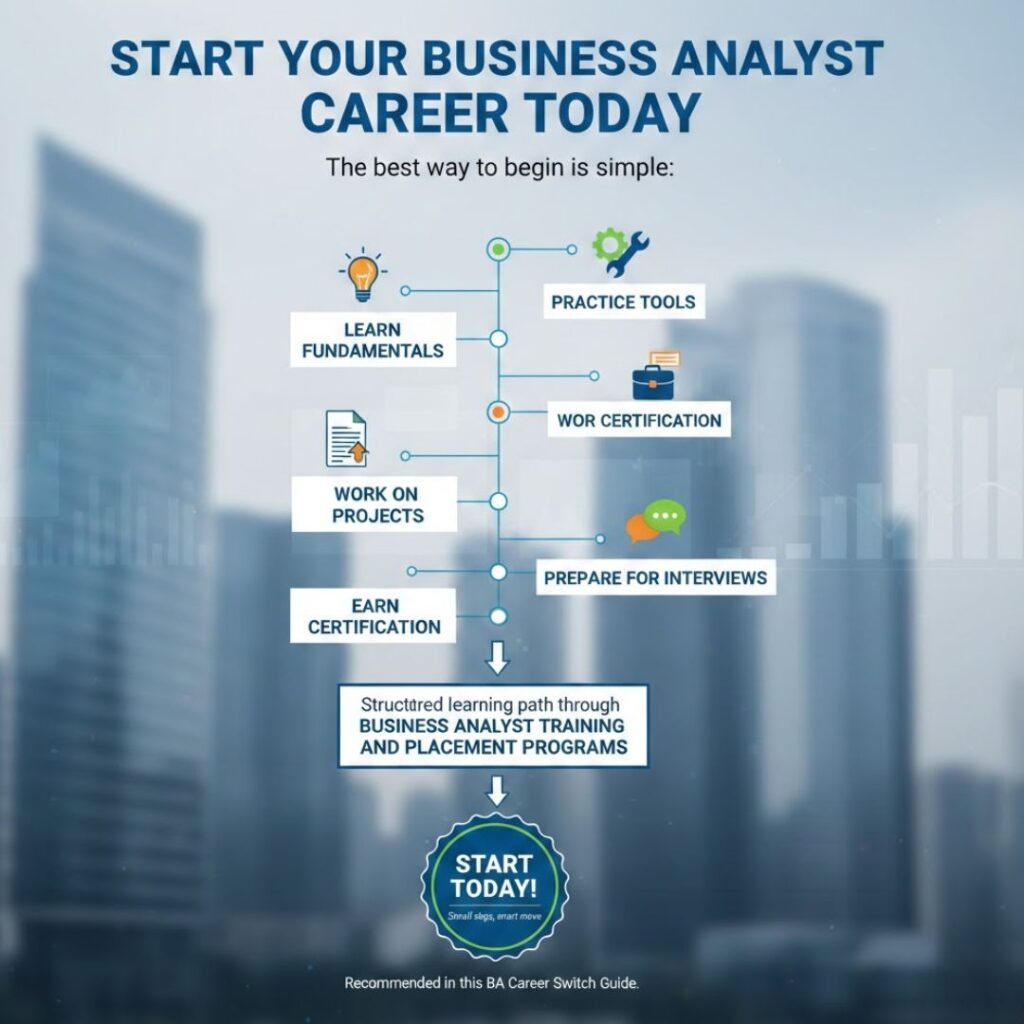
The best way to begin is simple:
- Learn fundamentals
- Practice tools
- Work on projects
- Earn certification
- Prepare for interviews
Following a structured learning path through business analyst training and placement programs helps you transition smoothly.
Starting today, even with small steps, is the smartest move recommended in this BA Career Switch Guide.
Conclusion
It’s not like you have to start from scratch when you go to business analysis. It’s about making your skills more official and building on what you already know.
Anyone may make the switch effectively with the right BA training, hands-on project experience, and structured learning.
This BA Career Switch Guide is based on real-life career changes that happen every day.
Your shift into business analysis isn’t just possible, it’s quite likely to happen in 2026 if you stay steady, practice often, and focus on practical skills.