
The Role of a Business Analyst is changing quickly, and H2K Infosys thinks now is the best moment to start a career in this profession. In the past, business analysts operated as go-betweens for business and IT teams. Now, they are essential to making digital transformation happen. Today’s business analysts (BAs) are in charge of figuring out what a business requires, coming up with good solutions, and encouraging change that adds value to the company. The role has grown since firms now rely on AI, automation, data, and customer experience needs. Business Analysts are becoming an important part of making business plans and making sure that technology works for real people, not just creating requirements.
If you’re planning to build a career through BA Training, this is honestly the best time, because companies are actively hiring BAs who can bridge the gap between business teams, data teams, and tech teams.
Why the Role of a Business Analyst Is Changing So Quickly
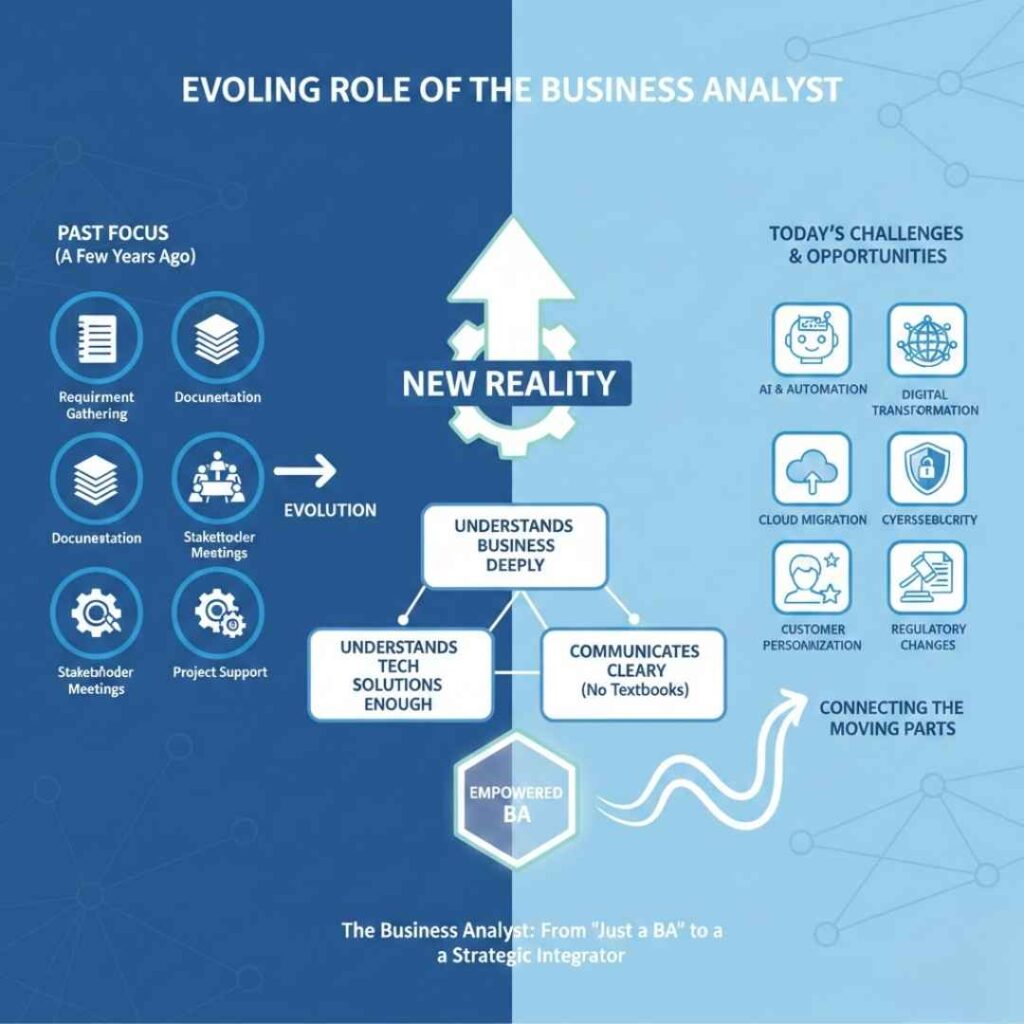
A few years ago, the Role of a Business Analyst was mostly focused on requirement gathering, documentation, stakeholder meetings, and supporting project delivery. That still exists, but the expectations have shifted.
Today, organizations are dealing with:
- AI adoption and automation
- Digital transformation projects
- Cloud migration
- Cybersecurity concerns
- Customer personalization
- Regulatory changes
And someone has to connect all these moving parts practically. That’s where the Role of a Business Analyst has become more powerful.
I’ve noticed one thing in the industry: companies don’t want “just a BA” anymore. They want someone who understands the business problem deeply, understands the tech solution enough, and can communicate clearly without sounding like a textbook.
That is the new reality of the Role of a Business Analyst.
Trend #1: Business Analysts Are Becoming AI Translators
AI is not replacing BAs. But BAs who ignore AI will struggle.
The Role of a Business Analyst is now shifting into something like an “AI translator.” Meaning: the BA doesn’t need to build machine learning models, but must understand what AI can do, where it fits, and what risks come with it.
Practical example
A retail company wants to implement AI-based demand forecasting.
A developer may focus on the algorithm.
A data analyst may focus on the dataset.
But the Role of a Business Analyst is to ask:
- What business decision will this forecasting support?
- What happens if predictions are wrong?
- Who will trust the output?
- What KPIs will define success?
That’s why modern business analyst courses now include AI exposure, data interpretation, and real business case mapping.
Trend #2: Documentation Is Shrinking, Communication Is Growing
This is something many new learners don’t realize. In 2026, people have less patience for 60-page requirement documents. Teams want clarity fast.
So the Role of a Business Analyst is becoming more communication-driven than documentation-driven.
Instead of writing long BRDs, BAs now work with:
- User stories
- Acceptance criteria
- Process maps
- Sprint backlogs
- Lightweight functional specs
And honestly, if you can explain a complex business flow in a simple diagram, you’re already ahead.
This is why business analyst training programs are focusing heavily on Agile frameworks and practical tools like Jira, Confluence, and Miro.
Trend #3: Agile and Hybrid Workflows Are Now the Default
The Role of a Business Analyst has shifted heavily into Agile environments. Even companies that claim they are “Waterfall” are quietly using Agile practices.
So what does this mean?
A BA today must be comfortable with:
- Sprint planning
- Backlog grooming
- Writing user stories
- Working alongside Product Owners
- Coordinating with QA and developers daily
In fact, the Role of a Business Analyst often overlaps with Product Owner responsibilities in many organizations.
That’s why people are increasingly choosing business analyst classes that teach both Agile BA work and real-world project workflows.
Trend #4: BAs Are Expected to Understand Data (Not Just Requirements)
Let’s be real: almost every decision in business is data-backed now.
The Role of a Business Analyst includes working with dashboards, KPIs, reporting tools, and sometimes SQL queries. You don’t have to become a data scientist, but you do need to speak the language of data.
Real scenario
A healthcare company wants to reduce appointment no-shows.
A BA is expected to analyze patterns like:
- Which locations have high no-shows?
- What appointment types are affected?
- What time slots are most problematic?
This is where business analysis online training becomes extremely useful, because modern training covers Excel, SQL basics, and BI tools exposure.
And yes, employers ask about this in interviews.
Trend #5: Business Analysts Are Now Part of Strategic Decision-Making
This is one of the biggest shifts.
Earlier, the BA was treated as a support role. Now, the Role of a Business Analyst is often positioned closer to leadership teams.
BAs are being asked to contribute to:
- Business transformation strategy
- Cost optimization initiatives
- Customer experience redesign
- Process automation planning
- Vendor and tool evaluation
This is why a good ba certification matters. It shows you understand frameworks and can apply structured thinking.
Many professionals now prefer business analyst certification online because it’s flexible and matches industry expectations.
Trend #6: Domain Knowledge Is Becoming a Competitive Advantage
Here’s something I’ve personally seen: two BAs can have the same technical skills, but the one with strong domain understanding wins.
The Role of a Business Analyst becomes much stronger when you specialize in domains like:
- Banking and finance
- Healthcare
- Insurance
- Retail and eCommerce
- Telecom
- Supply chain
Domain knowledge helps BAs ask smarter questions. And smart questions are honestly the real superpower in the Role of a Business Analyst.
That’s why top business analyst courses are now offering domain-based projects.
Trend #7: Automation and Tools Like RPA Are Growing BA Work
The figure eights may also not be performed by a machine but created using two cut logs or a sewn cloth tube.
Developers no longer have a monopoly on automation.
Now the Business Analyst has to find repetitive workflows and propose automation using:
RPA tools
Workflow automation platforms
Low-code applications
Example
A bank manually handles loan applications over email for approvals.
A BA is able to map the workflow, pinpoint bottlenecks, and recommend ways that it could be automated.
Businesses love this because automation saves time and money fast.
That is the reason why BA training and placement studies now focus on automation-based real-time projects.
Trend #8: Cybersecurity and Compliance Awareness Is Now Mandatory
This part is often ignored, but it matters a lot.
The Role of a Business Analyst now includes understanding compliance rules like:
- GDPR-style privacy laws
- Data retention requirements
- Security risk documentation
- Access control needs
Even if you’re not a security analyst, you need awareness. Because BAs are often the ones documenting business rules that directly impact security.
This is why modern business analyst training includes compliance basics.
Trend #9: Stakeholder Management Is Becoming More Complex
In older projects, a BA might deal with one department and one IT team.
Now? The Role of a Business Analyst involves dealing with:
- Business leadership
- Product teams
- Data teams
- Developers
- QA teams
- Vendors
- External customers
And all of them have different expectations.
This is why the Role of a Business Analyst is as much about psychology as it is about analysis.
Sometimes you’re not solving a technical issue, you’re solving a communication problem.
That’s why strong business analyst classes focus on stakeholder role-play exercises and interview practice.
Trend #10: Remote Work Has Changed How BAs Collaborate
Remote and hybrid work is now normal, and the Role of a Business Analyst has adapted.
Instead of in-person whiteboard meetings, BAs now rely on:
- Virtual workshops
- Digital requirement gathering sessions
- Online sprint planning
- Collaboration tools like Teams, Zoom, and Miro
The BA who can run a clean remote workshop is extremely valuable.
Honestly, remote collaboration is now part of the everyday Role of a Business Analyst.
Skills That Will Define the Future Role of a Business Analyst
If you want to future-proof your career, focus on skills that match the evolving Role of a Business Analyst:
Core skills that still matter
- Requirement elicitation
- Process modeling (BPMN)
- Documentation (user stories, use cases)
- Gap analysis
- Stakeholder communication
Skills that are now “must-have”
- Agile and Scrum workflows
- Data interpretation (Excel, SQL basics)
- BI tools awareness
- AI and automation understanding
- Risk and compliance awareness
This is why structured ba training makes a difference it helps you learn these skills in the right order.
Real Cases: BA and the Transformation of Digital Banking
Let’s take a practical case.
A bank would like to introduce a mobile app feature that enables customers to open accounts digitally without stepping foot in a branch.
The function of a Business Analyst in this project would be:
- Mapping customer onboarding journey
- Defining KYC requirements
- Identifying fraud prevention checkpoints
- Managing the compliance and IT relationship
- Writing user stories for developers
- Supporting QA with acceptance criteria
- Ensuring smooth customer experience
That’s not a small role. That’s a leadership-level role.
Hence many professionals are opting business analyst certification online to prove their expertise in managing complicated transformation projects.
Why BA Certifications Will Be More Valuable in 2026

Sure – experience still counts for a lot, but there’s an increasing need in companies for rapid evidence of an individual with some structured BA skills.
As a valuable ba certification, recognition of it can help candidates make a distinct impression when applying for positions such as:
- Business Analyst
- Product Analyst
- Agile BA
- Process Analyst
- Data Business Analyst
And when paired with actual project experience, certification is even more powerful.
So it is no wonder students want to look for business analyst courses that offer certified training and real-life projects.
Career Outlook: Is the Role of a Business Analyst Still in Demand?
Yes, absolutely.
The Role of a Business Analyst is still in demand because companies are constantly changing new tools, new customer needs, new regulations, new automation.
And someone has to manage that transition.
In fact, many organizations are increasing BA hiring because they’ve realized failed projects usually fail due to unclear requirements, poor stakeholder alignment, or weak process understanding. That’s exactly what BAs fix.
So if you’re considering business analysis online training, you’re stepping into a field that has long-term growth.
How to Choose the Right BA Training Program for Future Trends
Not all training programs prepare you for the modern Role of a Business Analyst.
A strong training program should include:
- Agile + Scrum BA practices
- Real-time projects (not just theory)
- Tools like Jira, Confluence, Excel, SQL basics
- Resume building and interview preparation
- Mock interviews
- Placement support
That’s why people search specifically for BA training and placement, because job support matters as much as learning.
Final Thoughts: The Future Role of a Business Analyst Is Bigger Than Ever
The future is not about BAs disappearing it’s about the Role of a Business Analyst becoming more strategic, more data-driven, and more connected to AI and automation.
If you want a career that mixes business thinking, communication, problem-solving, and tech exposure, the BA path is honestly one of the smartest choices right now.
And if you start with the right business analyst training, supported by a strong ba certification, you’ll be prepared not only for today’s job market but for where the industry is heading next.