
H2K Infosys shows that selecting the right training partner counts more than the certification when it comes to Business Analyst Career Growth. I have seen many people switch into BA roles, and I can say that one BA Training course that had the trainees complete real projects was transformational.
The best courses go beyond theory to teach actual skills, including how to gather requirements, communicate with stakeholders, document, practice Agile, and utilize industry tools. Your career will progress more quickly when you have the necessary real-world experience, have practiced interviews, and have received help with placements and certification.
If you want to be a Business Analyst for the long haul, you need to invest in structured education, actual projects, and guidance. That is the only thing that will help you achieve significant progress in your career.
The Reality of Business Analyst Job Growth in 2026
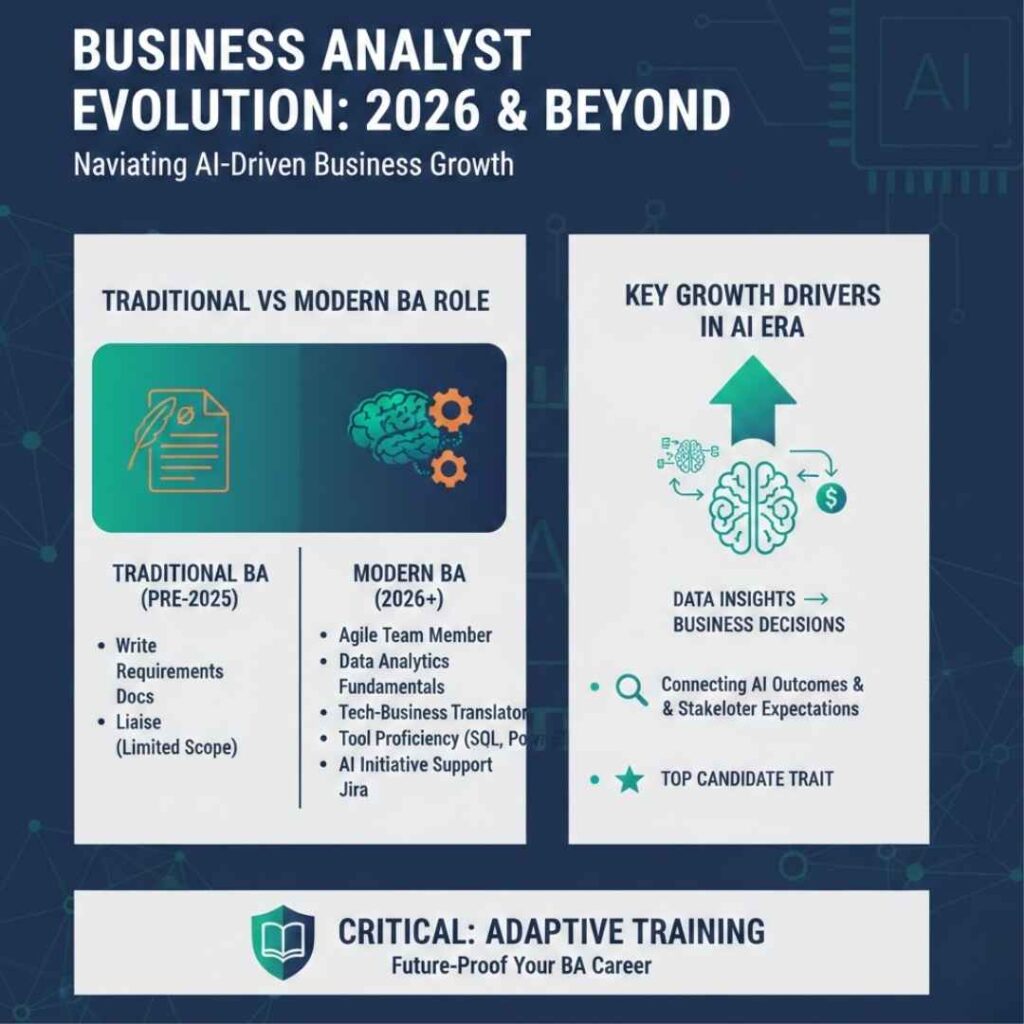
The duties of business analysts have changed. It’s not simply about writing requirements documentation anymore. BAs are expected to do the following by today’s businesses:
- Be a part of Agile teams
- Learn the basics of data analytics
- Talk to both the tech and business teams
- Use tools like SQL, Power BI, and Jira.
- Help with initiatives that use AI to make decisions
As more and more businesses use AI in 2025–2026, Business Analyst Career Growth will depend a lot on how successfully you can turn data insights into business choices. I have seen hiring managers put applicants that can connect AI outcomes with stakeholder expectations at the top of their lists.
That’s why the correct training for business analysts becomes really important.
Why H2K Infosys is Unique for Business Analyst Career Growth
Many make the mistake of signing up for business analyst courses that are purely theoretical. Business Analyst Career Growth comes from learning in a simulated real-world environment.
At H2K Infosys, you will find:
- Live instructor-led sessions
- Simulations of real projects in real time
- Practical exposure on tools
- Mock interviews from role-specific perspectives
- Business analyst specific training and placement assistance
I’ve talked to people who used to work in QA, customer support, and even non-IT. What helped them in their Business Analyst career growth was having real stakeholder scenarios, not just theoretical ones.
Not just slides, but real learning
Let’s be honest. You can’t just watch recorded videos anymore.
To really grow your career as a Business Analyst, you need to:
- Hold practice sessions for acquiring requirements
- Make BRDs and FRDs
- Write down what you did during the Agile sprint.
- Look at datasets to get business information
That’s where structured business analyst classes come in handy. You don’t just memorize definitions; you actually see how requirements change during a sprint (which, trust me, occurs all the time at work).
In two weeks, a client changed their mind on what was most important three times. That encounter taught me more than any book ever could. Programs that mimic this turbulence get you ready for genuine Business Analyst Career Growth.
Certification Matters But Only If It’s Backed by Skill
A ba certification looks good on LinkedIn, sure. But hiring managers in 2026 are smarter. They test you with scenario-based questions.
This is why pursuing a business analyst certification online alongside hands-on training gives better Business Analyst Career Growth outcomes. Certification validates knowledge, but applied learning proves competence.
Students who combine both often see faster interview callbacks and better salary negotiations.
Online Learning That Feels Practical
There’s still skepticism around business analysis online training. People wonder, “Can I really learn effectively online?”
From what I’ve seen yes, but only if it’s interactive.
Good online programs:
- Include live discussions
- Offer tool practice
- Provide mentor guidance
- Assign real case studies
That structure accelerates Business Analyst Career Growth because it mimics actual job responsibilities.
Placement Support: The Missing Part
Most institutes provide training. Very few support you all the way to getting a job.
- Comprehensive business analyst training and placement support offers
- Market trend based resume optimization
- Mock interviews with feedback on the spot
- LinkedIn marketing guidance
- Networking support
And this influences Business Analyst Career Growth positively. It reduces the time interval between training and employment.
Due to the rise of AI analytics and automation tools in the job market, especially in today’s job market, the training has to be purposeful as opposed to being haphazard.
Following the trends in the industry in 2026
Let’s chat about what’s popular right now.
Companies are now looking for BAs who can:
- Use AI dashboards
- Understand predictive analytics
- Work together in mixed work settings
- Manage digital transformation programs that involve people from different departments
Adaptability is important for Business Analyst Career Growth today. Programs that change their curriculum often (instead of using the same old 2018 material) help professionals stay up to date.
And that relevance? It has a direct effect on pay raises and chances to be a leader.
A Realistic Path to Business Analyst Career Growth
Here’s what I’ve noticed after observing multiple career transitions:
- Structured ba training
- Hands-on project experience
- Certification validation
- Interview preparation
- Continuous skill updates
When these five elements align, Business Analyst Career Growth becomes measurable, not just hopeful.
It’s not magic. It’s preparation meeting opportunity.
Who Should Consider This Path?
If you are:
- A working professional stuck in a stagnant role
- A QA tester wanting domain expansion
- A fresher confused about direction
- A non-IT professional planning a tech shift
Then structured learning combined with placement guidance can accelerate your Business Analyst Career Growth significantly.
I’ve seen professionals double their salary within 18 months after entering BA roles. Not overnight. But steadily, strategically.
Conclusion
It’s not about blindly following trends when you want to grow your career as a business analyst. It’s about picking the perfect environment that helps you learn new skills, gain confidence, and get ready for work.
When business analyst courses include hands-on experience, help with being certified, and organized job placement help, professionals have more clarity and direction.
Companies seek professionals that can adapt, think like a business, and know about technology in 2026. If your training reflects that reality, your Business Analyst Career Growth becomes not just achievable but sustainable.