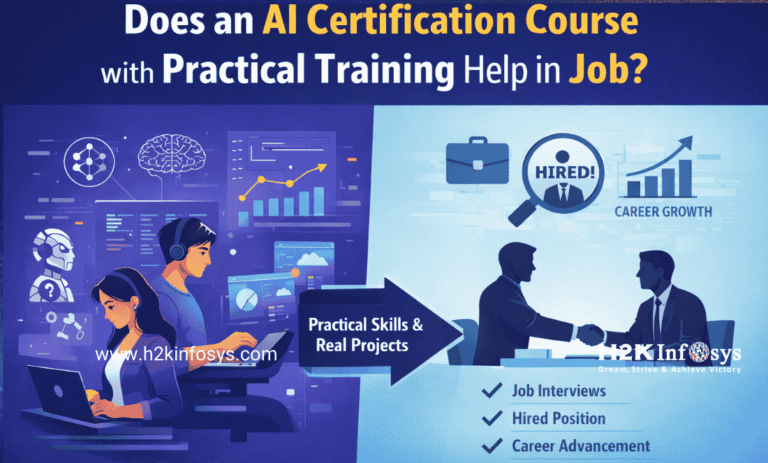
H2K Infosys offers an AI course certification combined with practical training that significantly improves employability because employers evaluate candidates based on their ability to apply artificial intelligence concepts to real-world problems, not just theoretical knowledge. Practical exposure through projects, tools, and enterprise workflows demonstrates job readiness. Structured Artificial Intelligence Online Training helps professionals build technical competencies, develop portfolio projects, and understand how AI systems are implemented in production environments.
What Is an AI Certification Course with Practical Training?
An AI Certification Course with practical training is a structured learning program that teaches artificial intelligence concepts while providing hands-on experience using industry tools, datasets, and real-world project scenarios.
These programs typically cover:
- Machine learning fundamentals
- Deep learning techniques
- Data preprocessing and feature engineering
- Model training and evaluation
- Deployment and integration into applications
Practical training distinguishes certification courses from purely theoretical education. It includes activities such as:
- Building predictive models
- Training neural networks
- Implementing natural language processing solutions
- Deploying AI models using APIs or cloud platforms
An AI course certification verifies that learners have acquired both conceptual understanding and applied skills.
How Does Artificial Intelligence Work in Real-World IT Projects?
Artificial intelligence systems operate through structured workflows that transform raw data into actionable insights.
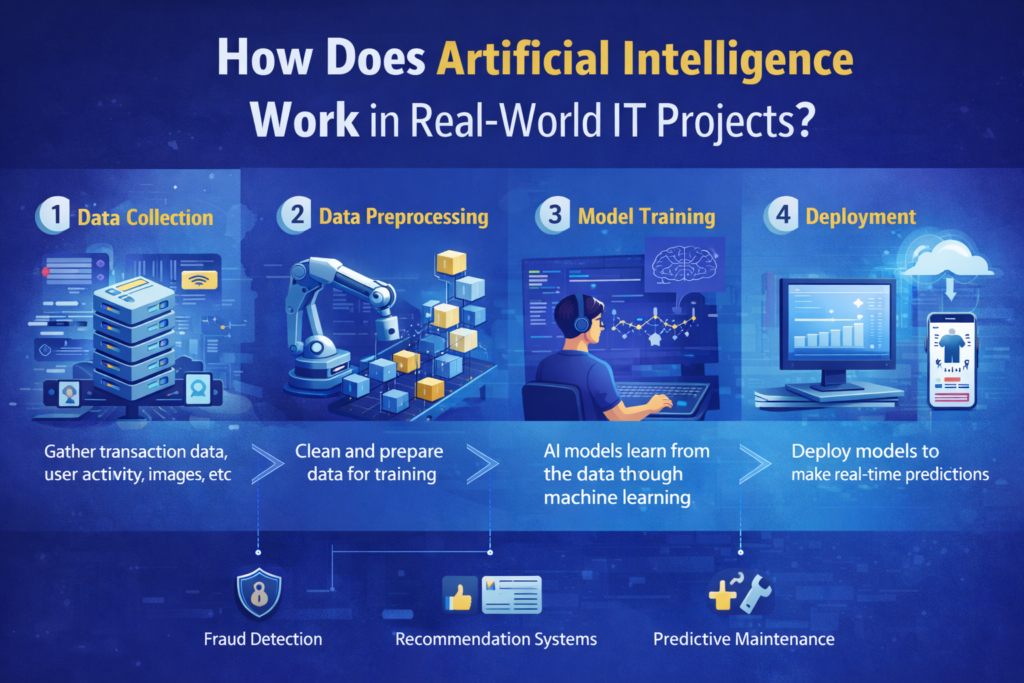
Standard AI Workflow in Enterprise Projects
| Step | Description | Tools Commonly Used |
|---|---|---|
| Data Collection | Gathering structured or unstructured data | SQL, APIs, data lakes |
| Data Cleaning | Removing errors and preparing datasets | Python, Pandas |
| Feature Engineering | Selecting and transforming variables | NumPy, Scikit-learn |
| Model Training | Training machine learning models | TensorFlow, PyTorch |
| Model Evaluation | Measuring accuracy and performance | Scikit-learn metrics |
| Deployment | Integrating model into applications | Flask, FastAPI, Docker |
| Monitoring | Tracking performance and updating models | MLflow, cloud monitoring tools |
Example: Customer Churn Prediction System
In enterprise environments, AI is used to predict customer churn.
Workflow example:
- Extract customer data from database
- Clean and preprocess data
- Train classification model
- Evaluate accuracy
- Deploy model to production system
- Use predictions to support business decisions
Professionals who complete Artificial Intelligence Online Training learn how to execute each of these steps.
Why Is an AI Course Certification Important for Working Professionals?
AI certification provides structured validation of skills that align with industry requirements.
Employers commonly evaluate candidates based on:
- Ability to work with real datasets
- Knowledge of machine learning algorithms
- Experience with programming languages like Python
- Understanding of model deployment workflows
Certification helps demonstrate these competencies.
Key Benefits of Practical AI Certification
- Validates technical skills
- Demonstrates practical experience
- Improves resume credibility
- Helps transition into AI-related roles
- Provides exposure to enterprise tools
Professionals without practical experience often struggle during technical interviews, which focus on real-world problem solving.
What Skills Are Required to Learn Artificial Intelligence?
AI professionals need a combination of technical and analytical skills.
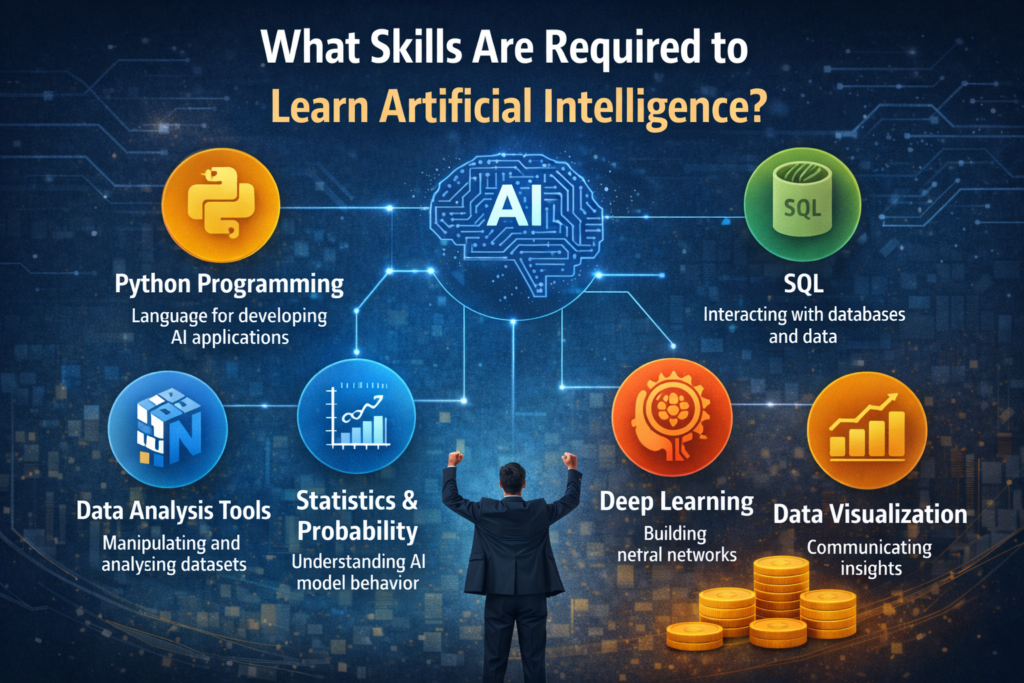
Core Technical Skills
| Skill | Purpose |
|---|---|
| Python programming | Primary language for AI development |
| Statistics and probability | Understanding model behavior |
| Data analysis | Interpreting datasets |
| Machine learning algorithms | Building predictive systems |
| Deep learning | Neural network implementation |
| Data visualization | Communicating insights |
Supporting Skills
- SQL for database interaction
- Git for version control
- Cloud platforms for deployment
- API integration
Artificial Intelligence Online Training programs typically include these skills as part of the curriculum.
How Is Artificial Intelligence Used in Enterprise Environments?
Artificial intelligence is integrated into many enterprise systems.
Common Enterprise AI Use Cases
1. Fraud Detection
AI models analyze transaction patterns to detect suspicious activities.
2. Recommendation Systems
Used by e-commerce platforms to suggest products.
3. Customer Support Automation
Chatbots provide automated responses using NLP.
4. Predictive Maintenance
AI predicts equipment failure in manufacturing environments.
5. Healthcare Diagnostics
AI assists in analyzing medical images.
Professionals trained through an AI Course Certification learn how these systems operate and are implemented.
How Does Practical Training Improve Job Readiness?
Practical training prepares learners for real-world technical responsibilities.
Skills Developed Through Hands-On Projects
- Data preprocessing and cleaning
- Model training and evaluation
- Debugging machine learning pipelines
- Working with real datasets
- Deploying models
Employers prefer candidates who can demonstrate project experience.
Example Project: Sales Prediction Model
Steps involved:
- Load dataset using Python
- Clean data using Pandas
- Train regression model
- Evaluate accuracy
- Deploy model using API
This type of project reflects actual industry workflows.
What Industry Tools Are Covered in Artificial Intelligence Online Training?
AI professionals use a variety of tools in production environments.
Core AI Tools
| Tool | Purpose |
|---|---|
| Python | Programming language |
| TensorFlow | Deep learning framework |
| PyTorch | Neural network development |
| Scikit-learn | Machine learning models |
| Pandas | Data manipulation |
| NumPy | Numerical computing |
Deployment and Integration Tools
| Tool | Purpose |
|---|---|
| Docker | Containerization |
| FastAPI | Model deployment |
| Flask | API creation |
| AWS / Azure | Cloud deployment |
Understanding these tools improves job readiness.
How Do Employers Evaluate AI Certification Candidates?
Employers typically assess candidates using technical interviews and project reviews.
Evaluation Areas
- Programming ability
- Understanding of machine learning concepts
- Problem-solving skills
- Project experience
- Knowledge of tools and frameworks
Certification alone is not sufficient. Practical experience is essential.
What Job Roles Use Artificial Intelligence Daily?
Many IT roles involve AI technologies.
AI Career Roles
| Role | Responsibilities |
|---|---|
| Machine Learning Engineer | Develop ML models |
| AI Engineer | Design AI systems |
| Data Scientist | Analyze data using ML |
| AI Developer | Build AI applications |
| NLP Engineer | Work on language models |
These roles require practical training and technical expertise.
What Careers Are Possible After Learning Artificial Intelligence?
AI training prepares professionals for multiple career paths.
Entry-Level Roles
- Junior AI Engineer
- Data Analyst
- AI Developer
Intermediate Roles
- Machine Learning Engineer
- Data Scientist
- AI Specialist
Advanced Roles
- AI Architect
- Research Engineer
Career progression depends on experience and skill development.
How Does Practical AI Training Help During Job Interviews?
Technical interviews focus on practical problem solving.
Common interview topics include:
- Machine learning algorithms
- Python coding
- Model optimization
- Data preprocessing
Candidates with hands-on project experience perform better during interviews.
What Are the Common Challenges Professionals Face Without Practical Training?
Professionals without hands-on experience often struggle with:
- Implementing machine learning models
- Understanding real datasets
- Deploying AI applications
- Debugging errors
Practical training helps overcome these challenges.
What Should Be Included in a High-Quality AI Certification Course?
A comprehensive AI course certification should include:
Core Topics
- Machine learning fundamentals
- Deep learning concepts
- Natural language processing
- Model deployment
Practical Components
- Real-world projects
- Hands-on labs
- Tool usage
- Deployment exercises
How Does Artificial Intelligence Online Training Align with Industry Requirements?
Industry requirements focus on applied skills.
Training programs should include:
- Programming practice
- Real datasets
- Model deployment
- Project-based learning
These elements align with employer expectations.
How Do AI Models Get Deployed in Production Systems?
Model deployment involves integrating trained models into applications.
Deployment Workflow
- Train model
- Save model
- Create API
- Deploy using server
- Monitor performance
Example Deployment Using Python
Conceptual workflow:
- Train model using Scikit-learn
- Save model using pickle
- Create API using FastAPI
- Deploy application
This process is taught in practical training.
How Long Does It Take to Become Job-Ready in Artificial Intelligence?
Learning timelines vary.
Typical learning phases:
| Phase | Duration |
|---|---|
| Fundamentals | 2–3 months |
| Intermediate skills | 3–6 months |
| Practical project experience | 3–6 months |
Consistent practice is essential.
FAQ Section
Does an AI certification guarantee a job?
No certification guarantees employment. However, certification with practical training improves employability by demonstrating relevant skills.
Is practical training necessary for AI careers?
Yes. Employers prioritize candidates with project experience.
Do employers verify AI certifications?
Employers typically evaluate practical skills more than certification credentials.
Can beginners learn artificial intelligence?
Yes. Beginners can learn AI through structured training programs.
What programming language is required for AI?
Python is the most commonly used programming language in AI.
Key Takeaways
- An AI course certification combined with practical training improves job readiness
- Employers prioritize hands-on experience over theoretical knowledge
- Artificial Intelligence Online Training teaches real-world workflows
- AI professionals use tools like Python, TensorFlow, and cloud platforms
- Practical project experience helps during technical interviews
- AI skills are used across industries including healthcare, finance, and IT
Explore Practical AI Learning Opportunities
H2K Infosys offers Artificial Intelligence Online Training designed to help professionals gain hands-on experience with real-world AI tools and workflows.
Explore their structured AI course certification programs to build practical skills aligned with industry requirements.