Salesforce Career Growth will continue to thrive over the next five years, and many of my contacts, who are trained by H2K Infosys, are already receiving rapid advancement, greater compensation, and more opportunities abroad.
If you’re wondering if this is still worth pursuing in 2026, the short answer is yes. Salesforce Career Path in the USA now appears to be even more promising than it was a few years ago, primarily because companies are investing heavily in automation, AI, and customer data.
Why Salesforce Is Still In Huge Demand
Let’s be honest for a second. This tech ability is saturated,’ and they say that every few years.” I heard the same about Salesforce in 2021. But the reality? There are still unfilled positions at companies around the country.
The reason is simple. Salesforce is not only a CRM any longer. There’s a whole ecosystem, with AI tools, automation technology, data clouds and industry-specific products. And when companies have invested tens of millions in this platform, they need experts to run it.
That is precisely why the Salesforce Career Growth perspective keeps looking solid and future-ready.
Hell, I recently talked to a friend moving from a trash-tier admin in Texas into the ranks of a senior consultant over 3 years. His biggest advantage? He didn’t learn once and stop getting his first certification.
What Will Change in the Next 5 Years
Here’s where things get interesting. The future of Salesforce Career Growth will be AI-powered and data-driven. With apps like Einstein AI now being put into mainstream use, companies are in need of professionals who have a dual understanding of business and technology.
This means:
- More demand for hybrid skills
- Stronger focus on automation
- Higher salaries for certified professionals
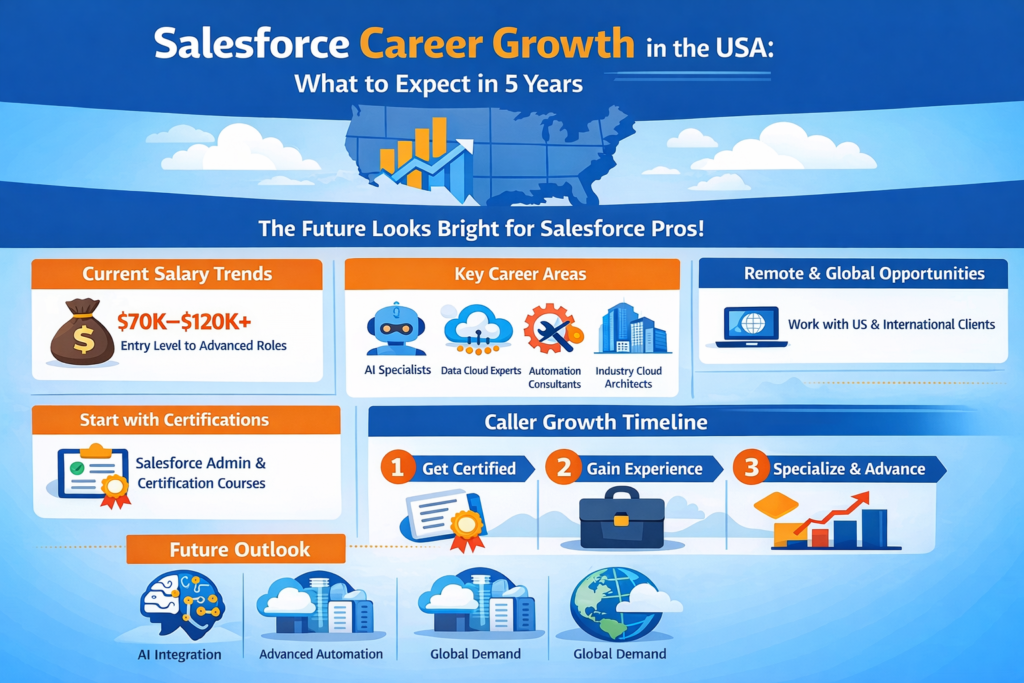
- Remote and global work opportunities
I’ve observed that today hiring managers are more interested in those applicants who have both the certifications and hands-on project experience. So it’s not enough to just collect the badges anymore. But they are the infrastructure that continues to underpin society.
It’s no wonder that many beginners take Salesforce administrator classes to become more confident in the area before pursuing higher roles.
Salary Trends in the USA
Let’s talk money. Because, really, that’s what drives most career choices.
Currently, the chief at an entry-level facility in the USA might take home $70K–$90K per year. With experience, this could rise to $120K+ or more. Automation, CPQ or architecture specialists often make even more.
And here’s the thing: Salesforce Career Growth is anything but linear. Then it really takes off when you have domain knowledge.
For instance, the specialists of healthcare, finance, or retail clouds are widely sought after. So, selecting a niche at the beginning can be a fast track to your career.
Certifications Do Matter (But Strategy Matters More)
Online, there’s much debate about how relevant certifications are or aren’t. At least from what I have observed, they are especially if they’re part of hands-on learning.
For many, Salesforce certification courses offer the most structure. These courses are designed to teach you about real‐world workflows, not just theory.
But let me share a mistake I see all the time:
They are thrown into tests without developing real-world competencies. Then they struggle in interviews.
A smarter approach is:
- Learn concepts
- Build real projects
- Practice problem-solving
- Then attempt certification
This is how to secure a lucrative salesforce Career Growth in the long term and differentiate yourself.
Why Admin Roles Are the Gateway
The majority of individuals start their learning journey from the Salesforce admin certification courses. And that makes sense. The admin role really requires an understanding of how businesses use Salesforce in the real world.
I’ve started to see a pattern:
A lot of admins are transitioning to being a consultant/DA/SA, etc.
The job of the admin is not just to take care of users and reports anymore. It’s about solving business problems. That is where REAL Salesforce Career Growth occurs.
Real-World Example: A Career Switch
I heard from a reader last month. She had worked in customer support in India and wanted to come to the USA. She studied in structured Salesforce certification, added portfolio projects to her name, and got a remote job offer within 10 months.
Now she is in the U.S., working with a start-up and preparing for her move.
Her biggest takeaway?
Consistency beats speed.
And that’s a lesson I keep seeing in successful professionals.
The Rise of Remote and Global Opportunities
A significant change for Salesforce Career Growth, in particular, is that work from home has gained a lot of importance. Today, companies are hiring talent across the globe, giving more chances to talented professionals.
If relocation isn’t an option in the short term, remote experience working on projects with U.S. clients can boost your profile.
This worldwide rank is likely to increase, particularly because cloud platforms break down geographical distances.
Future Roles That Will Explode
If you’re thinking long-term, watch these zones:
- Salesforce AI specialists
- Data Cloud experts
- Automation consultants
- Industry cloud architects
- DevOps and integration experts
These roles are starting to take shape, and these will lead to the next wave of Salesforce Career Growth.
I’ve noticed a huge uptick in the last year for job postings that are asking for experience in AI and automation.
How to Stay Relevant
Here’s a problem we don’t talk about too much. The platform changes constantly. So learning once isn’t enough.
Here’s What You Must Do To Keep Salesforce Career Growth Steady.
Stay updated with releases
- Join communities
- Build side projects
- Learn business processes
- Develop communication skills
The truth is, soft skills are as important as you think they are. The greatest Salesforce practitioners are not only technology people, they know people and know business.
Choosing the Right Training Path
I often am asked by beginners what the best Salesforce certification course to take first is? So here’s my advice: Choose a structured program with real-world projects.
Look for training that includes:
- Hands-on labs
- Mock interviews
- Case studies
- Live project exposure
Faster Salesforce Career Growth: All these aspects shoot up your Salesforce Career Growth in no time, more than the pseudo knowledge you acquire.
The Biggest Mistake to Avoid
Attempting to know it all at once. I did this as I started in my career, and it held me back.
Instead:
- Start with fundamentals
- Gain experience
- Specialize gradually
This mindset helps to promote Salesforce Career Growth and prevent burnout.
Final Thoughts
If you’re looking to carve out a long-term tech career, this field is in demand and provides job flexibility and the opportunity for high pay. The next five years will benefit anyone who can marry certifications with experience and business savvy.
And based on what I’ve seen in actual hiring and growth, Salesforce Career Growth is only going to continue as companies’ investment in customer experience, automation and AI grows as well.
If you’re getting started, don’t overthink it. Start with something small, stick to it, and learn as you go. That’s what distinguishes the winners from the quitters.