Yes, H2K Infosys AI courses with structured career support can improve a learner’s ability to obtain entry-level jobs by providing industry relevant skills, hands-on project experience, interview preparation, and job search guidance. However, career support alone does not guarantee employment; success depends on the learner’s technical proficiency, project portfolio, consistency, and alignment with current industry requirements. Well-designed AI learning programs, including Artificial Intelligence Certification Online and structured, help bridge the gap between academic knowledge and job-ready skills by combining theoretical understanding with practical implementation.
What Is AI Learning for Beginners and Career Support in AI Courses?
AI learning for beginners refers to structured training programs designed to teach foundational and applied artificial intelligence concepts to individuals with little or no prior experience in AI. These programs typically include:
- Machine learning fundamentals
- Data preprocessing techniques
- Model training and evaluation
- Python programming for AI
- Real-world project implementation
Career support in AI and Machine learning Courses refers to structured services that prepare learners for employment. These may include:
- Resume and LinkedIn profile development
- Interview preparation and mock interviews
- Project portfolio building
- Career mentorship and technical guidance
- Job search strategies and application support
Career support focuses on helping learners translate technical skills into demonstrable job readiness.
Why Is AI Learning Important for Working Professionals?
Artificial intelligence is integrated into many enterprise systems across industries such as finance, healthcare, retail, cybersecurity, and cloud computing. Professionals with AI skills can contribute to data-driven decision-making, automation, and predictive analysis.
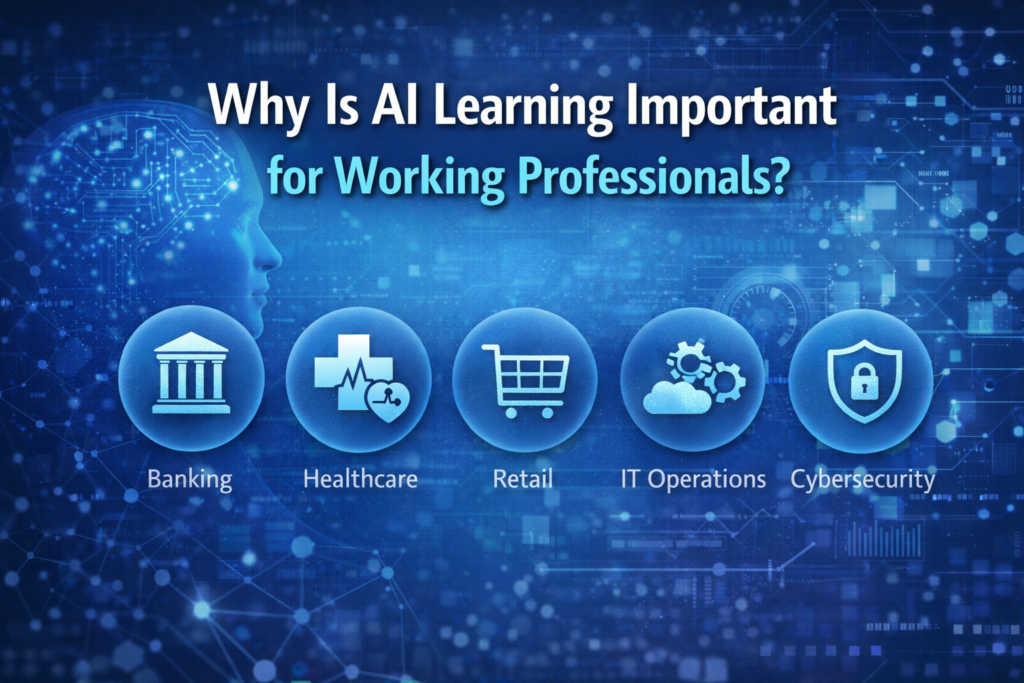
Common Enterprise Applications of AI
| Industry | AI Use Case | Tools Commonly Used |
|---|---|---|
| Banking | Fraud detection | Python, TensorFlow, Scikit-learn |
| Healthcare | Medical image analysis | PyTorch, CNN models |
| Retail | Recommendation systems | Collaborative filtering, Spark ML |
| IT Operations | Predictive maintenance | Time series models |
| Cybersecurity | Threat detection | Anomaly detection algorithms |
Working professionals benefit from AI skills because these technologies support automation, reduce manual analysis, and improve operational efficiency.
How Does AI Work in Real-World IT Projects?
Artificial intelligence systems follow a structured lifecycle. Understanding this lifecycle is essential for anyone taking AI and machine learning courses.
Typical Enterprise AI Workflow
Step 1: Data Collection
Organizations gather data from sources such as:
- Databases (SQL Server, Oracle)
- Cloud storage (AWS S3, Azure Blob)
- Application logs
- APIs
Example:
Customer transaction data
System logs
User activity metrics
Step 2: Data Preprocessing
Raw data is cleaned and transformed before training models.
Tasks include:
- Removing duplicate records
- Handling missing values
- Feature engineering
- Normalization
Tools used:
- Pandas
- NumPy
- Apache Spark
Example:
df.fillna(mean_value)
df.drop_duplicates()
Step 3: Model Training
Machine learning models are trained to recognize patterns.
Common models include:
- Linear regression
- Decision trees
- Random forests
- Neural networks
Tools:
- Scikit-learn
- TensorFlow
- PyTorch
Step 4: Model Evaluation
Models are evaluated using metrics such as:
- Accuracy
- Precision
- Recall
- F1 score
Example:
accuracy_score(y_true, y_pred)
Step 5: Deployment
The trained model is deployed into enterprise systems using:
- REST APIs
- Docker containers
- Cloud platforms (AWS, Azure, GCP)
Deployment allows applications to make predictions in real time.
What Skills Are Required to Learn AI and Machine Learning Courses?
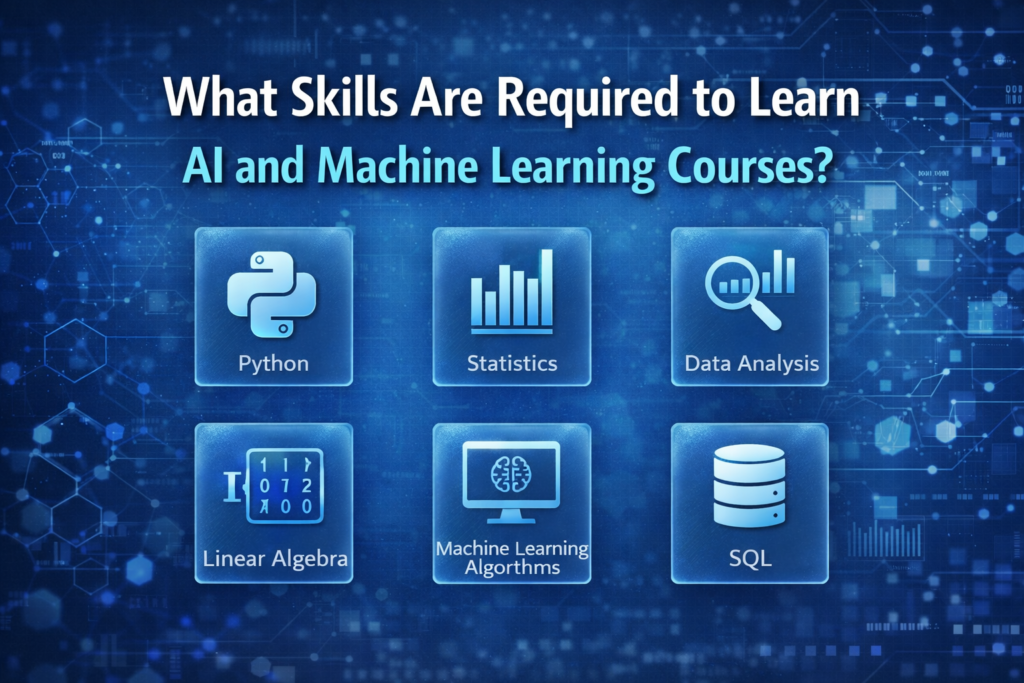
AI learning for beginners requires foundational technical skills combined with practical implementation knowledge.
Core Technical Skills
| Skill | Purpose | Importance Level |
|---|---|---|
| Python Programming | Model development | Essential |
| Statistics | Understanding algorithms | Essential |
| Linear Algebra | Neural networks | Important |
| Data Analysis | Data preparation | Essential |
| Machine Learning Algorithms | Model training | Essential |
| SQL | Data retrieval | Important |
| Cloud Basics | Model deployment | Useful |
Supporting Skills Required in Entry-Level Roles
- Problem-solving ability
- Logical thinking
- Data interpretation
- Debugging skills
- Understanding of business requirements
Career support programs often focus on helping learners demonstrate these skills during interviews.
How Do AI Courses with Career Support Help in Job Preparation?
Career support complements technical training by focusing on job readiness.
Key Career Support Components
1. Resume and Profile Development
Technical resumes emphasize:
- Projects completed
- Technologies used
- Measurable results
- Practical experience
Example:
Instead of writing:
“Learned machine learning”
Write:
“Developed a predictive model using Python and Scikit-learn to classify customer churn with 87% accuracy.”
2. Project Portfolio Development
Employers expect candidates to demonstrate applied knowledge.
Typical beginner projects include:
- Spam detection system
- Customer churn prediction
- Image classification model
- Sales prediction model
Portfolio platforms:
- GitHub
- GitLab
- Kaggle
3. Mock Interviews and Technical Preparation
Interview preparation includes:
- Coding assessments
- Machine learning theory questions
- Scenario-based questions
- Problem-solving exercises
Example questions:
- Explain overfitting
- Difference between supervised and unsupervised learning
- How would you improve model accuracy?
4. Job Application Guidance
Career support programs help learners understand:
- How to apply for entry-level roles
- How to prepare for technical interviews
- How to position their skills effectively
How Is AI Used in Enterprise Environments?
Artificial intelligence is integrated into enterprise systems through structured workflows.
Enterprise AI Architecture Example
Data Sources → Data Processing → Model Training → Model Deployment → Application Integration
Tools Used in Enterprise AI Systems
| Layer | Tools |
|---|---|
| Data Storage | SQL, NoSQL, Data Lakes |
| Data Processing | Spark, Pandas |
| Model Training | TensorFlow, PyTorch |
| Deployment | Docker, Kubernetes |
| Cloud Integration | AWS, Azure, Google Cloud |
What Job Roles Use AI Skills Daily?
Entry-level professionals typically work in support or junior-level roles.
Common Entry-Level Roles After AI Learning for Beginners
| Role | Responsibilities |
|---|---|
| Junior Data Analyst | Data analysis and reporting |
| Machine Learning Intern | Assist in model development |
| AI Support Engineer | Support AI-based systems |
| Junior Python Developer | Develop automation scripts |
| Data Engineer Trainee | Prepare data pipelines |
What Careers Are Possible After Completing AI and Machine Learning Courses?
Career growth depends on skill level, experience, and specialization.
Career Progression Path
| Level | Role |
|---|---|
| Entry-Level | Junior Data Analyst |
| Mid-Level | Machine Learning Engineer |
| Advanced | AI Engineer |
| Senior | AI Architect |
What Makes Career Support Effective in AI Courses?
Not all career support programs provide the same level of benefit.
Effective Career Support Includes
- Hands-on project experience
- Real-world datasets
- Mentor guidance
- Interview preparation
- Industry-relevant tools
Career support is most useful when combined with practical skill development.
Common Enterprise Tools Covered in AI and Machine Learning Courses
Programming and Framework Tools
| Tool | Purpose |
|---|---|
| Python | AI development |
| TensorFlow | Deep learning |
| PyTorch | Neural networks |
| Scikit-learn | Machine learning |
Data Tools
| Tool | Purpose |
|---|---|
| Pandas | Data manipulation |
| NumPy | Numerical computing |
| SQL | Data queries |
| Spark | Large-scale data processing |
Cloud and Deployment Tools
| Tool | Purpose |
|---|---|
| AWS | Cloud deployment |
| Docker | Containerization |
| Kubernetes | Scalable deployment |
How Career Support Helps Bridge the Industry Skill Gap
Many learners struggle because they lack real-world experience.
Career support helps by providing:
- Guided project development
- Technical mentorship
- Interview practice
- Industry workflow exposure
This improves readiness for entry-level job requirements.
Example of a Beginner AI Project Workflow
Customer Churn Prediction Project
Step 1: Load data
import pandas as pd
df = pd.read_csv("customer_data.csv")
Step 2: Clean data
df.fillna(method='ffill')
Step 3: Train model
from sklearn.ensemble import RandomForestClassifier
model = RandomForestClassifier()
model.fit(X_train, y_train)
Step 4: Evaluate model
model.score(X_test, y_test)
This workflow reflects common real-world practices.
Challenges Learners Face Without Career Support
Common challenges include:
- Lack of project experience
- Difficulty understanding industry expectations
- Poor interview preparation
- Incomplete technical knowledge
Career support programs address these challenges by providing structured guidance.
How Employers Evaluate Entry-Level AI Candidates
Employers typically evaluate candidates based on:
Technical Skills
- Python proficiency
- Machine learning understanding
- Data handling ability
Practical Experience
- Projects completed
- GitHub portfolio
Problem-Solving Skills
- Logical thinking
- Debugging ability
Communication Skills
- Ability to explain technical concepts clearly
FAQ: AI Learning for Beginners and Career Support
Do AI courses guarantee a job?
No. AI courses provide skills and preparation, but employment depends on individual performance, project experience, and interview success.
Are AI and machine learning courses suitable for beginners?
Yes. Many courses are designed for beginners and start with programming and machine learning fundamentals.
How long does it take to learn AI for entry-level roles?
Typically 4–12 months, depending on learning pace, consistency, and practice.
What is the best programming language for AI beginners?
Python is widely used due to its simplicity and extensive AI libraries.
Do employers require AI certification?
Certifications can help demonstrate knowledge, but practical experience and project portfolios are often more important.
Is career support necessary in AI courses?
Career support is helpful because it prepares learners for job interviews, resume building, and real-world applications.
Can non-IT professionals learn AI?
Yes. Beginners can start with programming basics and gradually progress to machine learning.
Key Takeaways
- AI courses with career support can help learners prepare for entry-level jobs by developing practical skills and job readiness.
- Career support includes resume building, interview preparation, and project portfolio development.
- AI learning for beginners focuses on programming, machine learning, and real-world project implementation.
- Employers evaluate candidates based on technical skills, project experience, and problem-solving ability.
- Hands-on experience with enterprise tools such as Python, TensorFlow, and cloud platforms is essential.
- Career support improves readiness but does not guarantee employment; consistent practice and project development are critical.
Explore H2K Infosys AI and machine learning courses to build hands-on experience with real-world tools and guided career support.
Enroll in structured training designed to help professionals develop practical AI skills aligned with industry requirements.