The quickest way to understand how AI is reshaping CRM in 2026 is simple: companies using platforms like H2kinfosys training programs are already applying intelligent automation to sales, marketing, and customer service through powerful Salesforce AI Features.
Artificial intelligence is no longer a “future add-on” in Salesforce it’s baked into the platform. If you’ve worked in CRM over the last couple of years, you’ve probably noticed how Salesforce Einstein, predictive analytics, and generative tools are showing up everywhere from dashboards to chatbots. The latest Salesforce AI Features are designed to remove repetitive work, surface insights faster, and help teams make decisions with real data instead of guesswork.
And honestly, after seeing how companies actually use these tools in the wild, it’s pretty clear why demand for Salesforce classes, Salesforce course programs, and professional Salesforce training courses has exploded recently.
Let’s discuss the key Salesforce AI features you should know in 2026 and how they’re being applied by businesses in practice.
Einstein Copilot: Salesforce User AI Assistant
Einstein Copilot is getting all the buzz among Salesforce AI features.
Suppose you want an AI assistant living in Salesforce. Instead of clicking through dozens of reports, users can simply ask questions like:
- “Which deals are most likely to close this quarter?”
- “Summarize the last customer interaction.”
- “Create a follow-up email for this lead.”
And the system responds instantly.
A sales manager I spoke with recently described it this way: before Copilot, their team spent hours digging through dashboards. Now the AI summarizes pipeline health in seconds. That kind of workflow change is exactly why Salesforce AI Features continues to dominate the AI CRM conversation.
For anyone learning through a Salesforce course, Copilot is quickly becoming one of the most practical tools to understand.
Predictive Lead Scoring with Einstein AI
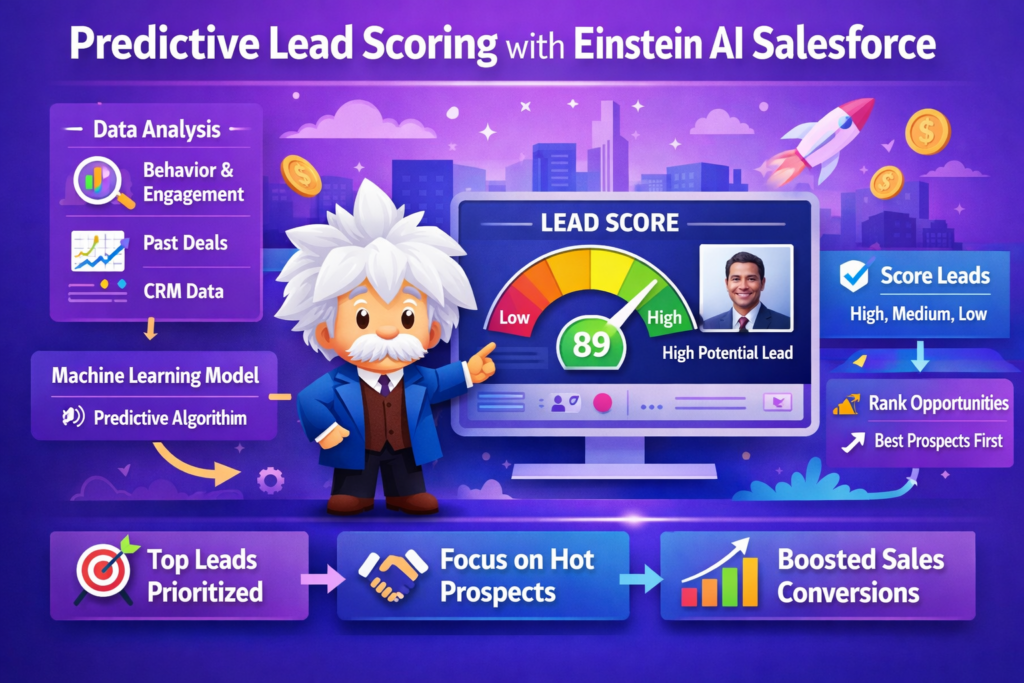
Sales teams have always struggled with the same question: Which leads should we actually focus on?
Predictive lead scoring is one of those Salesforce AI Features that sounds simple but makes a huge difference in daily operations.
Using machine learning models, Einstein AI Salesforce analyzes past deals, engagement patterns, and customer behavior. It then assigns a probability score to each lead.
In practice, this means:
- High-value prospects rise to the top automatically
- Sales reps stop chasing low-probability leads
- Conversion rates improve without increasing workload
A SaaS startup I worked with last year saw a 23% jump in close rates after enabling this feature. Nothing else changed they simply trusted the scoring system.
This is exactly the kind of real-world application people explore in modern Salesforce training courses.
AI-Powered Email and Content Generation
Generative AI has become one of the most exciting Salesforce AI Features released recently.
Salesforce AI Features With Einstein generative tools, users can automatically generate:
- Sales emails
- Customer support responses
- Marketing campaign copy
- Meeting summaries
And the content is generated using the customer data already inside Salesforce.
Here’s a practical example.
A sales rep preparing for a meeting can ask the AI to generate a personalized follow-up email referencing the client’s industry, recent purchases, and conversation history. What used to take 10 minutes now takes about 15 seconds.
When people talk about AI Salesforce innovations, this is usually the feature they notice first because it’s so visible in everyday workflows.
Einstein Opportunity Insights
Sales forecasting has traditionally been a mix of spreadsheets, instinct, and optimism.
One of the smartest Salesforce AI Features fixing that problem is Einstein Opportunity Insights.
This tool analyzes:
- email communication patterns
- deal activity
- engagement levels
- competitor mentions
Then it alerts teams about risks or opportunities in real time.
For example, if a prospect suddenly stops responding or if a key stakeholder hasn’t been contacted, Salesforce flags the deal automatically.
I remember watching a demo where the system warned a rep that a deal was at risk simply because engagement dropped for two weeks. Sure enough, the prospect had started evaluating competitors.
Insights like these are a major reason professionals are investing more time in Salesforce classes online and certifications focused on AI.
AI-Powered Customer Service Automation
Customer support is another area where Salesforce AI Features have become incredibly useful.
Service Cloud now employs AI to:
- Auto-classify tickets as they come in
- Suggest answers to agents
- Provide recommended articles
- Predict the escalation of cases
Consider a support center that gets thousands of tickets every day. AI helps with automatic ticket routing and instead focuses on the most urgent tickets. It routes them to the most appropriate agents in real time.
A telecom company recently reported cutting response time by nearly 40% after implementing this AI routing system.
That’s a perfect example of Salesforce and AI working together to solve a real operational problem.
AI-Driven Forecasting for Sales Teams
Another powerful addition to the list of Salesforce AI Features is AI-driven sales forecasting.
Traditional forecasting often relies on a manager’s intuition. But Einstein forecasting analyzes historical data and sales patterns to generate highly accurate predictions.
It looks at things like:
- deal velocity
- pipeline changes
- rep performance
- seasonal trends
Then it produces forecasts that are often far more reliable than manual projections.
I’ve seen companies adjust hiring plans, inventory planning, and marketing budgets based on these AI forecasts. That’s when you realize these tools aren’t just “nice dashboards” they influence real business strategy.
For professionals exploring AI Salesforce careers, this capability is worth understanding deeply.
Real-Time Personalization in Marketing Cloud
Salesforce AI Features have also been useful for Marketing teams, particularly in Marketing Cloud.
Marketing teams have AI assistance in customizing customer journeys in the moment.
The platform, instead of sending a standard template, will customize for the following behavior types:
- browsing history
- previous customer purchases
- previous customer email engagement
The platform will then customize the message, the offer, or the recommendations.
For example, the system will send a personalized discount email automatically to a customer if the customer has viewed the same product several times and has not purchased it.
Salesforce Einstein is viewed to be very advanced in intelligent automation and is therefore considered to have one of the most advanced AI systems in CRM today.
AI Data Insights with Einstein Analytics
Data is everywhere in Salesforce, but interpreting it used to take a lot of manual analysis.
One of the lesser-known Salesforce AI Features is automated data insights.
Einstein Analytics can scan datasets and automatically highlight:
- unusual trends
- sudden performance changes
- hidden correlations
For instance, a retail company discovered that certain product bundles performed significantly better in specific regions something analysts hadn’t noticed before.
AI surfaced the pattern in seconds.
Moments like that are exactly why many professionals enroll in a structured Salesforce course to learn how to interpret AI-generated insights correctly.
AI-Powered Workflow Automation
Another area where Salesforce AI Features shine is workflow automation.
Automation tools now use AI to decide when actions should trigger, not just follow rigid rules.
Salesforce can analyze data and recommend process improvements beyond simple “if this then that” statements.
Some examples of this include:
- Engagement drops and follow-up tasks are automatically created
- Sales reps receive suggestions for next-best actions
- At-risk customers are automatically included in the retention campaign
Companies using Salesforce and AI together will have improved intelligent workflows.
Why AI Skills Are Critical for Salesforce Practitioners
All this advancement means the position of a Salesforce practitioner is also evolving rapidly.
Only a few years ago, the primary focus of administrators was setup and reporting. Today, understanding data models, AI, and predictive automation is essential for most job roles.
This is likely the reason for the increased demand for the Salesforce training courses.
Companies want professionals who can:
- configure Einstein AI Salesforce tools
- interpret AI-driven insights
- Optimize workflows using automation
- connect AI features with real business goals
Learning these skills through structured Salesforce classes gives professionals a major advantage in the job market.
The Expanding Future of Salesforce AI
In the years to come, Salesforce AI Features are predicted to include more automation, coupled with generative intelligence.
Experts from the industry anticipate the following changes in the next few years:
- autonomous sales agents conducting routine outreach
- executive dashboards made through AI
- customer lifetime value modeling
- engines that make real-time decisions throughout customer journeys
With billions already invested in AI, Salesforce Einstein is only going to make the features offered by Salesforce even more powerful.
Starting a Salesforce class today requires understanding AI because it is now key to the platform
Conclusions
The most significant learning is that the Salesforce AI Features are not only meant to show off the latest tech. They address genuine issues in sales, service, and marketing.
With things like predicted lead scoring and emails generated by AI, the platform is subtly changing the way sales teams function daily.
The most valuable professionals in the CRM ecosystem are those who can identify real-life business challenges and leverage the AI capabilities within Salesforce to address those challenges.
If you are looking to develop your career in Salesforce or looking to build your knowledge further, Salesforce training courses focusing on Salesforce Einstein and current AI tools would be your best option for 2026.
The fact is simple: businesses are not just adopting Salesforce anymore; they are adopting Salesforce coupled with AI.