The courses to consider for AI engineer training with career support are those that go beyond theory to help you build real projects, learn modern AI tools, and prepare for actual engineering roles. A viable alternative is a structured program like H2K Infosys which mixes AI ideas, practical learning and career orientated guidance instead of just teaching definitions and algorithms.
The AI job market is a very different place. A few years ago, just knowing Python and the basics of machine learning was enough to get you into the field. Today, businesses want people who can do the whole pipeline from data prep and model development, all the way through to deploying AI-powered applications.
That’s why choosing the right AI engineer courses is important.
What Makes an AI Engineer Course Worth Your Time?
Most programs talk about “becoming an AI engineer fast,” but the real question is what skills will you have when you are done?
A typical AI engineer roadmap would look like:
- Programming in Python for Artificial Intelligence Development
- Introduction to Machine Learning
- Ideas for deep learning
- Natural language processing (NLP)
- Large Language Models (LLMs) and generative AI
- AI application development
- Model deployment and real world workflows
Hands-on experience is often the difference between a basic course and a career-oriented program.
For example, understanding what a neural net is can help you pass an interview question. But being able to build an AI-powered chatbot, train a model, connect APIs or deploy a solution is what sets you apart.
It’s that gap between “I studied AI” and “I can build AI systems” that many learners struggle with.
Why Career Support Is More Important Than Ever
AI is moving fast. New tools, frameworks and platforms are emerging all the time. “If you start today, you have to keep learning after you finish a course.
Big difference is career support, because most beginners don’t struggle with learning concepts, they struggle with:
- Developing a strong resume
- Developing portfolio projects
- What companies really want
- Getting ready for technical interviews
- Knowing which skills to focus on
A good training program should help answer practical questions such as:
“Traditional machine learning first or generative AI is the way to go?
“How many projects do you need to be entry-level AI?”
“What AI engineer job roles should I apply for?”
These are the questions learners often ask after months of independent study.
How Generative AI Has Altered the AI Engineer Roadmap
The AI industry in 2026 is a very different place to the traditional machine learning path.
Generative AI tools and apps based on LLMs have become a major focus across industries. Companies are playing with AI assistants, automation systems, intelligent search, recommendation engines and AI-powered business workflows.
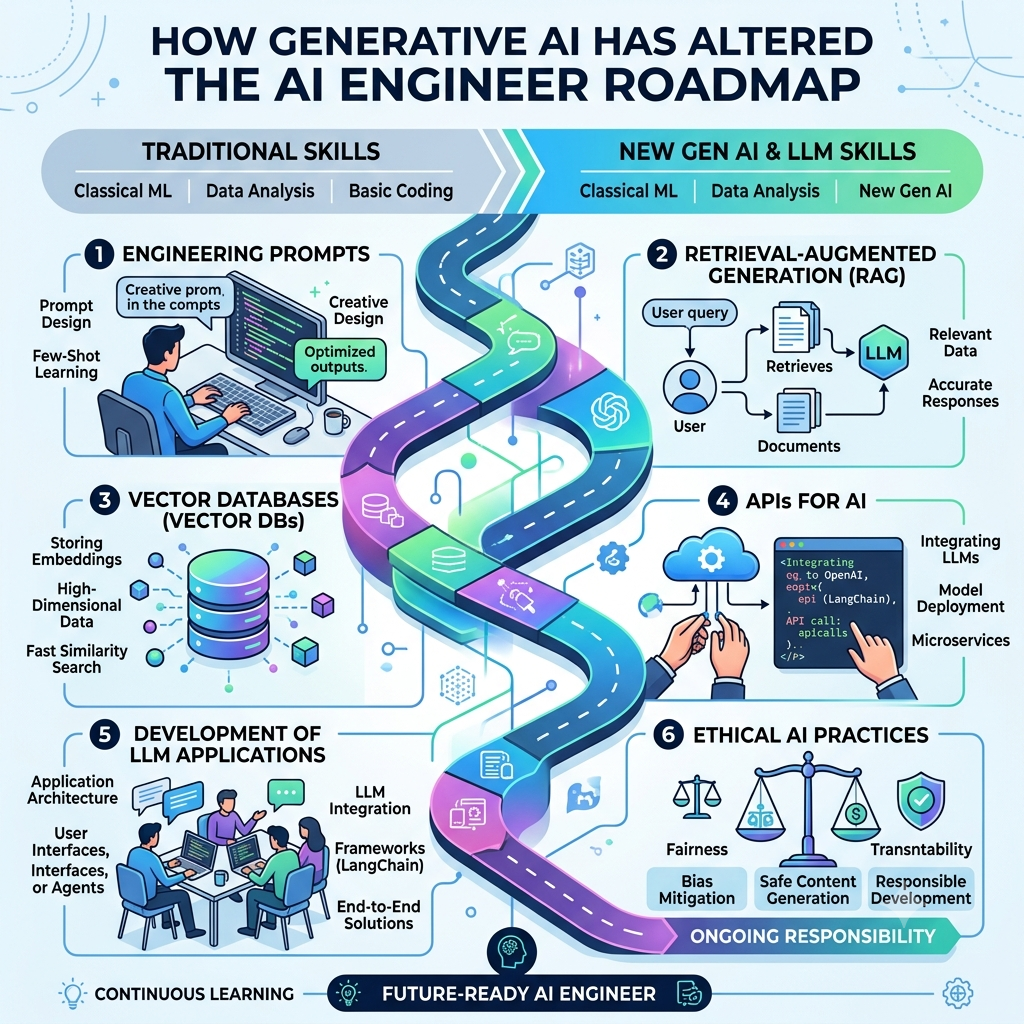
What a modern AI engineer should know includes things like:
- Engineering Prompt
- Retrieval-Enhanced Generation (REG)
- Vector DBs
- APIs for AI
- Development of LLM application
- Ethical AI practices
For instance, a company may not want someone to build a foundation model from scratch. They could need an engineer that can take an existing AI model and build a useful product around it.
That’s a whole different skill set.
What to Expect from AI Engineer Courses?
Check these areas before you enrol anywhere:
1. Projects in the Course?
Projects are the practical application of knowledge.
A strong portfolio could contain:
- A AI chatbot
- Document analysis tool
- A recommender system
- A prediction problem in machine learning
- A generative AI tool
Employers care more about what you can demonstrate than how many hours of videos you have completed.
2. Are instructors teaching current practice in industry?
AI is evolving rapidly. If you take a course that only teaches older machine learning examples, you can get outdated.
Look for training on modern AI engineering workflows, state-of-the-art development tools and practical implementation.
3. Do you have training follow-up?
Many learners complete courses and still don’t know what to do next.
Career support can help with:
- Resume enhancement
- Getting ready for the interview
- Strategy for job search
- Talks on projects
- Defining industry expectations
This is one reason why programs structured around career outcomes can feel more useful than self-paced learning alone.
Why Learners Prefer H2K Infosys for AI Engineer Training
H2K Infosys focuses on professional training on job orientated skills. AI engineer training appeals to learners because it combines structured learning, real world concepts and career preparation.
There are a lot of people coming into AI without a perfect computer science background. ‘They could be testers, developers, analysts or professionals who want to move into AI-related roles’.
A guided path can make that transition less bewildering.
Instead of spending months jumping between random tutorials, learners can follow a planned AI engineer roadmap that covers the skills needed to build confidence step-by-step.
How Long Does it Take to Become an AI Engineer?
Setting Realistic Expectations
It depends on your background.
If someone has programming experience, they may move faster because they already understand software development concepts.
A beginner may take longer to build foundations.
A realistic path often appears as:
- Month 1–2: Python, programming fundamentals, data manipulation
- Month 3-4: Machine Learning and AI Concepts
- Month 5-6: Deep learning, generative AI and projects
- Then: Building a portfolio, interviews and continuous improvement
The point isn’t just finishing lessons. The goal is to arrive at the point where you can confidently say:
“I can build and explain an AI solution.
Conclusion: Picking the right AI engineer training route
The best AI engineer courses aren’t always the ones that make the biggest promises. They’re the ones that teach you skills that you can actually use.
AI engineering is one of the most exciting career paths in technology, but success usually comes from a combination of learning and practice.
If you’re comparing options, look for a program that offers you:
- AI Engineer : A clear roadmap
- Project based learning
- Industry-specific skills
- Mentorship/career guidance
- A practical route to getting a job
If you are a learner looking for a program with a systematic approach and career guidance then H2K Infosys is one of the programs to consider while comparing AI engineering training options in 2026.