
Right now, organizations are hiring Business Analysts in 2026 faster than almost any other tech-adjacent role. Data is now the backbone of decision-making, and companies are actively investing in people who can translate that data into business strategy, something H2K Infosys and similar training providers have been emphasizing for years. That’s exactly why Business Analysts in 2026 are becoming some of the most valuable professionals in modern organizations.
Not long ago, business analysts were mostly documentation specialists, people who wrote requirements and organized meetings. Today, the story looks very different. Business Analysts in 2026 are deeply involved with data platforms, automation tools, AI-driven dashboards, and strategic planning. The role has evolved quickly, and honestly, if you’ve been following tech hiring trends lately, you’ve probably noticed companies mentioning analytics skills even in traditional BA job descriptions.
Why Business Analysts in 2026 Are More Data-Focused Than Ever
If you talk to hiring managers today, a common theme pops up they want analysts who understand both business context and data interpretation.
That’s where Business Analysts in 2026 stand apart. They’re not just gathering requirements anymore. They’re asking questions like:
- What patterns are hiding inside this customer dataset?
- Why did churn increase after the last product release?
- Which workflow automation could save the operations team hours every week?
A friend of mine working at a fintech startup recently described their BA role as “half strategist, half data translator.” That description actually sums up the direction the profession is moving.
And this shift explains the surge in demand for structured business analyst training and practical ba training programs that teach tools like SQL, Power BI, Tableau, and Agile methodologies alongside core analysis techniques.
The Evolution of Skills Required for Business Analysts 2026
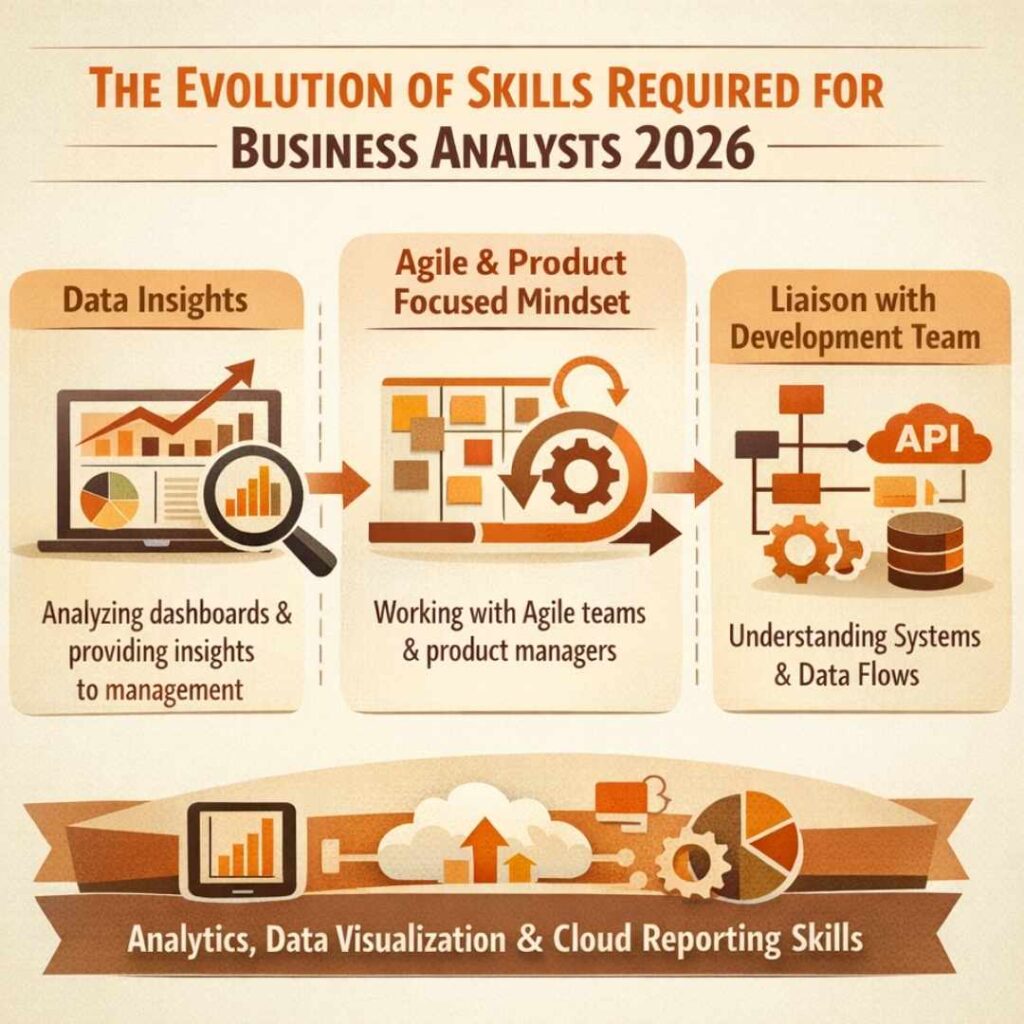
A clear pattern for the future skill set of Business Analysts is the hybridization of the skill set. Business Analysts in 2026 typically encompass the following:
1. Data Insights
Analysts not only elicit requirements but also analyze dashboards, draw, articulate insights, and provide trend explanations to upper management.
2. Agile and Product Focused Mindset
Most Business Analysts for 2026 will have to directly collaborate with product managers and developers in Agile setups. This requires an understanding of sprint planning, backlog grooming, and the delivery of value in a continuous manner.
3. Liaison with the Development Team
Analysts do not have to be programmers, but they have to be sufficiently technical to communicate meaningfully about APIs, data flow, and the architecture of systems.
This is the reason why many structured business analyst training programs have started including elements related to analytics, data visualization, and reporting in the cloud.
Why Companies Are Investing in Business Analyst Certification
As I’ve been engaged in conversations around hiring, I’ve noted another shift recruiters are starting to seek out structured credentials more frequently.
A grounded BA Certification or business analyst certification online program conveys an important message of practical exposure.
When organizations recruit Business Analysts in 2026, they are expecting employees who can begin making contributions almost immediately. Because the practical components of most certifications involve tasks such as:
- The analysis of customer retention data
- The design of process improvement
- The writing of Agile user stories
- The creation of KPI dashboards
These practical experiences far exceed what a person gains from understanding a theory.
Real Industry Example: How the BA Role Is Changing
In early 2025, a handful of global retailers began utilizing predictive analytics to forecast their supply chain. Rather than using purely historical data, analysts began focusing on streaming data in real time from their logistics systems.
In 2026, responsibility shifted to Business Analysts, who were tasked with interpreting predictive models and structuring them to support operational decisions.
Such as,
- preemptively managing inventory for an anticipated seasonal increase in demand
- identifying and managing product sell-through cycles across various regions
- advising transactional, automated re-ordering at predetermined levels
If there were no analysts to capture the input of data scientists and business executives, the information would simply and regrettably exist, unutilized, in dashboards.
The Growing Demand for Business Analyst Training
Here’s something that might surprise people entering the field: companies are not only hiring analysts they’re retraining existing employees.
Many professionals from operations, QA testing, or support roles are moving toward analytics careers through structured business analysis online training programs.
Why?
Because organizations know that domain experts with analytical training make excellent Business Analysts in 2026.
They already understand the business processes. Once they learn tools like:
- SQL queries
- data visualization platforms
- requirements modeling
- Agile frameworks
They become incredibly valuable contributors.
How Career Switchers Are Entering the BA Field
It is evident that a growing number of career change professionals have moved into analytics roles.
Persons formerly employed within:
- banking operations
- healthcare administration
- retail management
- customer support
have now moved into business analyst training programs to change their careers into more data-focused roles.
This is clear, as the Business Analysts of 2026 will be at the crossroads of business understanding and technological knowledge. This fusion creates opportunities in virtually every industry, including fintech, healthcare, logistics, and e-commerce.
Some training providers do more than teach business analyst skills. They also offer job placement support, portfolio development, interview practice, and networking with employers.
Tools Business Analysts in 2026 Are Using Daily
Job postings and industry reports indicate that toolkits are expanding rapidly.
Most Business Analysts in 2026 regularly work with:
- Databases querying SQL
- Dashboards in Power BI or Tableau
- Agile project tracking with JIRA or Azure DevOps
- Quick analysis using Excel and analytics Python tools
- Process modeling tools like BPMN or Lucidchart
The blend between social and technical tools is the reason why business analyst training is becoming more advanced.
The Future Outlook for Business Analysts
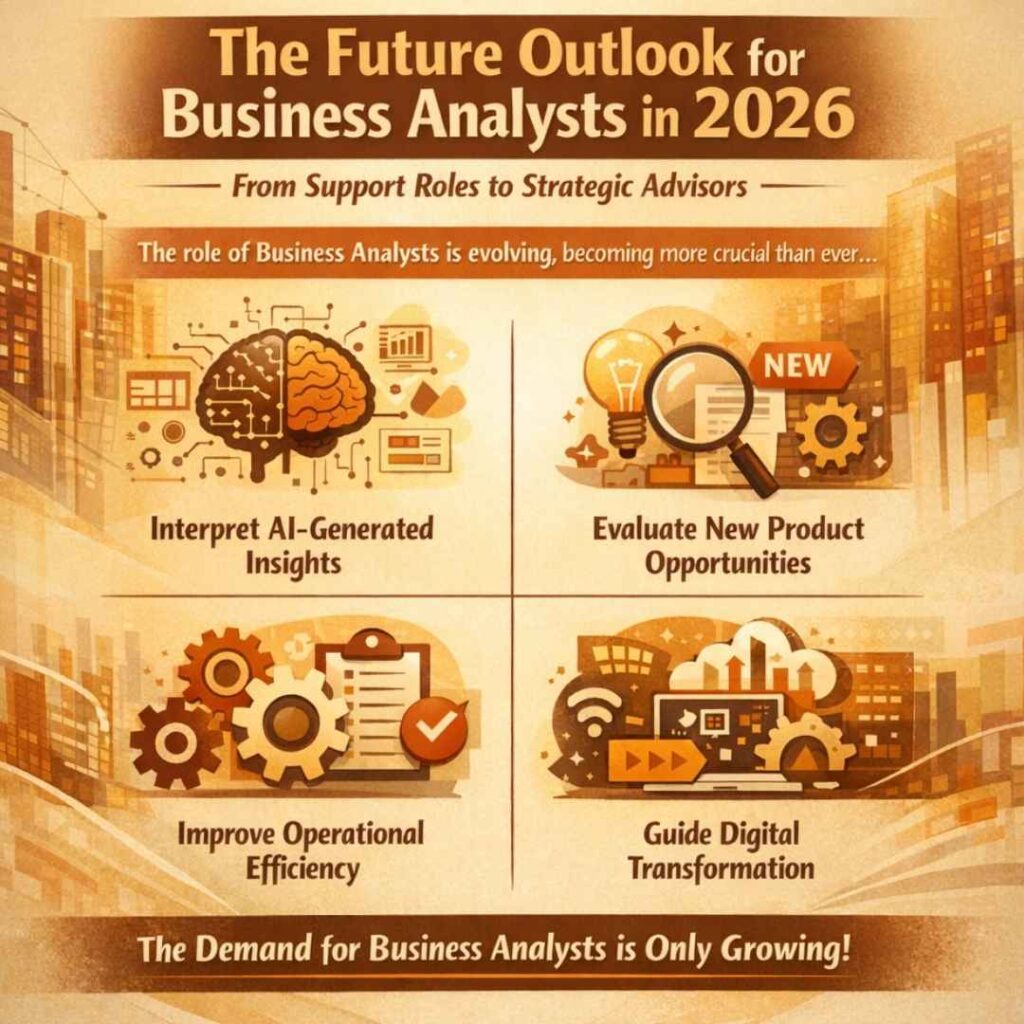
If the last few years taught us anything, it’s that data will only become more central to business strategy.
And that means Business Analysts in 2026 are not just supporting roles, they’re strategic advisors.
Organizations increasingly rely on analysts to:
- interpret AI-generated insights
- Evaluate new product opportunities
- improve operational efficiency
- guide digital transformation projects
So the demand isn’t slowing down anytime soon.
Conclusion
The profession has been transformed by the emergence of data-driven organizations. By 2026, Business Analysts will be expected to understand the role of data in a business ecosystem, and to develop a framework to enable data to be used effectively to support business operations. This will call for a range of skills in analytical thinking, communication, and technologies, and will be pivotal in ensuring the business operates in a more effective manner.
For anyone thinking of this career, it is very worthwhile to undertake some form of structured learning, be it BA Training, business analyst courses, business analyst certification online, or practical business analyst training and placement programs, as this will be very helpful in achieving a form of real-world readiness.
The evolution of the profession in the last few years has been remarkable. Business Analysts in 2026 will not just be writing requirements. They will also be becoming business data interpreters, team translators, and, most importantly, the quiet movers and shakers of progressive business strategies.