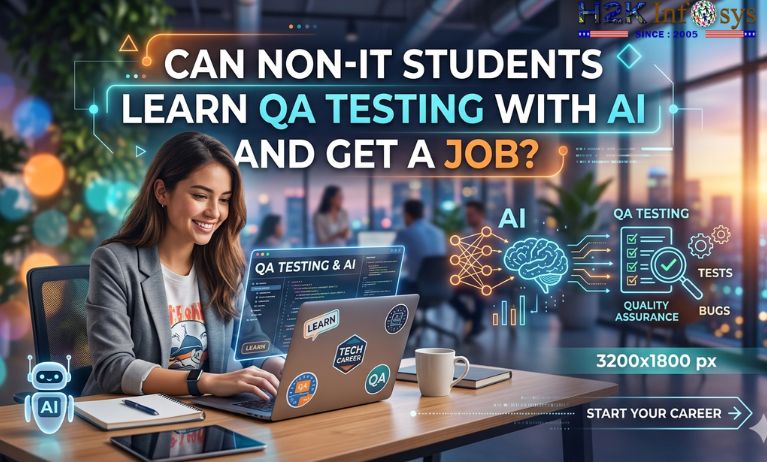
The tech industry is expanding rapidly, and software quality has become a critical part of every product, from mobile apps to banking platforms. This growing demand has opened new career opportunities, especially in Quality Assurance (QA) testing. One common question many students ask is, can non-IT students learn QA testing with AI and get a job?
The short answer is yes. In fact, thousands of professionals from commerce, arts, and other non-technical backgrounds are successfully working in software testing today. With the help of modern AI tools, no-code testing platforms, and structured learning paths, entering the QA field has become easier than ever.
This article explores whether non-IT students can learn QA testing, how AI helps beginners, what skills are required, and how to get your first job in testing.
Understanding QA Testing
Quality Assurance (QA) testing is the process of checking whether software works correctly before it is released to users. QA testers identify bugs, usability issues, and performance problems to ensure the product meets quality standards.
For example, before a banking app goes live, testers verify whether:
- Login works correctly
- Transactions process properly
- The app works across different devices
- No security or usability issues exist
QA testing plays a key role in the software development lifecycle (SDLC) because it helps companies release reliable and stable products.
Because every software product needs testing, QA professionals are required in industries like fintech, healthcare, e-commerce, gaming, and SaaS.
Can Non-IT Students Really Enter QA?
Many people believe that software testing is only for computer science graduates. This is a myth.
Modern software testing welcomes professionals from various backgrounds. Many companies hire people from commerce, management, science, and arts streams as testers if they have the right skills and training.
There are two main reasons why non-IT students can easily transition into QA:
1. Manual testing doesn’t require coding
Manual testing focuses on verifying software behavior, writing test cases, and reporting bugs. It does not require programming knowledge to begin.
2. Soft skills matter a lot
QA testers need skills such as
- Analytical thinking
- Attention to detail
- Communication
- Problem-solving
These skills are common among graduates from many non-technical fields.
In fact, many testers start with manual testing roles and later learn automation tools as they gain experience.
How AI Is Changing QA Testing
Artificial intelligence has significantly transformed the QA industry. Instead of replacing testers, AI tools are helping them work faster and more efficiently.
AI can assist testers in several ways:
Test Case Generation
AI tools can automatically generate test scenarios based on application behavior.
Automated Bug Detection
Machine learning models can detect patterns in bugs and predict potential defects.
Smart Automation
AI-driven testing tools reduce repetitive manual work and improve testing efficiency.
No-Code Testing Tools
Some platforms allow testers to automate tests without writing code.
This means non-IT learners can now use AI tools to perform tasks that previously required advanced programming knowledge.
Skills Needed to Become a QA Tester
Although coding is not mandatory for beginners, QA testers still need a combination of technical and soft skills.
Core technical skills
Some important skills include
- Understanding SDLC and STLC
- Writing test cases
- Bug reporting using tools like Jira
- Basic database knowledge
- API testing using tools like Postman
- Cross-browser testing
These skills are fundamental for all QA roles.
Soft skills
Companies also look for:
- Analytical thinking
- Communication skills
- Attention to detail
- Documentation skills
A strong mix of technical and soft skills makes a QA tester effective.
Step-by-Step Roadmap for Non-IT Students
If you come from a non-IT background, you can follow this simple roadmap to start a QA career.
Step 1: Learn Software Testing Fundamentals
Start with basic concepts such as:
- Software Development Life Cycle (SDLC)
- Software Testing Life Cycle (STLC)
- Types of testing (functional, regression, integration)
Understanding these concepts is the first step toward becoming a tester.
Step 2: Learn Manual Testing
Manual testing is the easiest entry point.
Focus on learning:
- Test case writing
- Bug reporting
- Requirement analysis
- Test execution
Manual testing builds the foundation for all advanced testing roles.
Step 3: Practice Real Projects
Theory alone is not enough.
You should practice testing on:
- Demo websites
- Open-source applications
- Testing simulations
Hands-on practice helps build confidence and practical knowledge.
Step 4: Learn AI-Assisted Testing Tools
Modern testers often use tools like
- AI test automation platforms
- No-code testing frameworks
- Smart bug detection tools
These tools help beginners perform complex testing tasks faster.
Step 5: Learn Basic Automation (Optional)
Once you gain confidence, you can learn automation tools such as:
- Selenium
- Playwright
- Cypress
Learning basic programming languages like Python or Java can also improve career opportunities.
Automation testing skills are valuable for long-term growth.
Step 6: Build a QA Portfolio
Create a portfolio that includes:
- Sample test cases
- Bug reports
- Testing documentation
- Demo testing projects
This portfolio demonstrates your practical skills to recruiters.
Step 7: Prepare for QA Interviews
Common interview topics include:
- SDLC and STLC
- Defect life cycle
- Types of testing
- Writing test cases
- Real-world testing scenarios
Mock interviews and practice sessions can significantly improve your chances of getting hired.
Job Roles After Learning QA Testing
After completing QA training, you can apply for various entry-level roles such as:
- Junior QA Tester
- Manual Tester
- QA Analyst
- Software Tester
With experience, you can move into advanced roles like:
- Automation Tester
- Performance Tester
- QA Engineer
- Test Architect
This career path offers continuous growth and specialization opportunities.
Salary Expectations for QA Testers
QA testing is a well-paid career, especially in the tech industry.
Typical salary ranges in India include:
- Freshers: ₹3 – ₹5 LPA
- Mid-level testers (3–5 years): ₹7 – ₹12 LPA
- Senior QA professionals: ₹15+ LPA
Salary mainly depends on your skills, tool expertise, and experience, not your degree background.
How Long Does It Take to Learn QA Testing?
The learning timeline varies based on dedication and practice.
On average:
- Basic QA training: 3–6 months
- Professional expertise: 1 year or more
Consistent practice and real projects can speed up your learning process.
Challenges Non-IT Students May Face
Although QA is accessible to non-IT learners, there can still be challenges.
Technical terminology
Many beginners struggle with software development concepts.
Lack of confidence
Non-IT students sometimes doubt their ability to succeed in tech roles.
Learning tools
Understanding testing tools and workflows takes time.
The best way to overcome these challenges is structured learning, hands-on practice, and mentorship.
The Future of QA Testing with AI
The future of QA testing looks very promising.
Automation testing and AI-driven testing tools are rapidly growing, and companies increasingly rely on skilled testers to maintain software quality.
Even with automation advancements, manual testing remains essential because human observation and exploratory testing cannot be fully automated.
As AI tools evolve, testers will become AI-augmented professionals who combine analytical thinking with automation technologies.
This means the demand for skilled QA professionals is likely to continue growing.
Final Thoughts
Online qa training is one of the few tech careers that allows beginners to enter without deep programming knowledge. With the help of AI tools, no-code testing platforms, and structured learning paths, non-IT graduates can build valuable skills and start a successful career in software testing.
If you are detail-oriented, curious about how software works, and willing to learn new tools, QA testing can be a rewarding career choice. With the right training, practice, and persistence, your non-IT background will not stop you from entering the tech industry; it may even give you a unique advantage.