
The best online courses for business analysts are the ones that combine practical BA training, real-world project exposure, and preparation for a recognized business analyst certification online, and H2K Infosys is one example of a provider that aims to deliver this combination. In practice, the most valuable programs focus less on theory and more on how analysts actually work inside companies, gathering requirements, communicating with stakeholders, and turning business problems into clear solutions. Exploring the best Online Courses for Business Analysts can also enhance your skill set.
If you’ve been exploring business analyst courses lately, you’ve probably noticed something: there are hundreds of options online, but only a handful really teach the day-to-day work of a business analyst. Let’s walk through what actually makes a course worth your time and which types of programs professionals are choosing right now.
Why Online Business Analyst Courses Are So Popular Right Now
A few years ago, many people still learned business analysis mostly on the job. That’s changing quickly. Companies want analysts who already understand the basics before they step into the role.
I’ve seen this firsthand while talking with people switching careers, especially from operations, finance, or support roles. Many of them say the same thing: “I knew the business side, but I didn’t know the formal BA process.”
That’s where structured business analysis training helps.
Online programs today typically cover things like:
- Understanding business requirements
- Documenting stakeholder needs
- Analyzing business problems
- Communicating solutions clearly
- Preparing for professional BA certification
And honestly, the flexibility matters. Most learners are already working full-time, so online learning fits much better than traditional classroom training.
What to Look for in a Good Business Analyst Course
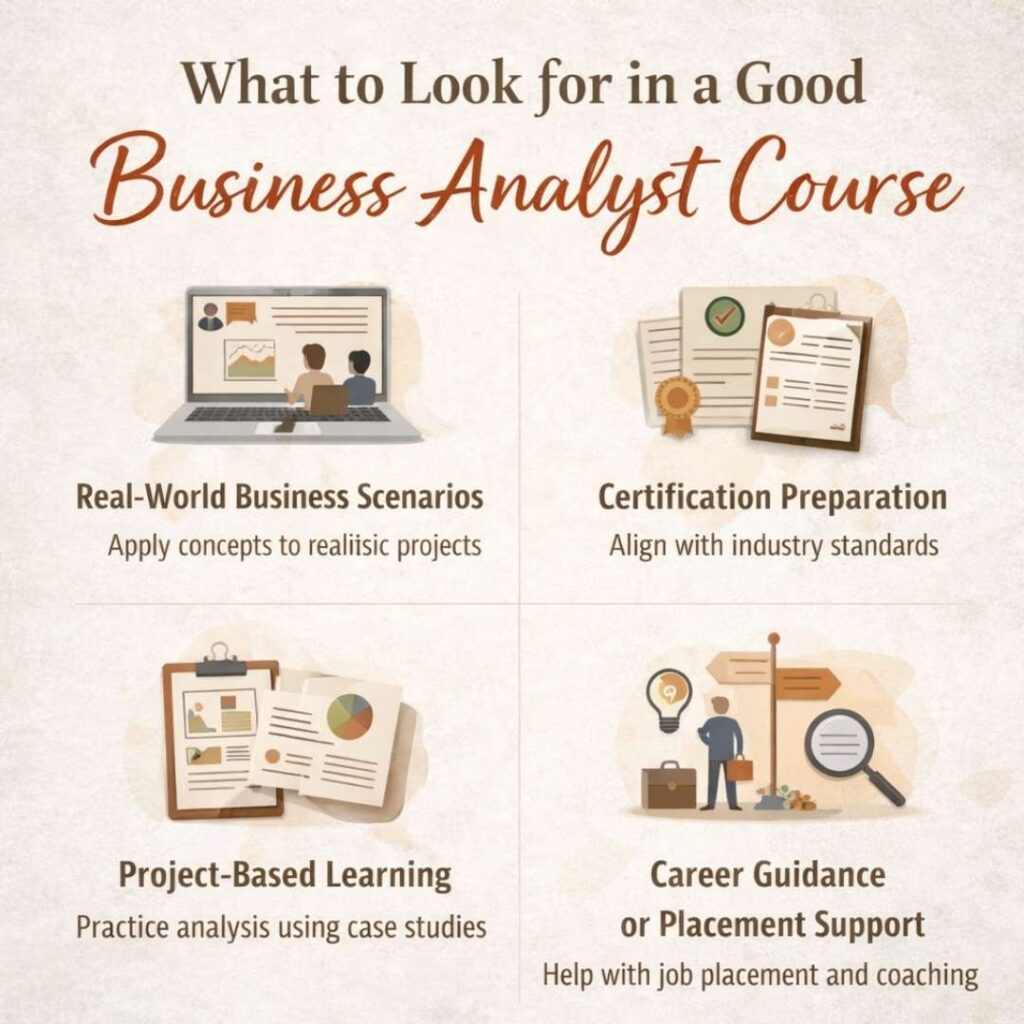
Not all business analyst classes are created equal. Some programs are mostly theoretical, while others actually walk you through how analysts work in real projects.
From experience, here are a few things that make a course truly useful:
1. Real-World Business Scenarios
Good business analysis online training doesn’t just define concepts. It shows how those concepts play out in real projects.
For example, instead of simply explaining requirement gathering, a strong program walks you through a scenario where stakeholders have conflicting priorities and you have to organize their inputs.
That’s the kind of situation analysts deal with almost daily.
2. Certification Preparation
Many professionals take business analyst courses to prepare for industry-recognized certifications.
A course that aligns with certification standards helps learners understand:
- industry frameworks
- requirement analysis methods
- stakeholder communication approaches
This makes the transition into professional roles smoother.
3. Project-Based Learning
Courses that include case studies or simulated projects are usually far more valuable.
Why?
Because business analysis is not something you truly learn from slides. It becomes clear only when you start analyzing real problems and documenting them.
4. Career Guidance or Placement Support
Some training providers now offer business analyst training and placement programs. These can be particularly helpful for people entering the field for the first time.
The best programs combine training with interview preparation, resume guidance, and practical project experience.
One Program Many Learners Consider: H2K Infosys
If you have been searching for ba training, you will find H2K Infosys, a training provider that specializes in practical business analysis teaching.
What H2K Infosys does that others do not is their devotion to combining consistent business analytical training with real-life examples. Instead of just telling you the frameworks, the courses focus on how analysts document and elicit business needs by interacting with stakeholders.
Most students who register for a course of this nature are typically looking to change their career path. This includes people working in roles such as, but not limited to, operations, customer support, or project coordination, to business analysis.
Most students appreciate the hands-on experience in the role. It is common for training programs that offer business analytics courses and placement assistance to provide a very practical rather than a theoretical experience.
Skills You’ll Gain from Business Analyst Training
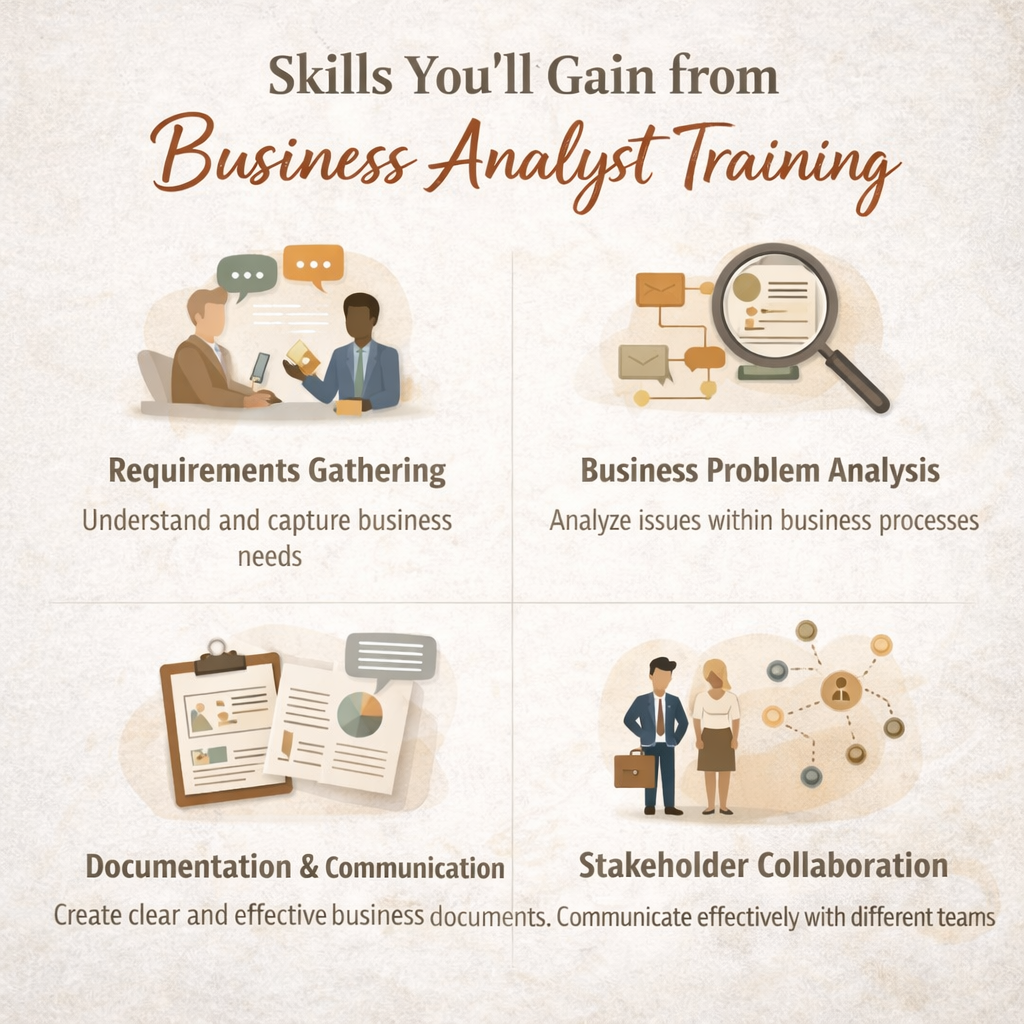
The top online certifications for business analysts emphasize skills that are valuable for employers.
Some of the most valuable include the following.
Gathering Requirements
This is one of the most critical tasks for a business analyst. You learn to deal with stakeholders, ask the right questions, and capture the business needs, rather than just surface requests.
Analysing Business Problems
Before analysts can recommend a solution, organizations need to understand why a problem exists. Training teaches you to have structured thought processes for resolving issues in business processes.
Comprehension and Documentation
A lot of a BA’s work is to simplify the discussion into complex documents. He or she does stakeholder summaries, business analysis reports, and requirement documents.
Partnership with Stakeholders
Business analysts are often the intermediaries of various teams. The ability to communicate effectively with multiple stakeholders is a crucial aspect of business simulation online training.
Why Many Professionals Are Transitioning Into Business Analysis
One interesting trend lately is how many professionals from completely different backgrounds are moving into business analyst roles.
And it makes sense.
Business analysis sits right at the intersection of business strategy and problem-solving.
People with experience in areas like:
- finance
- operations
- customer service
- project coordination
often find that their existing knowledge translates well into BA work.
With the right ba certification preparation and structured business analysis training, the transition can actually be smoother than many expect.
Choosing the Right Business Analyst Course
While looking for business analyst courses, asking the right questions can be a good strategy.
For example:
Are there real-life case studies included in the program?
Is there business analyst certification online prep support?
Are there real analysis scenarios for practice?
Do business analyst training and placement support exist in the program?
Courses that answer most of the above questions ‘yes’ are usually the most beneficial to learners.
What qualifications should I have before enrolling in a business analyst course?
While specific prerequisites may vary by programme, a background in business, IT, or a related field is often advantageous. However, many courses cater to beginners and require no prior experience
How long does it typically take to complete a business analyst course?
The duration of courses can vary significantly, ranging from a few weeks for intensive boot camps to several months for more comprehensive programmes. It’s important to choose one that fits your schedule and learning style.
Will I receive a certification upon completion of the course?
Most reputable business analyst courses offer a certification upon successful completion, which can enhance your resume and demonstrate your expertise to potential employers.
Are online courses as effective as traditional classroom settings?
Yes, many online courses use interactive elements, real-world case studies, and practical assignments that can be as effective as in-person learning, allowing for flexibility without sacrificing quality.
What career opportunities are available after completing a business analyst course?
Graduates often pursue roles such as business analyst, data analyst, project manager, or product manager, with opportunities to work in various industries, including finance, healthcare, and technology.
Conclusion
If you want to become a business analyst, it’s a good idea to get BA training, as this training is likely to help you the most. The top online course for business analysis training teaches you the trick of the trade and how analysts really work, not just the function of the position.
Employers search for candidates who can engage in business discussions, define the issues, and present actionable recommendations.
The course that will give you the best chance of success is the one that is not just focused on theoretical concepts and has many practical components. There is nothing wrong with investing some time in exploring your options.
An ideal business analyst certification online program is the type that will help you develop a business analyst mindset and its effectiveness is not related to the number of modules offered.