H2K Infosys Artificial Intelligence (AI) training equips professionals with the knowledge required to design, deploy, and manage intelligent systems that automate decision-making and data analysis. As organizations increasingly integrate AI into enterprise workflows, structured AI learning for Beginners offered through platforms such as H2K Infosys help develop a workforce capable of working with data-driven technologies.
AI training helps professionals understand algorithms, data pipelines, and model deployment practices used in modern IT environments. By building these skills, employees can collaborate with data scientists, automate repetitive processes, and support AI-enabled business applications across industries.
What Is AI Training?
AI training refers to the structured process of learning how to design, implement, and maintain artificial intelligence systems. These programs typically combine theoretical foundations with hands-on practice using widely adopted frameworks and tools.
AI training commonly includes topics such as:
- Machine learning fundamentals
- Data preprocessing and feature engineering
- Model training and evaluation
- Deep learning techniques
- Natural language processing (NLP)
- Model deployment and monitoring
For working professionals, AI learning for Beginners often starts with programming and data fundamentals before progressing toward advanced machine learning workflows.
Key Components of AI Training
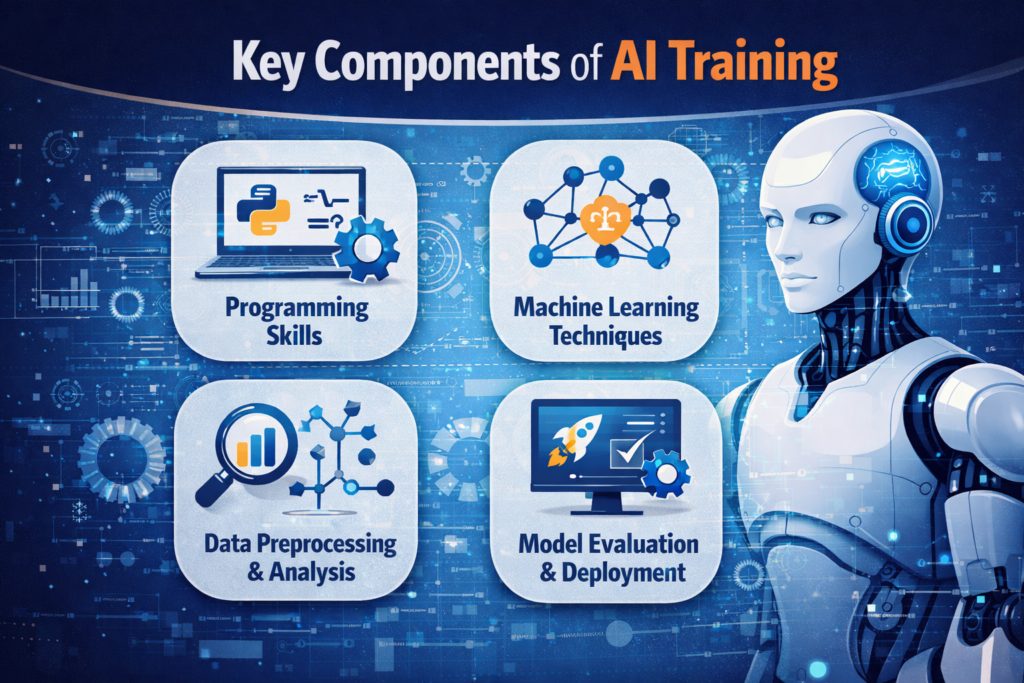
| Component | Description | Example Tools |
|---|---|---|
| Programming Skills | Writing scripts to process data and train models | Python, R |
| Data Processing | Cleaning and preparing datasets for training | Pandas, NumPy |
| Machine Learning Algorithms | Training predictive models | Scikit-learn |
| Deep Learning | Neural network architectures | TensorFlow, PyTorch |
| Model Deployment | Integrating models into production systems | Docker, Kubernetes |
These components collectively prepare professionals to work with AI systems used in enterprise software and data platforms.
Why Is AI Training Important for the Future Workforce?
Organizations increasingly rely on intelligent automation to analyze data, predict outcomes, and improve operational efficiency. AI training helps professionals adapt to these evolving requirements.
Several factors contribute to the growing importance of AI skills:
1. Increasing Data Volume
Modern organizations generate large volumes of data from:
- Customer interactions
- IoT devices
- Enterprise applications
- Digital platforms
AI systems help analyze this data at scale, enabling faster decision-making.
2. Automation of Routine Tasks
AI can automate repetitive processes such as:
- Document classification
- Customer support chatbots
- Fraud detection
- Predictive maintenance
Professionals with AI knowledge can design and maintain these automation systems.
3. Integration With Enterprise Software
AI capabilities are increasingly embedded within enterprise systems such as:
- Customer relationship management (CRM)
- Business intelligence platforms
- Supply chain analytics tools
Understanding how AI models interact with enterprise infrastructure is an important skill for IT professionals.
How Does AI Work in Real-World IT Projects?
In enterprise environments, AI projects typically follow structured workflows that combine data engineering, model development, and deployment.
Typical AI Project Workflow
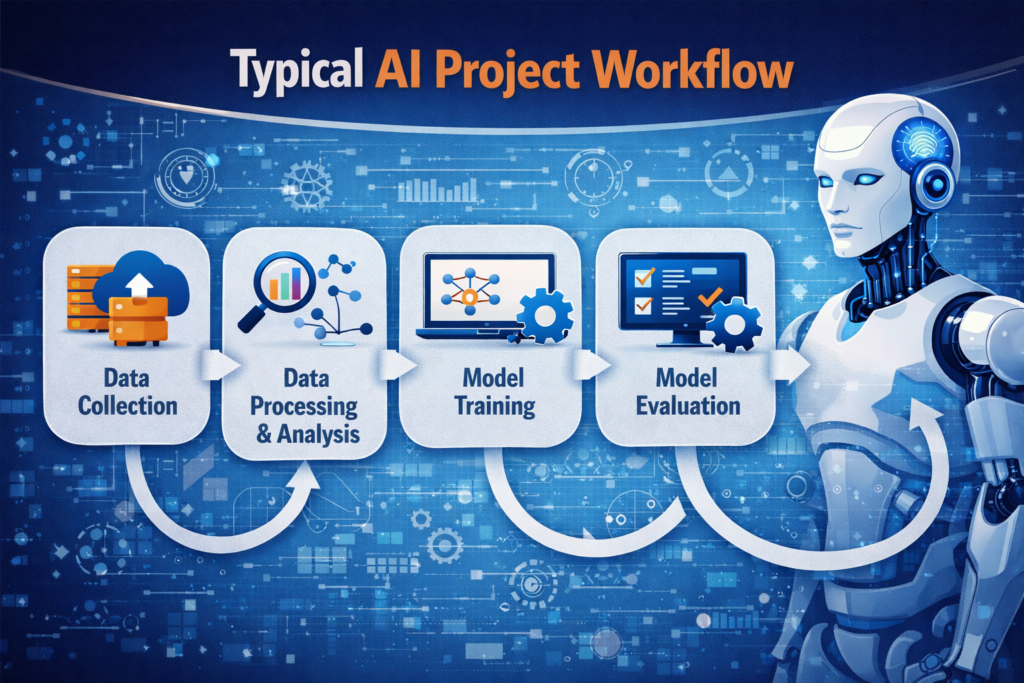
| Stage | Description |
|---|---|
| Data Collection | Gathering structured and unstructured data from internal systems |
| Data Preparation | Cleaning and transforming data into usable formats |
| Model Development | Training machine learning algorithms |
| Model Evaluation | Measuring accuracy, precision, and recall |
| Deployment | Integrating models into production applications |
| Monitoring | Tracking performance and retraining models |
Example Scenario: Predictive Customer Support
A technology company may deploy AI to improve customer support operations.
Workflow example:
- Collect historical support ticket data.
- Train a machine learning model to classify issue categories.
- Deploy the model within the ticketing platform.
- Automatically route tickets to appropriate support teams.
This workflow demonstrates how AI training enables professionals to participate in real enterprise AI projects.
What Skills Are Required to Learn AI and Machine Learning?
Professionals entering AI and Machine learning Courses typically build skills in several technical areas.
Core Technical Skills
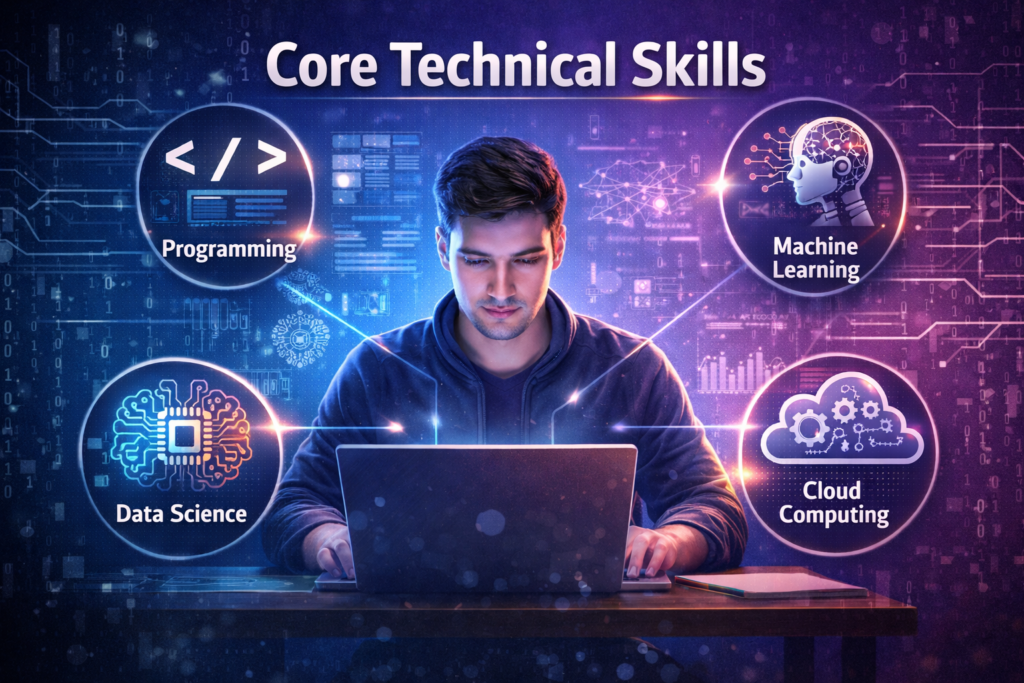
| Skill Area | Why It Matters |
|---|---|
| Programming | Required to implement algorithms and data pipelines |
| Statistics | Helps understand model accuracy and probability |
| Data Analysis | Enables exploration of datasets |
| Linear Algebra | Important for neural network computations |
| Software Engineering | Supports production-level AI systems |
Supporting Skills
Additional skills commonly developed in AI training include:
- Data visualization
- Cloud computing
- Model deployment
- Version control
- Experiment tracking
These capabilities help professionals move from experimental models to scalable enterprise systems.
How Is AI Used in Enterprise Environments?
AI technologies are widely applied across industries to improve decision-making and operational efficiency.
Common Enterprise AI Use Cases
| Industry | AI Application | Description |
|---|---|---|
| Finance | Fraud detection | Identifying suspicious transactions |
| Healthcare | Medical image analysis | Detecting patterns in imaging data |
| Retail | Demand forecasting | Predicting product demand |
| Manufacturing | Predictive maintenance | Anticipating equipment failures |
| Telecommunications | Network optimization | Managing traffic loads |
In enterprise IT systems, AI models often operate as microservices integrated into larger application architectures.
Enterprise AI Architecture
Typical architecture components include:
- Data ingestion pipelines
- Feature engineering services
- Model training environments
- Model APIs
- Monitoring dashboards
Professionals trained through AI learning for beginners programs gradually learn how these components interact within enterprise systems.
What Job Roles Use AI Daily?
AI knowledge is relevant to a wide range of technical roles.
AI-Related Job Roles
| Role | Primary Responsibilities |
|---|---|
| Data Scientist | Develop predictive models and analyze datasets |
| Machine Learning Engineer | Deploy and scale machine learning models |
| AI Researcher | Explore new algorithms and methodologies |
| Data Engineer | Build data pipelines for training models |
| Business Intelligence Analyst | Use AI insights for strategic decisions |
Many professionals transition into these roles after completing structured AI and machine learning courses.
What Careers Are Possible After Learning AI?
AI training opens opportunities across multiple industries and technical domains.
Career Path Examples
| Career Path | Focus Area |
|---|---|
| Machine Learning Engineer | Production model deployment |
| AI Solutions Architect | Designing AI systems for enterprises |
| Data Analyst with AI Skills | Applying machine learning for analytics |
| NLP Engineer | Building language processing systems |
| Computer Vision Specialist | Developing image recognition systems |
Each path requires different levels of expertise, but foundational AI training provides a starting point for specialization.
How AI Training Programs Typically Structure Learning
Structured AI training programs often follow a progressive learning path designed for working professionals.
Typical Learning Path
| Stage | Topics Covered |
|---|---|
| Foundation | Python programming, statistics |
| Data Processing | Data cleaning, feature engineering |
| Machine Learning | Regression, classification algorithms |
| Deep Learning | Neural networks, CNNs, RNNs |
| Deployment | APIs, cloud deployment, monitoring |
Hands-on projects are often included to help learners apply theoretical concepts in practical environments.
Challenges Professionals Face When Learning AI
Although AI training provides valuable skills, learners often encounter several challenges.
Common Learning Challenges
1. Mathematical Foundations
Understanding algorithms often requires familiarity with statistics and linear algebra.
2. Data Availability
Real-world datasets may be incomplete or inconsistent, requiring extensive preprocessing.
3. Model Deployment
Moving models from development environments to production systems involves infrastructure considerations.
4. Ethical and Regulatory Considerations
Organizations must ensure that AI systems comply with privacy and fairness guidelines.
AI training programs increasingly incorporate these topics to prepare professionals for real-world implementation.
Best Practices for Learning AI Effectively
Professionals pursuing AI learning for beginners can follow several practical strategies.
Recommended Learning Practices
- Start with programming fundamentals, particularly Python.
- Work with real datasets instead of only theoretical exercises.
- Practice building small machine learning models.
- Study model evaluation metrics such as precision and recall.
- Learn deployment techniques for integrating models into applications.
Hands-On Practice Example
A beginner AI project might involve:
- Importing a dataset.
- Performing exploratory data analysis.
- Training a classification model.
- Evaluating accuracy.
- Deploying the model as an API.
This project-based approach helps learners develop practical experience that aligns with real enterprise workflows.
Frequently Asked Questions (FAQ)
What is AI learning for beginners?
AI learning for beginners introduces foundational concepts such as machine learning algorithms, data preprocessing, and model evaluation. It typically starts with programming and basic statistics before progressing to advanced topics.
How long does it take to learn AI?
The time required depends on prior technical experience. Professionals with programming backgrounds may develop practical AI skills within several months of structured learning and hands-on projects.
Do AI and machine learning courses require programming knowledge?
Yes. Most courses require familiarity with programming languages such as Python because algorithms, data pipelines, and models are implemented using code.
Is AI only for data scientists?
No. Many IT roles interact with AI systems, including software engineers, data engineers, analysts, and DevOps professionals responsible for deploying models.
What industries use AI the most?
Industries such as finance, healthcare, retail, manufacturing, and telecommunications commonly use AI for predictive analytics, automation, and data analysis.
Can beginners transition into AI careers?
Yes. With structured learning, hands-on projects, and consistent practice, professionals can gradually build the skills required for entry-level AI and machine learning roles.
Key Takeaways
- AI training provides professionals with the skills needed to build and manage intelligent systems.
- Structured AI learning for beginners programs introduce programming, data analysis, and machine learning fundamentals.
- Enterprise AI projects involve workflows that include data preparation, model training, deployment, and monitoring.
- AI technologies are widely used across industries for automation, analytics, and predictive decision-making.
- Completing AI and machine learning courses can prepare professionals for roles such as data scientist, machine learning engineer, and AI solutions architect.