When it comes to learning Artificial Intelligence (AI) from scratch, it’s all about becoming familiar with some fundamental concepts such as data handling, how machine learning models actually learn, and how they are ultimately applied. After that, it’s all about practice with the tools that professionals across the industry are working with every day. A well-structured AI training program will be one that offers the right balance of theory and practice. In most cases, this will be with the aid of Python and frameworks such as TensorFlow and PyTorch. The majority of AI Training Programs are designed to assist working professionals in taking the right steps in building the right skills that they need for the job.
What is Artificial Intelligence (AI)?
At the most fundamental level, Artificial Intelligence is all about creating systems that can perform tasks that we normally associate with human intelligence such as recognizing patterns, making decisions, understanding natural language, and even predicting the future.
Of course, that’s not all. AI is more like an umbrella term that encompasses several aspects. The most common ones are:
- Machine Learning (ML): Where the AI system learns and performs tasks without actually being programmed.
- Deep Learning: A more advanced version of Machine Learning.
- Natural Language Processing: The ability of AI systems to process and generate natural language.
- Computer Vision: The ability of AI systems to see and interpret visual data such as images and videos.
In the end, AI systems are all about data. Ultimately, they are designed to either make predictions or make decisions. Sometimes it’s even both.
Why is AI Important for Working Professionals?
AI is no longer just a phenomenon that we read about in research journals. Today, AI is already an integral part of our daily enterprise systems in various sectors such as finance, healthcare, retail, and IT. If you are working in the tech industry or even in adjacent fields, there is a huge possibility that you are already working with AI in one way or another.
For professionals, AI is slowly but surely moving from being a “nice-to-have” skill to being an essential skill.
Why it matters:
Helps automate routine work, e.g., reports, monitoring, or data cleaning
Helps with better decision-making with predictive insights
Integrates with other tools that you might be using, e.g., ERPs, CRMs, or cloud services
Can open up opportunities in data-centric roles or hybrid roles
Even roles like testers, business analysts, or DevOps engineers are increasingly intersecting with AI-driven work processes.
How Can You Start Learning AI from Scratch Today with H2K Infosys?
Getting into AI from scratch is always intimidating at first, but it is definitely doable if you follow a clear plan. That’s exactly what an AI training program H2K Infosys designed for step by step, building on one step at a time.
Here’s what your learning plan might look like if you were to start learning AI from scratch today:
Learn Programming Basics
You don’t need to be good at it, but you should be comfortable with:
Python Programming Basics (Variables, Loops, Functions)
Basic Data Structures (Lists, Dictionaries, maybe Tuples)
Learn Some Math Basics
You don’t need to be good at math, but you should be comfortable with:
Linear Algebra (Vectors, Matrices)
Probability and Statistics
A Bit of Calculus (Only for Understanding Optimization)
Learn Data Handling
This is where all the action happens in AI. You should be comfortable with:
Handling Messy Data
Data Cleaning and Preparation
Pandas, NumPy, Data Science Tools
Learn Machine Learning Concepts
This is the crux:
Supervised vs. unsupervised learning
Regression vs. classification
Basic model evaluation
Work with common frameworks
You will probably be exposed to:
TensorFlow
PyTorch
Scikit-learn
Each has its own set of applications, and all three are commonly used in industry projects.
Build small projects
This is where it all starts making sense:
Prediction models
Recommendation systems
Simple NLP applications like chatbots
Learn how deployment works
Not as glamorous as other parts, but equally important:
How to make models available through APIs
How to integrate with web applications or enterprise software
What Skills Are Required to Learn AI Training Courses?
While it’s true that programming is a significant part of AI and machine learning, it’s not the only part. There is also analytical thinking.
Core skills
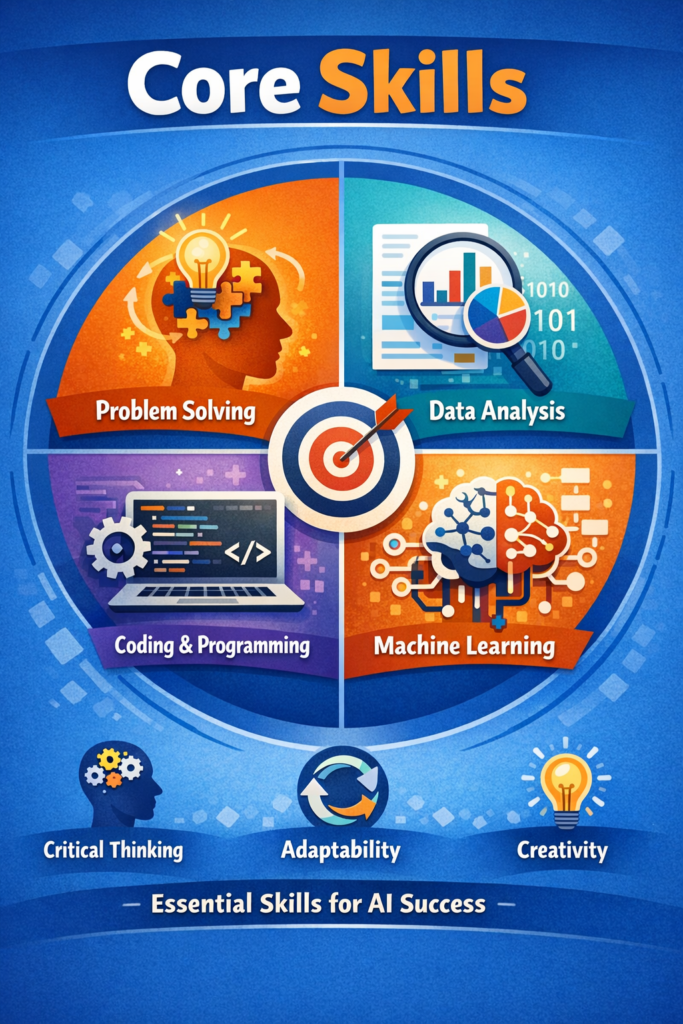
| Skill Area | What it involves |
|---|---|
| Programming | Mostly Python, sometimes R |
| Mathematics | Linear algebra, probability, statistics |
| Data Analysis | Cleaning, exploring, visualizing data |
| Machine Learning | Building and evaluating models |
| Problem Solving | Thinking through complex scenarios logically |
Supporting Skills (often underestimated)
Version control tools like Git
SQL for database-related tasks
APIs and cloud computing basics
These are often overlooked, but in practice, you will encounter these issues in almost every project.
How Does AI Work in Real-World IT Projects?
While in practice, things are slightly different. In real-world projects, it’s not as simple as training a model and calling it a day. There’s often a lot that goes on behind the scenes.
A typical workflow looks something like this:
Data Collection
Data Collection involves collecting data from databases, APIs, logs, etc.
Data Preprocessing
Data Preprocessing involves cleaning up missing values and normalizing data formats. There may be inconsistencies in data as well. These need to be handled as well.
Model Selection
Model Selection involves choosing the correct machine learning model for solving the problem at hand.
Train on existing data, such as historical data
Model Evaluation
Evaluate the model using metrics such as accuracy, precision, and recall
Deployment
Integrate the model into an application using an API or service
Monitoring
Monitor the model over time, updating as necessary
Example scenario
Use case: Fraud detection
Input: Transaction data
Process: Model recognizes unusual pattern
Output: Flags suspicious transactions
Nice and simple in theory, but can get complex in practice.
How is AI used in Enterprise environments?
AI is generally integrated into existing systems, rather than developed in isolation.
Common use cases include:
Customer support
Chatbots for answering common queries
Predictive maintenance
Identifying equipment failures before they happen
Recommendation systems
Suggesting items to customers
Fraud detection
Especially in banking/financial sectors
Common tools you’ll see:
| Category | Tools |
|---|---|
| ML Frameworks | TensorFlow, PyTorch |
| Data Processing | Apache Spark, Hadoop |
| Visualization | Tableau, Power BI |
| Cloud Platforms | AWS, Azure ML |
What job roles use AI on a daily basis?
AI skills are used in a wide variety of roles, not just those in “AI-related” job titles.
Typical roles:
| Role | What they usually do |
|---|---|
| Data Scientist | Build and analyze predictive models |
| ML Engineer | Deploy and optimize models |
| AI Engineer | Develop AI-based applications |
| Data Analyst | Interpret data and generate insights |
| Business Analyst | Translate AI insights into business decisions |
What careers can I look forward to with an AI Training Program?
There are a number of career paths you can take once you have a solid foundation in AI.
Career progression might look something like this:
Entry-level:
Junior Data Analyst
AI Support Engineer
Mid-level:
Machine Learning Engineer
Data Scientist
Advanced roles:
AI Architect
Research Scientist
Skill mapping (rough idea)
| Role | Key Skills |
|---|---|
| Data Analyst | SQL, Python, visualization |
| ML Engineer | Algorithms, deployment |
| AI Engineer | Deep learning, APIs |
| Data Scientist | Statistics, modeling |
What Does a Typical AI Training Program Include?
A typical Ai Course Certification program follows a structure that helps learners build confidence and skills.
Components of a typical AI course or training program:
- Python programming
- Data analysis and visualization
- Machine learning basics
- Introduction to deep learning
- Real-time or capstone projects
- Resume and interview preparation
The learning format may include:
- Instructor-led learning
- Recorded learning for convenience
- Practical learning
- Project-based learning
How Do AI Training Courses Help in Real Projects?
While learning, it’s not necessary to understand how all the concepts are interconnected. However, this can be seen as a positive attribute of AI training courses.
Example:
Customer churn prediction
A workflow for this example may look like this:
- Load the customer data
- Prepare the data
- Split the data into a training and a testing set
- Train a classification model
- Evaluate the model
- Deploy the model as a web service through an API
Pseudo-code for this example:
import pandas as pd
from sklearn.model_selection import train_test_split
from sklearn.ensemble import RandomForestClassifierdata = pd.read_csv("customer_data.csv")
X = data.drop("churn", axis=1)
y = data["churn"]
X_train, X_test, y_train, y_test = train_test_split(X, y)model = RandomForestClassifier()
model.fit(X_train, y_train)
This example does not involve complex concepts, but it does give a general idea of how all the concepts are interconnected.
What Challenges Do Beginners Face When Learning AI?
While learning, it’s not necessary to understand how all the concepts are interconnected. However, this can be seen as a positive attribute of AI training courses.
Components of a typical AI course or training program:
- Getting comfortable with the concepts of mathematics
- Dealing with big and untidy data
- Choosing the appropriate model for a specific task
- Troubleshooting if the model does not perform well
A few practical tips:
Start small don’t try to dive into complicated data sets too quickly
Concentrate on one idea at once
Practice as often as you can this is more important than speed
Try to get your hands on real world data sets whenever possible
FAQ – AI Training Program and AI Training Courses
1. Do I need coding to start AI?
Not really. It helps, sure but most beginner courses ease you in with Python from the ground up.
2. How long does it take?
Roughly 3–6 months to get comfortable with the basics. It depends a lot on how often you practice (that part matters more than people think).
3. Can non-tech folks learn AI?
Yeah, definitely. Roles like business analysts can actually benefit a lot from it.
4. What tools are used?
Mostly Python, along with TensorFlow, PyTorch, Scikit-learn, and sometimes cloud tools like AWS or Azure.
5. Can I use AI at work?
In many cases, yes even basic knowledge can simplify tasks.
Key Takeaways
Learning AI usually happens step by step it’s not something you pick up overnight. You’ll end up dealing with a mix of coding and a bit of math along the way, though it becomes manageable over time.
Most courses now try to focus more on real-world use cases, which honestly makes a big difference when you’re trying to understand how things actually work.
At a more advanced level, you start seeing full workflows from data to deployment. There are also quite a few paths you can take, whether it’s data analysis or AI engineering.
In the end, hands-on experience is what really helps everything make sens