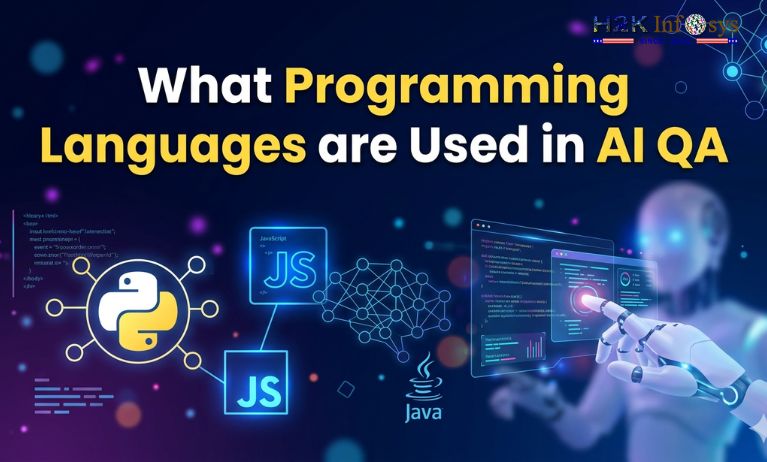
If you’re wondering what programming languages are used in an AI Software testing boot camp with job guarantee, here’s the straight answer: Python, Java, JavaScript, SQL, and sometimes C# or Ruby are the core languages you’ll encounter, with Python leading the pack by a wide margin.
Now, that’s the short version. But if you’re actually thinking about learning AI QA testing (or switching into it), the why behind these languages matters just as much as the list itself. And honestly, this is where most articles fall flat: they just list tools without explaining how they show up in real work.
Let me walk you through it the way I’d explain to someone I’ve worked with.
First, What AI QA Testing Actually Feels Like in Practice
When people hear AI QA testing, they often imagine something futuristic, robots testing software or systems magically fixing themselves.
Reality is… a bit more grounded.
Most of your day-to-day work looks like this:
- Writing automation scripts
- Testing APIs and UI flows
- Validating AI model outputs (this part is new-ish and interesting)
- Debugging weird edge cases where AI behaves unpredictably
I remember working on a chatbot testing project where the bot gave technically correct but contextually weird answers. You don’t just check “pass/fail,” there you need to think like a human.
That’s where programming languages come in. They’re your tools to:
- Build tests
- Simulate user behavior
- Validate large datasets
- And sometimes even test the AI itself
1. Python The One You’ll Use the Most (No Debate)
If you only learn one language for an AI QA testing course, make it Python.
Not because it’s trendy, but because it’s everywhere in AI.
Why Python keeps showing up
- Almost every AI/ML framework uses it
- Clean syntax (you won’t fight the language while learning and testing)
- Tons of testing libraries (Pytest, Robot Framework, etc.)
- Easy integration with tools like Selenium
But here’s the real reason:
AI systems themselves are usually built in Python.
So if you’re testing them, it just makes sense to stay in the same ecosystem.
Real-world scenario
Let’s say you’re testing a recommendation system.
With Python, you might:
- Pull model predictions
- Compare them against expected outputs
- Validate edge cases (like empty input, noisy data)
I’ve seen teams try to do this in Java; it works, but it feels like using a screwdriver to hammer a nail.
If you’re serious about AI QA testing courses, Python isn’t optional; it’s foundational.
2. Java Still the Backbone of Automation Testing
Now here’s where things get interesting.
Even though Python dominates AI, Java still dominates enterprise testing.
And that’s why most AI QA testing courses still include it.
Why companies still rely on Java
- Legacy systems (a lot of them) are Java-based
- Selenium + Java is still a standard combo
- Strong frameworks like TestNG and JUnit
Where Java fits in AI QA
You might not use Java to test the AI model itself, but you will use it to:
- Automate UI testing
- Run regression suites
- Integrate testing into CI/CD pipelines
A quick example
Imagine testing an AI-powered e-commerce app.
- Python validates the recommendation engine
- Java tests checkout flow and UI
Both matter. And in real teams, both are often used side by side.
3. JavaScript Where Frontend Testing Lives
If the product you’re testing has a UI (and almost all do), JavaScript becomes important.
Actually, more than important, it’s unavoidable.
Why JavaScript is everywhere now
Modern apps are built with:
- React
- Angular
- Vue
And testing them properly means using JavaScript-based tools like:
- Cypress
- Playwright
Where it connects to AI QA
Think about AI features like:
- Chatbots
- Voice assistants (web interfaces)
- Recommendation widgets
You’ll need JavaScript to:
- Simulate user interactions
- Validate dynamic UI behavior
- Test real-time responses
Small observation
I’ve noticed teams shifting from Selenium (Java-heavy) to Playwright (JavaScript-heavy). It’s faster, cleaner, and honestly less painful.
If your AI QA testing course includes JavaScript, that’s a good sign; it means it’s aligned with current industry trends.
4. SQL The Quiet Skill That Saves You
SQL doesn’t get much attention in blog posts, but in real projects it’s critical.
Especially in AI.
Why SQL matters in AI QA
AI systems are data-driven. So naturally, testing them involves:
- Checking datasets
- Validating transformations
- Verifying outputs stored in databases
Real example
You’re testing a fraud detection model.
You don’t just check if the UI says “fraud detected.”
You go deeper:
- Is the data stored correctly?
- Did the model flag the right transactions?
- Are edge cases logged properly?
That’s SQL territory.
Honestly, I’ve seen testers struggle more with SQL than with Python. It’s not flashy, but it’s essential.
5. C# Depends on Where You Work
C# shows up mostly in Microsoft-heavy environments.
If a company uses:
- .NET
- Azure AI services
- Windows-based systems
Then C# becomes relevant.
When you’ll actually use it
- Enterprise automation frameworks
- Backend validation
- Integration testing
It’s not something every AI QA testing course emphasizes, but it’s useful depending on your career direction.
6. Ruby Niche, but Still Around
Ruby pops up mainly in BDD (Behavior-Driven Development) setups.
If you’ve heard of Cucumber, that’s where Ruby comes in.
Where it fits
- Writing human-readable test cases
- Agile teams that focus on collaboration
Example:
Instead of writing code-heavy tests, you write something like:
“Given the user logs in
When they search for a product
Then recommendations should appear.”
It’s clean, readable, and surprisingly effective.
Still, it’s not as common today as Python or JavaScript.
So Which Language Should You Start With?
If you’re just starting an AI QA testing course, don’t overcomplicate it.
Here’s a practical path:
Step 1: Start simple
- Python
- Basic SQL
Step 2: Add automation
- Java or JavaScript
Step 3: Specialize
- AI model testing
- API testing
- CI/CD integration
That’s it. You don’t need to learn everything at once.
What’s Changing in 2026 (And Why It Matters)
This space is evolving quickly, and if you’re learning now, you’re actually in a great position.
Trends I’m seeing right now
- AI-assisted testing tools are growing (self-healing tests and test generation)
- Python is becoming even more dominant
- JavaScript tools like Playwright are replacing older frameworks
- Low-code testing tools are rising, but they still need programming knowledge underneath
There was also a recent push in large companies toward AI model observability, basically monitoring how models behave in production. That’s becoming part of QA too.
A Quick Reality Check
A lot of people ask:
“Do I need to learn all these languages?”
No. You really don’t.
In most real jobs:
- You’ll use 1–2 languages daily
- Others are just “nice to have.”
What matters more is the following:
- Understanding testing concepts
- Knowing how AI systems behave
- Being able to debug and think critically
Languages are just tools.
Final Thoughts (From Someone Who’s Seen This Play Out)
If I had to boil it down:
- Python your core skill
- Is Java or JavaScript your automation strength
- SQL: your data backbone
Everything else depends on your environment.
And one small piece of advice: don’t get stuck in tutorial mode.
Build something messy. Test a real app. Break things.
That’s where you actually learn.
If you’re exploring programming languages for AI QA and planning to join AI QA testing courses, focus on practical usage, not just theory. The field rewards people who can apply knowledge, not just list tools.And once you start working with real systems, all of this will make a lot more sense probably faster than you expect.