
Introduction
The role of a business analyst is growing fast. Companies need professionals who can connect business goals with data and technology. This demand creates many opportunities, but it also creates confusion. Many learners ask a simple question. Which direction should I take?
This guide explains the most important business analyst career paths and helps you choose the best one for your goals. You will learn what each path involves, what skills you need, and how business analyst training and Business analyst certification support your growth. You will also see how business analyst training and placement programs prepare you for real job roles.
By the end, you will have a clear plan to start or grow your career.
Why Business Analyst Careers Are in High Demand
Organizations depend on data to make decisions. A business analyst helps turn data into action. This role supports product teams, IT teams, and leadership.
Key Industry Insights
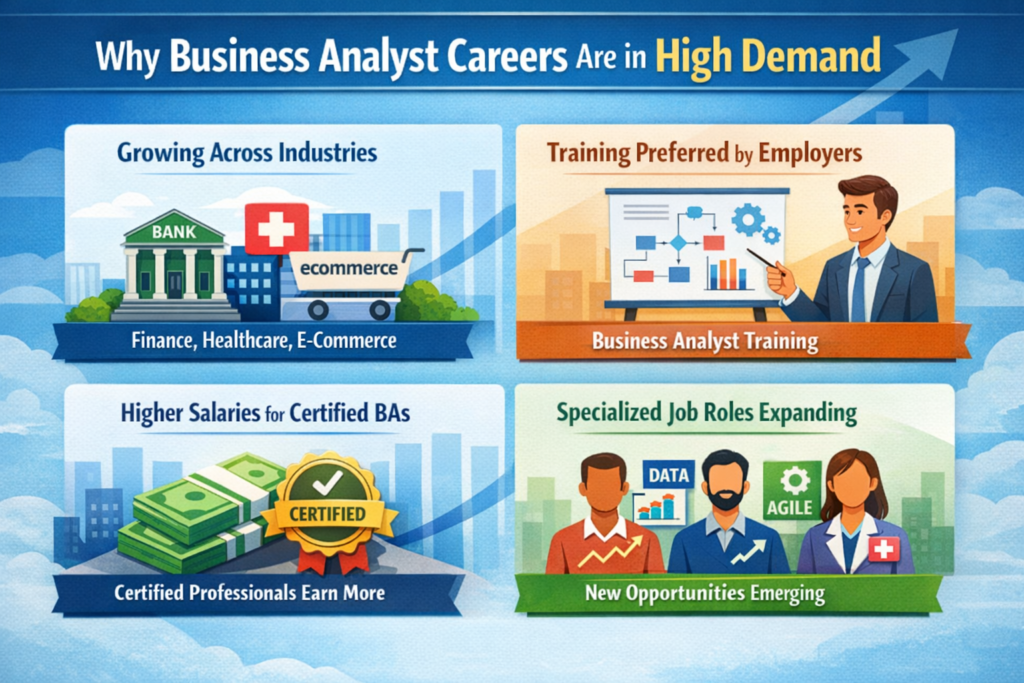
- The demand for analysts continues to rise across industries like finance, healthcare, and e-commerce
- Companies prefer candidates with structured business analyst training
- Certified professionals often earn higher salaries than non certified peers
- Job roles are expanding into specialized areas
These trends make business analyst career paths more diverse and valuable than ever.
What Does a Business Analyst Do
A business analyst identifies problems and provides solutions. The analyst works with stakeholders and technical teams.
Core Responsibilities
- Gather business requirements
- Analyze data and workflows
- Create reports and dashboards
- Support project implementation
- Improve business processes
Example
A retail company wants to improve sales. A business analyst studies customer data, finds patterns, and suggests pricing or marketing changes.
Top Business Analyst Career Paths
There are many business analyst career paths based on your skills and interests. Each path focuses on a different area of business or technology.
1. IT Business Analyst
An IT business analyst works between business teams and IT teams.
Key Responsibilities
- Translate business needs into technical requirements
- Work with developers and testers
- Support system upgrades
Skills Required
- SQL and data analysis
- Requirement documentation
- Basic understanding of software systems
Best Fit
Choose this path if you like technology and problem solving.
This is one of the most popular business analyst career paths because of high demand in IT projects.
2. Data Business Analyst
A data business analyst focuses on data insights.
Key Responsibilities
- Analyze large datasets
- Build dashboards
- Present insights to stakeholders
Tools Used
- Excel
- Power BI
- Tableau
Example
A company uses data to understand customer behavior. The analyst creates dashboards to show trends.
This path is ideal for those who enjoy working with numbers. Many learners choose this among business analyst career paths for its strong salary growth.
3. Functional Business Analyst
A functional analyst specializes in a specific domain like finance or healthcare.
Key Responsibilities
- Understand business processes
- Provide domain specific solutions
- Work with stakeholders in a specific industry
Example Domains
- Banking
- Insurance
- Healthcare
This path is strong for candidates with industry experience. It is one of the focused business analyst career paths.
4. Product Analyst
A product analyst works on product development and improvement.
Key Responsibilities
- Analyze user behavior
- Suggest product features
- Track product performance
Example
An app company tracks user engagement. The analyst suggests new features to improve retention.
This role is growing fast among modern business analyst career paths.
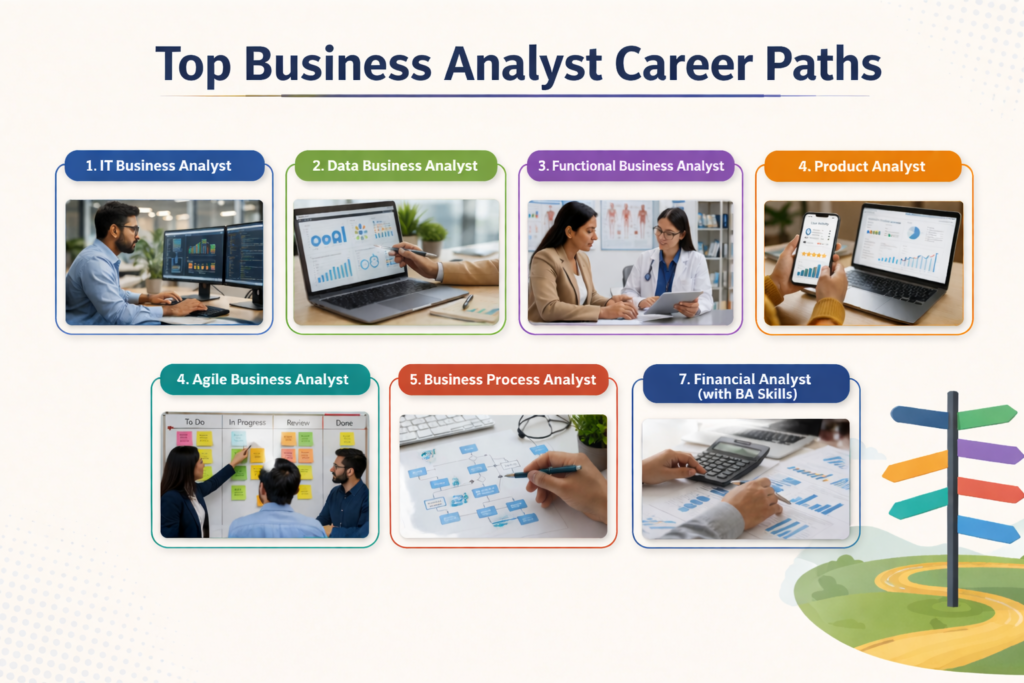
5. Agile Business Analyst
An Agile analyst works in Agile teams.
Key Responsibilities
- Write user stories
- Participate in sprint planning
- Work closely with product owners
Skills Required
- Agile frameworks
- Communication skills
- Collaboration
This is one of the most dynamic business analyst career paths in software development.
6. Business Process Analyst
A business process analyst improves workflows.
Key Responsibilities
- Study current processes
- Identify inefficiencies
- Suggest improvements
Example
A company reduces manual work by automating reports.
This role is important in operational improvement and stands out among business analyst career paths.
7. Financial Analyst with BA Skills
This role combines finance and business analysis.
Key Responsibilities
- Analyze financial data
- Forecast revenue
- Support budgeting decisions
This path suits candidates with finance backgrounds. It is a specialized option within business analyst career paths.
Skills Required for Business Analyst Career Paths
Every path requires a mix of technical and soft skills.
Technical Skills
- Data analysis
- SQL
- Excel
- Reporting tools
Business Skills
- Requirement gathering
- Process modeling
- Stakeholder communication
Soft Skills
- Problem solving
- Critical thinking
- Communication
Strong business analyst training helps you build these skills step by step.
Role of Business Analyst Training
Structured business analyst training helps you learn industry skills.
What You Learn
- Requirement analysis
- Data handling
- Tools like Excel and Power BI
- Real project scenarios
Why It Matters
Training helps you understand real work situations. It prepares you for interviews and job tasks.
Many learners choose business analyst training and placement programs to gain both skills and job support.
Importance of Business Analyst Certification
A Business analyst certification validates your skills.
Benefits
- Improves job credibility
- Increases salary potential
- Helps you stand out
Popular Certification Areas
- Requirement management
- Agile analysis
- Data analysis
Certifications support your growth across different business analyst career paths.
How to Choose the Best Career Path
Choosing the right path depends on your interests and strengths.
Step 1: Identify Your Interest
Ask yourself:
- Do I like data
- Do I like technology
- Do I like business processes
Step 2: Evaluate Your Background
- Technical background fits IT roles
- Finance background fits financial analysis
- Domain experience fits functional roles
Step 3: Choose Based on Demand
Research job trends. Data and Agile roles are in high demand.
Step 4: Get Proper Training
Enroll in business analyst training that includes real projects.
Step 5: Gain Certification
A Business analyst certification strengthens your profile.
Step 6: Apply for Roles
Use knowledge from business analyst training and placement programs to apply confidently.
This step by step approach helps you select from the many business analyst career paths.
Real World Example
A graduate starts with basic business analyst training. They learn Excel and SQL. Then they choose the data analyst path. They complete a Business analyst certification. After that, they join a company through a business analyst training and placement program.
Within two years, they move to a senior role.
This example shows how structured learning supports success across business analyst career paths.
Common Challenges and Solutions
Challenge 1: Lack of Experience
Solution: Work on projects during business analyst training
Challenge 2: Confusion About Career Direction
Solution: Explore different business analyst career paths before choosing
Challenge 3: Skill Gaps
Solution: Take structured business analyst training
Challenge 4: Job Placement
Solution: Choose business analyst training and placement programs
Tools Used in Business Analyst Roles
Data Tools
- Excel
- SQL
- Power BI
Documentation Tools
- JIRA
- Confluence
Modeling Tools
- Visio
- Lucidchart
These tools are covered in most business analyst training programs.
Step by Step Learning Roadmap
Step 1: Learn Basics
Start with business concepts and data fundamentals.
Step 2: Learn Tools
Focus on Excel, SQL, and reporting tools.
Step 3: Practice Projects
Work on real world scenarios.
Step 4: Choose a Path
Select from available business analyst career paths
Step 5: Get Certified
Earn a Business analyst certification
Step 6: Apply for Jobs
Use skills gained from business analyst training and placement
Salary Insights
Salaries vary based on role and experience.
Entry Level
- Moderate salary with growth potential
Mid Level
- Higher salary with specialized skills
Senior Level
- Leadership roles with strong pay
Specialized business analyst career paths like data and Agile often offer higher salaries.
Future Trends in Business Analysis
- Increased use of AI and data analytics
- Growth in Agile and product roles
- Demand for domain specific analysts
These trends expand opportunities in business analyst career paths.
Key Takeaways
- Business analysts are in high demand across industries
- There are multiple business analyst career paths to choose from
- Skills and certifications play a key role in career growth
- Structured business analyst training prepares you for real jobs
- Business analyst training and placement helps you start your career faster
Conclusion
Choosing the right career path requires clarity, skills, and planning. Explore different roles, build strong skills, and take action.
Start your journey today with the right business analyst training and move confidently toward your ideal role.