An AI Course in the USA can help you move toward a high-paying role, including programs offered by H2K Infosys. That part is true. But honestly, the course name itself isn’t what impresses employers. That idea gets overhyped quite a bit.
What really matters is what you can actually do your skills, the projects you’ve built, and whether you can handle the tools people use in real work environments.
The Best Online Artificial Intelligence Course don’t just explain concepts and leave you there. They walk you through actual workflows, introduce real tools, and give you problems that feel… close enough to what teams deal with on the job. That’s where things start becoming useful not just interesting to read about.
If you stay consistent, keep practicing, and don’t stop at watching videos or skimming notes, you can move into roles like machine learning engineer, data scientist, or AI engineer. It’s doable in a reasonable timeframe. But that shift only happens when knowledge turns into hands-on ability. There’s really no shortcut around that part.
What Is an AI Course in the USA?
When people say Courses of Artificial Intelligence they’re usually talking about a structured training program often online that covers artificial intelligence, machine learning, deep learning, and sometimes data science as well.
And it’s not just for hardcore programmers, which surprises people.
You’ll typically see learners like:
- IT professionals trying to level up
- People from non-tech backgrounds looking to switch careers
- Engineers who want to get deeper into intelligent systems
Some join out of curiosity just to finally understand what AI actually is. Others are more intentional. They already see where things are heading and don’t want to fall behind.
What Do You Actually Learn?
Most AI Course in the USA follow a similar path, though the depth can vary a lot.
Usually, you’ll cover:
- Programming (mostly Python, sometimes R)
- Machine learning (supervised and unsupervised)
- Deep learning (neural networks, CNNs, RNNs)
- Data cleaning and feature engineering
- Model evaluation and deployment
- Tools like TensorFlow, PyTorch, and Scikit-learn
On paper, it all looks neat and structured.
In reality… not so much.
A lot of the learning happens in the messy parts cleaning ugly datasets, fixing code that suddenly breaks, wondering why your model worked yesterday but performs worse today. That’s normal. Frustrating, yes but also where the real understanding kicks in.
A good AI Course in the USA gives you space to experiment, mess things up a little, and figure things out.
Why Do Professionals Even Learn AI?
Mostly because the demand is real. Not hype-driven actual demand.
AI is already used in finance, healthcare, retail, logistics, e-commerce, software… pretty much everywhere. Companies aren’t just experimenting anymore. They’re building real systems around it.
Some common reasons people start learning AI:
- There’s a clear skill gap in the market
- It opens doors for career transitions
- The pay tends to be better than many traditional roles
- You get to work on systems that automate tasks or improve decisions
Take banking, for example:
- Fraud detection uses AI models
- Chatbots rely on NLP
- Credit risk is handled with predictive analytics
This isn’t future talk it’s already happening.
How AI Projects Actually Work
In real teams, AI projects aren’t as clean as tutorials make them look.
A more realistic flow looks like this:
- Data collection (databases, APIs, logs, etc.)
- Data cleaning (missing values, duplicates, inconsistencies)
- Feature engineering
- Model selection
- Training
- Evaluation
- Deployment
Let’s say a retail company wants a recommendation system. It starts with customer data, then moves into testing models, building APIs, and finally integrating everything into the product.
From the outside, it seems straightforward.
Under the hood… it gets messy pretty fast.
Can an Online AI Course in the USA Help You Get a Job Faster?
Yes but only if it focuses on real skills, not just theory.
Some courses lean too heavily on definitions and terminology. The better ones push you to actually do the work.
What helps most:
- Hands-on projects
- Real datasets (fraud detection, churn prediction, forecasting, etc.)
- End-to-end projects, not just isolated models
Also important:
- Exposure to tools like AWS or Azure
- Version control (Git)
- Basic deployment and production concepts
And then there’s structure:
- Clear progression from basics to advanced topics
- Regular checkpoints or assessments
Plus interview prep:
- Coding practice
- ML case studies
- Basic system design
That combination adds up over time. Not instantly but it builds momentum.
What Skills Do You Need Before Starting?
You don’t need to know everything before you start. That would defeat the whole point.
Still, a few basics help:
- Python
- Basic statistics and probability
- Some linear algebra
- Handling and visualizing data
From there, you build into:
- Machine learning
- Model evaluation
- Deep learning
- NLP basics
And then there are softer skills often overlooked:
- Problem-solving
- Analytical thinking
- Explaining your work clearly
That last one matters more than people expect. Building something is one thing. Explaining why it works (or doesn’t) is another skill entirely.
How AI Is Used in Companies Today
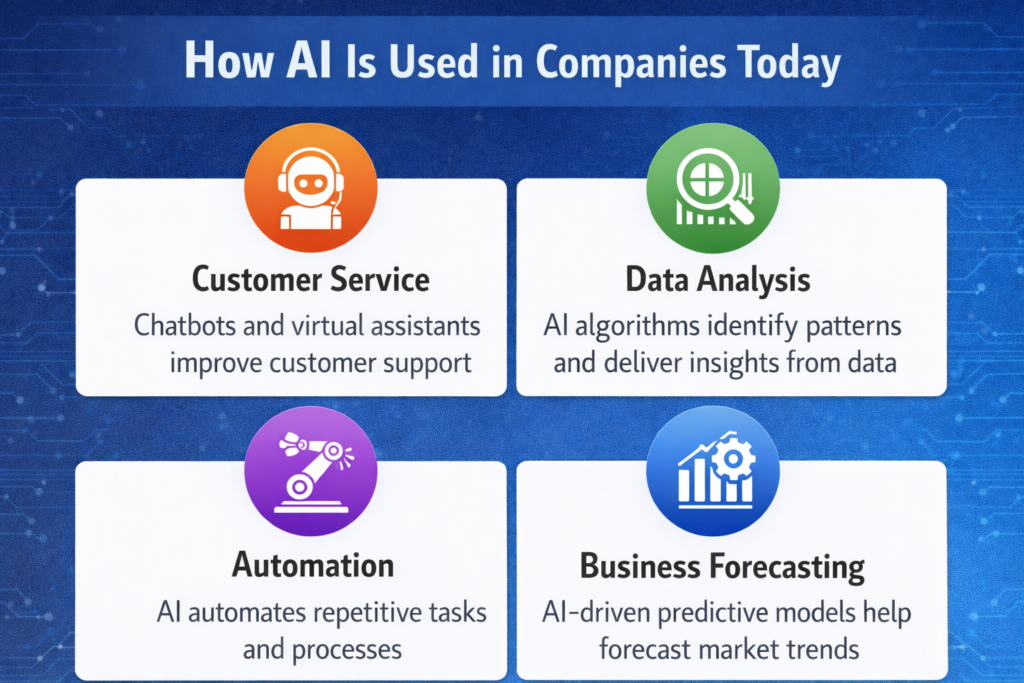
In real companies, AI is tied to results. Not just something to show off in presentations.
Common uses:
- Sales forecasting and demand prediction
- Chatbots and document classification (NLP)
- Image recognition (computer vision)
- Recommendation systems
But real-world environments come with constraints:
- Privacy laws (GDPR, HIPAA)
- Scaling challenges
- Legacy systems that don’t play nicely
And in many cases, explainability matters just as much as accuracy.
AI is powerful but yeah, it can get messy.
Job Roles That Use AI
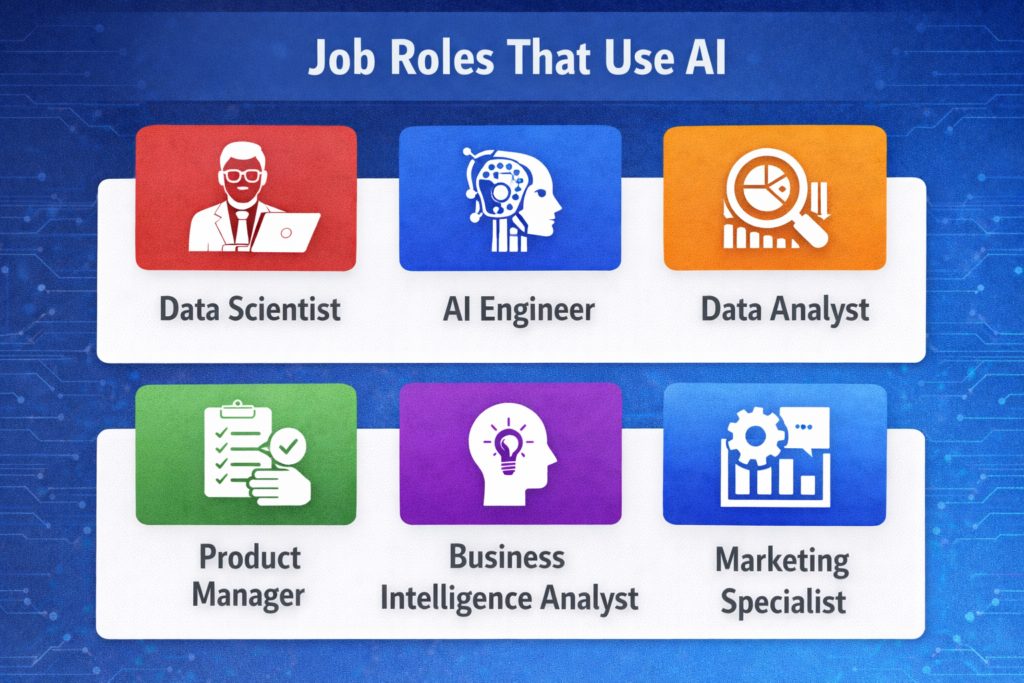
AI skills show up in different roles, and the boundaries aren’t always clear.
- Data scientists → focus more on analysis and modeling
- ML engineers → focus on deployment and scaling
- AI engineers → integrate AI into products
- Data analysts → lighter ML, more reporting
- NLP engineers → specialize in language systems
Titles vary a lot across companies, which can be confusing. But underneath, the core skills matter more than the label.
Career Paths After Learning AI Course in the USA
Your path depends on where you start and how far you want to go.
Entry-level roles:
- Junior data analyst
- AI support engineer
- Associate data scientist
Mid-level:
- Machine learning engineer
- Data scientist
- AI developer
Advanced roles:
- AI architect
- Lead data scientist
- Head of AI/ML
These roles tend to pay well because:
- The work is complex
- The impact is measurable
- There’s still a shortage of skilled people
That last point matters a lot.
Why Study AI in the
Courses based in the USA often align closely with industry expectations.
That usually means:
- Up-to-date tools and frameworks
- Curriculum based on hiring needs
- Cloud labs and practical setups
- A diverse learning community
So it’s less about geography and more about how realistic the learning environment is.
Typical Learning Path
Most people go through stages:
- Beginner → Python, stats, data basics
- Intermediate → machine learning models
- Advanced → deep learning, NLP
- Deployment → APIs, cloud, production
Trying to skip steps especially jumping straight into deep learning usually makes things harder than they need to be.
What Actually Makes You Job-Ready?
Finishing a AI Course in the USA helps. But it doesn’t automatically make you job ready.
What really matters:
- Working with real datasets
- Building full ML pipelines
- Deploying models
- Documenting projects clearly
For example, a churn prediction project might include:
- Data cleaning
- Feature selection
- Model training (logistic regression, random forest)
- Deployment via API
That kind of work shows employers what you can actually do.
Common Challenges
Most people hit roadblocks. That’s normal.
Typical struggles:
- No programming background
- Difficulty with math/stats
- Handling large datasets
- Model tuning issues
The way through isn’t dramatic it’s consistent effort:
- Practice regularly
- Use visualizations
- Follow a structured path
- Build projects
Watching tutorials feels productive. Building something shows what you actually understand.
FAQ
Can beginners learn AI from scratch?
Yes. Many courses start from the basics.
How long does it take to become job-ready?
No. But strong skills and projects improve your chances a lot.
Do AI courses guarantee a job?
No. But strong skills and projects improve your chances a lot.
Is coding required?
Yes Python especially.
Which industries hire AI professionals?
Finance, healthcare, retail, logistics, e-commerce, tech.
What tools should you learn first?
Python, TensorFlow/PyTorch, SQL, AWS/Azure.
Key Takeaways
AI Course in the USA can help but the real value comes from what you build and how consistently you practice.
Projects matter more than passive learning.
Understanding tools, deployment, and business context makes a big difference.
There’s no single path into AI which is part of why it’s appealing.
And honestly, the people who move fastest are usually the ones who just keep going. Building, practicing, getting stuck, figuring things out and staying patient through the messy parts.