Taking an AI Course with H2K Infosys isn’t really about adding one more line to your resume. I mean, it does help there but that’s not the interesting part. What actually happens is… you start seeing how things work behind the scenes. Systems you used to take for granted recommendations, predictions, automation they stop feeling like magic. You begin to understand how data flows in, how patterns get picked up, how decisions are made. It’s a bit eye-opening, honestly.
And the learning itself doesn’t stay stuck in theory for long. You’re not just reading you’re building things. Playing with datasets, training models, sometimes breaking them (more often than you’d expect), fixing them again. At first it feels scattered, like pieces that don’t quite connect. Then slowly… they do. You find yourself solving problems that actually resemble real business use cases. That’s usually when it clicks when it stops feeling academic and starts feeling useful.
Most Machine learning Training Courses are also pretty aligned with what companies are hiring for right now. So even if you didn’t start out aiming for it, you kind of drift toward roles like AI engineer or data scientist along the way.
So… what exactly is Artificial Intelligence?
At a basic level, AI is about building systems that can handle tasks we usually associate with human thinking learning, recognizing patterns, making decisions, improving over time.
But it’s not just one thing. It’s more like a collection of related areas:
- Machine Learning (ML)
- Natural Language Processing (NLP)
- Computer Vision
- Deep Learning
- Robotics and Automation
Most AI courses focus less on definitions and more on making these ideas practical like actually building systems that predict outcomes or automate decisions that used to be manual.
Why Machine Learning feels like the core of everything right now
If AI is the big picture, machine learning is doing most of the actual work. And yeah, it’s kind of everywhere now. What makes Artificial Intelligence Engineer Course stand out is that they go beyond theory. You actually see how models improve over time as they process more data which is really the whole idea.
Why all the attention?
- Decisions today are heavily data-driven
- Companies rely on predictions (customer behavior, risk, trends you name it)
- Automation is becoming… normal
- It scales well machines don’t get tired or inconsistent
- It’s quietly embedded across industries
Finance, healthcare, retail, cybersecurity it’s all using ML in some form.
What AI looks like in real projects
In real life, AI isn’t just “train a model and you’re done.” There’s a whole pipeline behind it and honestly, that pipeline matters just as much.
A typical flow looks like:
- Collecting data (databases, APIs, apps, cloud sources)
- Cleaning and preparing it (this part can get messy… fast)
- Training models (TensorFlow, Scikit-learn, etc.)
- Evaluating results (making sure it actually work not just on paper)
- Deploying it (usually through APIs)
- Monitoring and improving over time
Take a retail example. AI Course A company gathers customer purchase data, builds a model to predict what someone might buy next, plugs it into a recommendation engine, and keeps refining it as behavior changes.
Sounds smooth when you say it like that. In reality? It’s usually a bit chaotic. Lots of trial and error.
Why working professionals are starting to care
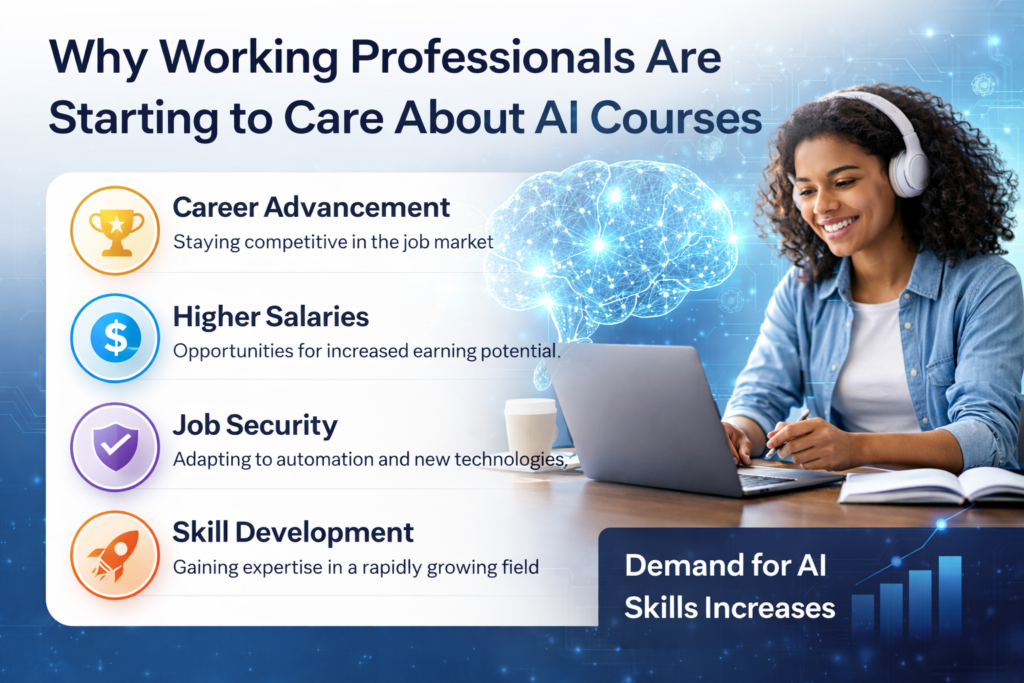
If you’re already in IT, AI is getting harder to ignore. It’s not always a requirement yet but it’s definitely becoming part of the bigger picture.
Learning AI can help you:
- Pick up practical skills (Python, data handling, ML concepts)
- Move into different roles (people shift from QA or support into data roles all the time)
- Understand systems better, which helps when working across teams
- Think more analytically more data-first
That last one is subtle, but it changes how you approach problems.
Do you need a strong background to start?
Not really. You don’t need to be an expert before jumping in.
That said, a few basics help:
- Some programming (Python is ideal)
- Basic math probability, linear algebra
- Familiarity with databases or SQL
- A problem-solving mindset (this one matters more than people expect)
As you go, you’ll usually build skills in:
- Supervised and unsupervised learning
- Data cleaning and visualization
- Model deployment (APIs, cloud)
- Neural networks and deep learning
- NLP for text data
Where AI Course actually shows up in businesses
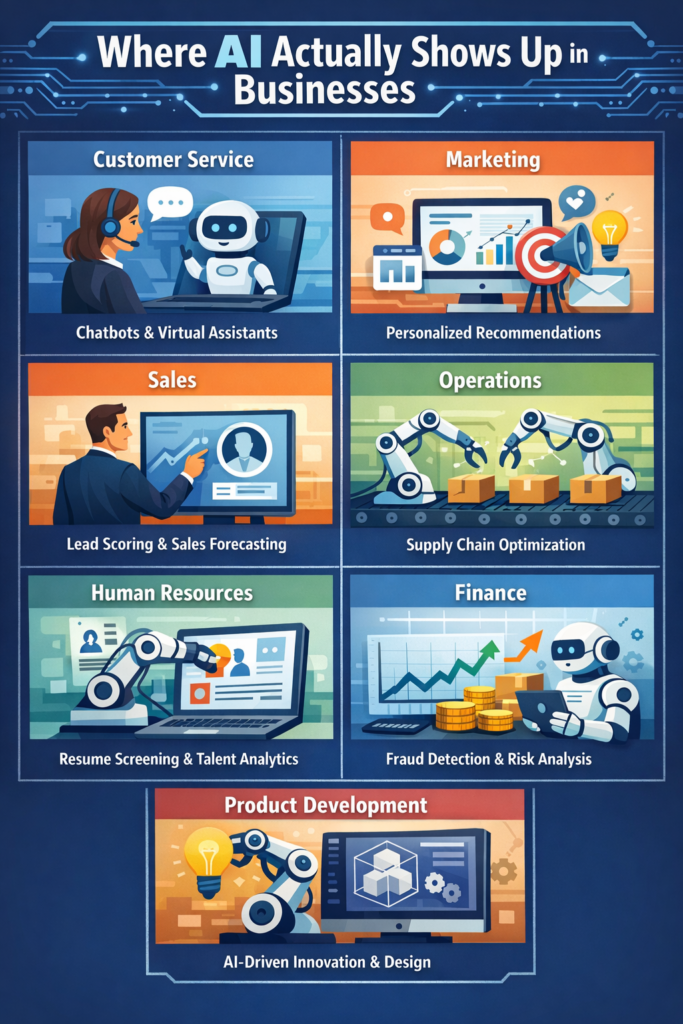
At this point, AI is pretty much everywhere even if it’s not always obvious.
A few common examples:
- Fraud detection → spotting unusual transactions in real time
- Customer support → chatbots handling repetitive queries
- Predictive maintenance → forecasting equipment failures
- Recommendation systems → suggesting products or content
You’ve probably interacted with AI multiple times today without realizing it.
Jobs that use AI regularly
AI doesn’t belong to just one role it spreads across different ones.
For example:
- AI Engineer → builds and deploys systems
- Data Scientist → analyzes data and builds models
- Machine Learning Engineer → focuses on production systems
- Data Analyst → works with insights
- NLP Engineer → handles language-based models
A rough progression might look like:
- Entry-level → data cleaning, reporting
- Mid-level → model building and evaluation
- Senior-level → system design, strategy
What you actually gain from an AI course
A good AI Course gives you more than just knowledge it gives you structure. Direction.
Some real benefits:
- A clear learning path (which saves a lot of time and confusion)
- Hands-on experience with real datasets
- Familiarity with tools like Python, TensorFlow, Git, cloud platforms
- Better job opportunities
- Skills that apply across industries
Where real learning actually happens (hint: projects)
Most of the real progress happens when you start building things.
A typical project might involve:
- Defining a problem (like predicting customer churn)
- Collecting and cleaning data
- Training models
- Evaluating performance
- Deploying via an API
Tools you’ll probably use:
- Jupyter Notebooks
- Git
- Flask or FastAPI
That’s where theory finally turns into something… tangible.
Challenges you’ll probably run into
AI is exciting, but yeah it can get frustrating too.
Some common hurdles:
- Math concepts that take time to really sink in
- Messy datasets (this is almost guaranteed)
- Model issues like overfitting or underfitting
- Deployment challenges
- Performance tuning it can take longer than expected
What tends to help:
- Start simple before jumping into complex models
- Use clean datasets early on
- Write readable code
- Test things often
And honestly just give yourself time. It’s a process.
Quick FAQ
AI vs Machine Learning?
AI is the broader field. ML is a subset focused on learning from data.
Do you need coding experience?
Basic Python helps, but many courses ease you into it.
How long does it take?
You can get the basics in 3–6 months. Going deeper takes longer.
Can non-developers learn AI Course?
Yes. People transition from all sorts of backgrounds.
Common tools?
Python, TensorFlow, PyTorch, Scikit-learn, SQL, AWS, Azure.
Final thoughts
AI Course aren’t just about learning concepts in isolation. They shift how you think. You start noticing patterns, seeing opportunities to automate things, approaching problems differently.
From a career standpoint, the value is pretty clear. Whether you want to move into AI-heavy roles or just stay relevant in a changing field, these skills carry weight.
And once you get into it… you realize there’s always more to learn. Which is kind of the fun part.