What is Data Analytics? (Simple Answer)
Data Analytics Courses for Beginners is basically looking at data and figuring out what it’s trying to tell you so better decisions can be made.
That’s it. No fancy definition needed.
So… Is Data Analytics Actually Beginner-Friendly?
I’ll be honest, when most freshers first look at this field, it feels confusing.
SQL, Python, dashboards, statistics… it looks like a lot.
But here’s the reality I’ve seen:
Most entry-level Data Analytics Courses for Beginners don’t use everything at once
You don’t need to be a coder to get started
And yes, people from non-tech backgrounds do break into this field
The problem isn’t the difficulty; it’s the direction.
How Freshers Should Actually Start (Step-by-Step)
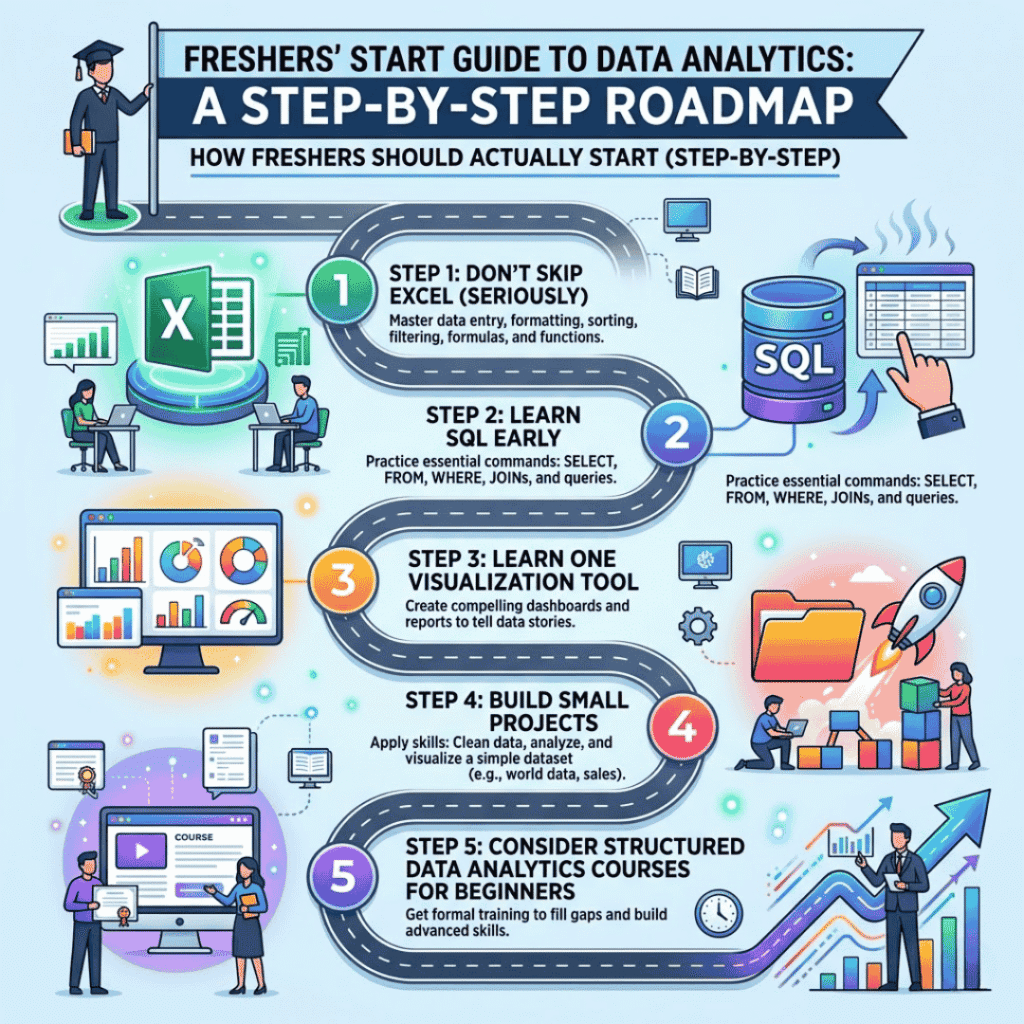
Let me give you the version that works in real life, not the overhyped roadmap.
Step 1: Don’t skip Excel (seriously)
A lot of beginners rush to Python.
Big mistake.
Excel teaches you:
- How data looks in real life
- Cleaning messy data
- Basic analysis thinking
Most beginners underestimate this. Don’t.
Step 2: Learn SQL early
If you ask working Data Analytics Courses for Beginners what they use daily, SQL comes up a lot.
Focus on:
- SELECT
- WHERE
- JOIN
Not everything. Just the basics first.
Step 3: Learn one visualization tool
Pick one:
- Power BI
- Tableau
Don’t try both at once.
This is where your work becomes presentable.
And honestly, this is what impresses recruiters.
Step 4: Build small projects (this is where people fail)
This is where things usually go wrong.
People watch tutorials… but don’t build anything.
Try simple stuff like:
- Sales dashboard
- Netflix data analysis
- Customer trends
It doesn’t have to be perfect. It just has to exist.
Step 5: Consider structured data analytics courses for beginners.
Self-learning is fine… until you get stuck.
A good course helps with:
- Clear structure
- Real datasets
- Guidance when you’re confused
- Sometimes, even placement support
If your goal is a job, this matters more than people admit.
What You’ll Actually Do: Real-World Example
Let’s make this practical.
Let’s say a company sees that fewer users are purchasing their product.
As an entry-level Data Analytics Courses for Beginners , you could:
Review what products were lost in sales.
Look at user behavior.
- Identify patterns (weekends, pricing, etc.)
Then suggest:
“Sales drop after price increase”
“Users leave before checkout.”
That’s literally the job.
Not rocket science, but it requires thinking.
Where Beginners Usually Struggle
Let’s not sugarcoat it.
1. Too much information
YouTube, courses, blogs… everything says something different.
Solution: Stick to one path. Don’t jump around.
2. Fear of tools
People think:
“I don’t know coding; I can’t do this.”
That’s not true.
You can get your first job with:
- Excel
- SQL
- Power BI
3. No confidence
This one is big.
You learn things… but feel like you don’t know enough.
Honestly? That feeling doesn’t fully go away even later.
Self-Learning vs Data Analytics Training and Placement
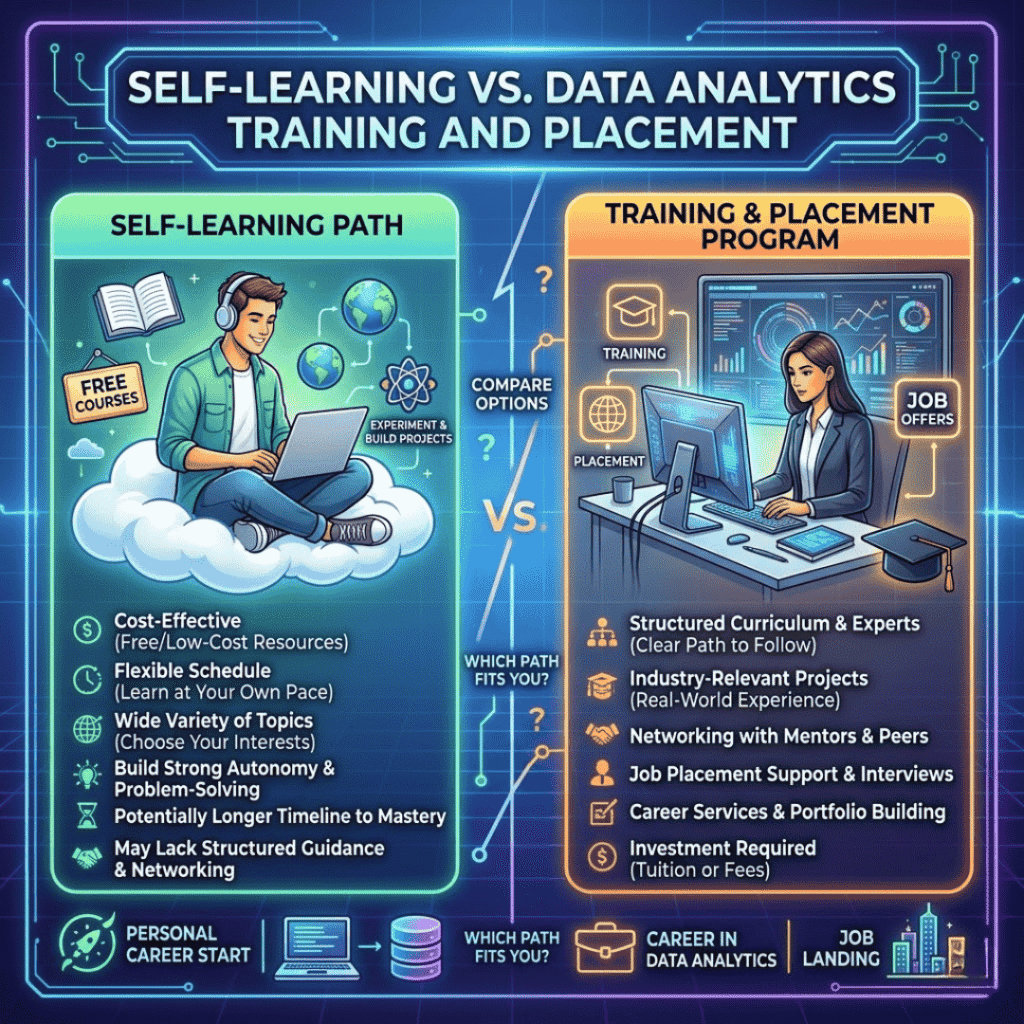
Here’s a real take, not marketing talk.
Self-learning works if:
- You’re disciplined
- You don’t mind figuring things out slowly.
Structured training helps if:
- You want faster results.
- You need guidance
- You want placement support.
Neither is “better.” It depends on your situation.
Is This Career Worth It in 2026?
Yes, and not just because it’s trending.
Companies are relying more on data analytics courses for Beginners than ever.
Every industry needs analysts:
- Healthcare
- Finance
- E-commerce
- Tech
And the good part?
Entry-level roles are still accessible to freshers.
Skills that You’ll Actually Gain here
By the time you finish a beginner-level course, you should be able to:
- Clean messy data
- Write basic SQL queries.
- Build dashboards
- Explain insights in simple terms.
If you can do these four things, you are light-years ahead of most beginners.
Quick Summary (TL;DR)
- Data analytics courses for Beginners can be learned by freshers.
- At first it feels counterintuitive, but in practice it becomes easier.
- Excel → SQL → dashboards.
- Projects are more important than theory.
- You can speed things up through structured courses.
If You Want to Go Deeper
Once you feel comfortable, you can try out the following:
- Advanced SQL
- Python for data analysis
- Data storytelling techniques
These will help you move beyond entry-level roles.
FAQs
Can I learn data analytics without coding?
Yes. You can begin with Excel and SQL. Coding (Python) is not a must-have in the beginning but comes in handy later.
How long does it realistically take?
If you’re consistent:
3–6 months to become job-ready (basics + projects)
Are data analytics classes online worth it?
They can be, especially if they offer:
- Real projects
- Mentorship
- Placement help
I’m from a non-tech background. Can I still do this?
Yes. Many analysts come from commerce, arts, or other non-tech fields.
What should I focus on first?
Start with Excel. Then move to SQL. Then dashboards. Keep it simple.
Final Thoughts
If you’re waiting to feel “ready,” you’ll probably wait forever.
Data Analytics Courses for Beginners isn’t something you fully understand before starting; they’re something you figure out while doing it.
Start small. Build things. Stay consistent.
And if you feel stuck, getting proper Data Analytics Courses for Beginners can honestly save you a lot of time.
Just don’t overthink it. Start.